Tukhovskaya Elena A, Yukin Alexey Yu, Khokhlova Oksana N, Murashev Arkady N, Vitek Michael P
Branch of Shemyakin and Ovchinnikov Institute of Bioorganic Chemistry, Russian Academy of Sciences, Moscow Region, Russia.
J Neurosci Res. 2009 Feb 15;87(3):677-82. doi: 10.1002/jnr.21874.
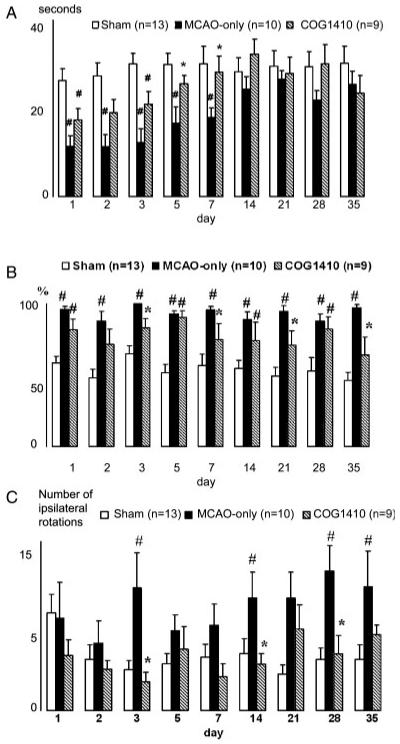
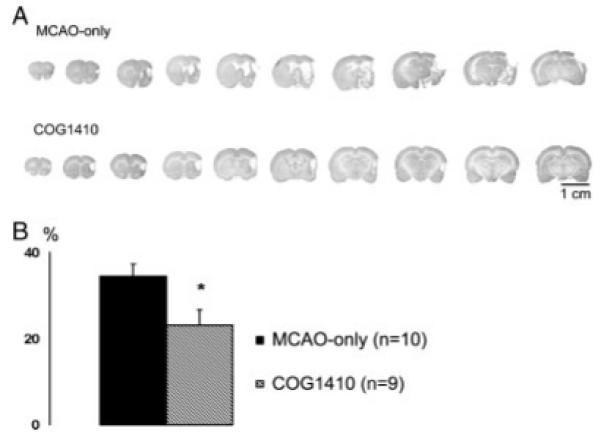
Apolipoprotein E (apoE) is the primary apolipoprotein synthesized in the brain in response to injury with known neuroprotective effects exerted through antioxidant, antiinflammatory, antiexcitotoxic, and neurotrophic mechanisms. We have previously demonstrated that COG1410, an apoE mimetic peptide, exerts neuroprotective and antiinflammatory effects in a murine model of traumatic brain injury (TBI). As in TBI, ischemia-reperfusion injury is a component of acute stroke, which displays a pharmacogenetic association with the APOE4 gene. Using an intraluminal middle cerebral occlusion (MCAO) model in rats, we found that a single intravenous injection of COG1410 at 120 min post-MCAO significantly improved vestibulomotor function, decreased poststroke locomotor asymmetry, and decreased infarct volume of the ipsilateral hemisphere. These results support further exploration of a novel apoE-mimetic peptide, COG1410, as a therapeutic treatment for stroke.
载脂蛋白E(apoE)是大脑中因损伤而合成的主要载脂蛋白,通过抗氧化、抗炎、抗兴奋毒性和神经营养机制发挥已知的神经保护作用。我们之前已经证明,一种载脂蛋白E模拟肽COG1410在创伤性脑损伤(TBI)小鼠模型中具有神经保护和抗炎作用。与TBI一样,缺血再灌注损伤是急性中风的一个组成部分,它与APOE4基因存在药物遗传学关联。在大鼠中使用管腔内大脑中动脉闭塞(MCAO)模型,我们发现MCAO后120分钟单次静脉注射COG1410可显著改善前庭运动功能,减少中风后运动不对称性,并减少同侧半球梗死体积。这些结果支持进一步探索新型载脂蛋白E模拟肽COG1410作为中风的治疗方法。