Owsley Cynthia, McGwin Gerald, Stalvey Beth T, Weston June, Searcey Karen, Girkin Christopher A
Department of Ophthalmology, School of Medicine, University of Alabama at Birmingham, Birmingham, AL 35294, USA.
J Natl Med Assoc. 2008 Sep;100(9):1089-95. doi: 10.1016/s0027-9684(15)31450-4.
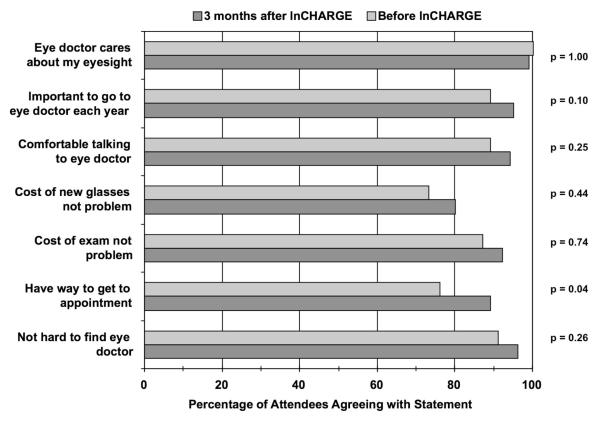
Older African Americans have higher rates of vision impairment and lower utilization rates of comprehensive eye care, compared to Caucasians. InCHARGE is an eye health education program for this population that promotes prevention through the annual, dilated comprehensive eye examination. This study, using a pre-/postdesign, evaluated whether InCHARGE imparted knowledge about prevention and strategies for reducing barriers to care. The program was presented to 85 older African Americans in 5 senior centers in Montgomery, AL. Changes in attitudes about annual eye care were assessed by a questionnaire before and 3 months after InCHARGE. At baseline, most (> 85%) responded it would not be difficult for them to find an ophthalmologist or optometrist, and the exam cost was not a problem. Twenty-five percent reported problems finding transportation to the doctor and covering the eyeglasses cost. Forty-four percent reported not having an eye exam in the past year; 13% reported not having one within 2 years. Three months after InCHARGE, those who reported that they could find a way to get to the doctor increased (X2 = 3.8, p = 0.04). After InCHARGE, 72% said they either had received or scheduled an eye exam. Responses to a question about what was learned from InCHARGE indicated that the InCHARGE's key messages about comprehensive eye care were successfully imparted to most. This study suggests that older African Americans in the urban south have positive attitudes about eye care, even before an eye health education presentation. Following InCHARGE, they identified transportation problems less frequently as a barrier, indicated that they learned InCHARGE's key message and had plans for seeking routine, preventive eye care. A next step is to verify through medical record review the extent to which the high rates of self-reported eye care utilization reflect behavior.
与白种人相比,年长的非裔美国人视力受损率更高,综合眼保健利用率更低。“CHARGE”是一项针对该人群的眼健康教育项目,通过每年一次的散瞳综合眼检来促进预防。本研究采用前后设计,评估“CHARGE”是否传授了预防知识以及减少就医障碍的策略。该项目在阿拉巴马州蒙哥马利市的5个老年中心向85名年长的非裔美国人进行了介绍。通过在“CHARGE”项目实施前和实施后3个月进行问卷调查,评估对年度眼保健态度的变化。在基线时,大多数(>85%)受访者表示找到眼科医生或验光师对他们来说并不困难,且检查费用不是问题。25%的人报告在前往就医的交通和支付眼镜费用方面存在问题。44%的人报告在过去一年没有进行眼检;13%的人报告在两年内没有进行眼检。“CHARGE”项目实施3个月后,报告称能找到就医途径的人有所增加(X² = 3.8,p = 0.04)。在“CHARGE”项目之后,72%的人表示他们已经接受或安排了眼检。对关于从“CHARGE”项目中学到了什么这一问题的回答表明,“CHARGE”项目关于综合眼保健的关键信息已成功传授给了大多数人。本研究表明,即使在进行眼健康教育讲座之前,美国南部城市的年长非裔美国人对眼保健也持积极态度。在“CHARGE”项目之后,他们较少将交通问题视为障碍,表明他们学到了“CHARGE”项目的关键信息,并制定了寻求常规预防性眼保健的计划。下一步是通过病历审查来核实自我报告的高眼保健利用率在多大程度上反映了实际行为。