Ma Wu, Tavakoli Tara, Derby Eric, Serebryakova Yevgeniya, Rao Mahendra S, Mattson Mark P
Stem Cell Center, Developmental Biology, American Type Culture Collection, Manassas, VA, USA.
BMC Dev Biol. 2008 Sep 22;8:90. doi: 10.1186/1471-213X-8-90.
Interactions of cells with the extracellular matrix (ECM) are critical for the establishment and maintenance of stem cell self-renewal and differentiation. However, the ECM is a complex mixture of matrix molecules; little is known about the role of ECM components in human embryonic stem cell (hESC) differentiation into neural progenitors and neurons.
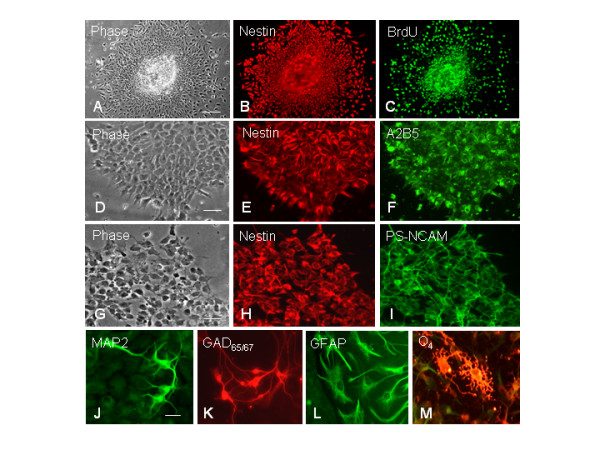
A reproducible protocol was used to generate highly homogenous neural progenitors or a mixed population of neural progenitors and neurons from hESCs. This defined adherent culture system allowed us to examine the effect of ECM molecules on neural differentiation of hESCs. hESC-derived differentiating embryoid bodies were plated on Poly-D-Lysine (PDL), PDL/fibronectin, PDL/laminin, type I collagen and Matrigel, and cultured in neural differentiation medium. We found that the five substrates instructed neural progenitors followed by neuronal differentiation to differing degrees. Glia did not appear until 4 weeks later. Neural progenitor and neuronal generation and neurite outgrowth were significantly greater on laminin and laminin-rich Matrigel substrates than on other 3 substrates. Laminin stimulated hESC-derived neural progenitor expansion and neurite outgrowth in a dose-dependent manner. The laminin-induced neural progenitor expansion was partially blocked by the antibody against integrin alpha6 or beta1 subunit.
We defined laminin as a key ECM molecule to enhance neural progenitor generation, expansion and differentiation into neurons from hESCs. The cell-laminin interactions involve alpha6beta1 integrin receptors implicating a possible role of laminin/alpha6beta1 integrin signaling in directed neural differentiation of hESCs. Since laminin acts in concert with other ECM molecules in vivo, evaluating cellular responses to the composition of the ECM is essential to clarify further the role of cell-matrix interactions in neural derivation of hESCs.
细胞与细胞外基质(ECM)的相互作用对于干细胞自我更新和分化的建立与维持至关重要。然而,ECM是基质分子的复杂混合物;关于ECM成分在人类胚胎干细胞(hESC)分化为神经祖细胞和神经元过程中的作用知之甚少。
采用一种可重复的方案从hESC中生成高度同质的神经祖细胞或神经祖细胞与神经元的混合群体。这种明确的贴壁培养系统使我们能够研究ECM分子对hESC神经分化的影响。将hESC来源的分化胚状体接种到聚-D-赖氨酸(PDL)、PDL/纤连蛋白、PDL/层粘连蛋白、I型胶原和基质胶上,并在神经分化培养基中培养。我们发现这五种底物在不同程度上引导神经祖细胞随后进行神经元分化。直到4周后才出现胶质细胞。在层粘连蛋白和富含层粘连蛋白的基质胶底物上,神经祖细胞和神经元的生成以及神经突生长明显多于其他三种底物。层粘连蛋白以剂量依赖的方式刺激hESC来源的神经祖细胞扩增和神经突生长。层粘连蛋白诱导的神经祖细胞扩增被抗整合素α6或β1亚基的抗体部分阻断。
我们确定层粘连蛋白是增强hESC来源的神经祖细胞生成、扩增并分化为神经元的关键ECM分子。细胞与层粘连蛋白的相互作用涉及α6β1整合素受体,这暗示层粘连蛋白/α6β1整合素信号在hESC定向神经分化中可能发挥作用。由于层粘连蛋白在体内与其他ECM分子协同作用,评估细胞对ECM组成的反应对于进一步阐明细胞-基质相互作用在hESC神经衍生中的作用至关重要。