Linheiro Raquel S, Bergman Casey M
Faculty of Life Sciences, University of Manchester, Manchester M13 9PT, UK.
Nucleic Acids Res. 2008 Nov;36(19):6199-208. doi: 10.1093/nar/gkn563. Epub 2008 Oct 1.
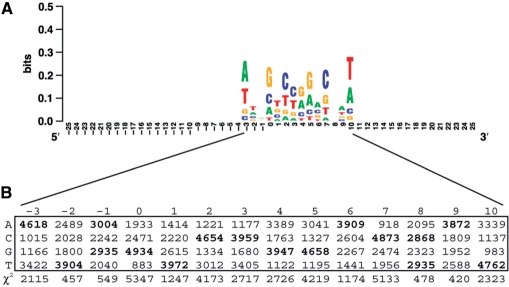
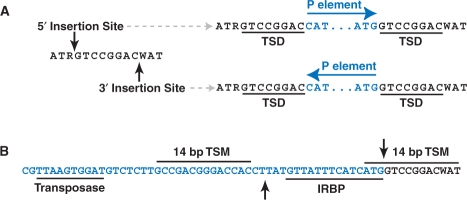
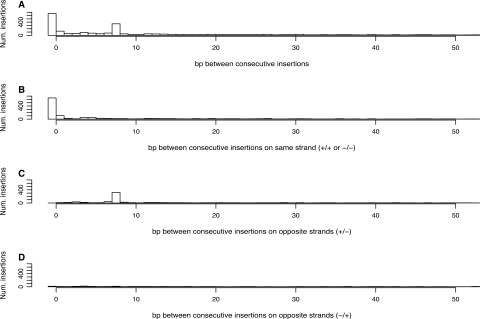
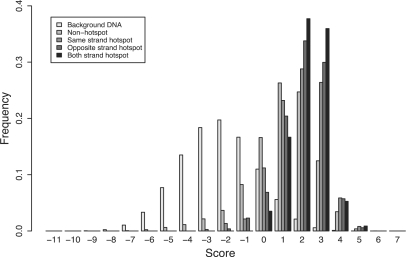
Understanding the molecular mechanisms that influence transposable element target site preferences is a fundamental challenge in functional and evolutionary genomics. Large-scale transposon insertion projects provide excellent material to study target site preferences in the absence of confounding effects of post-insertion evolutionary change. Growing evidence from a wide variety of prokaryotes and eukaryotes indicates that DNA transposons recognize staggered-cut palindromic target site motifs (TSMs). Here, we use over 10 000 accurately mapped P-element insertions in the Drosophila melanogaster genome to test predictions of the staggered-cut palindromic target site model for DNA transposon insertion. We provide evidence that the P-element targets a 14-bp palindromic motif that can be identified at the primary sequence level, which predicts the local spacing, hotspots and strand orientation of P-element insertions. Intriguingly, we find that the although P-element destroys the complete 14-bp target site upon insertion, the terminal three nucleotides of the P-element inverted repeats complement and restore the original TSM, suggesting a mechanistic link between transposon target sites and their terminal inverted repeats. Finally, we discuss how the staggered-cut palindromic target site model can be used to assess the accuracy of genome mappings for annotated P-element insertions.
了解影响转座元件靶位点偏好性的分子机制是功能基因组学和进化基因组学中的一项基本挑战。大规模转座子插入项目为研究靶位点偏好性提供了绝佳材料,可避免插入后进化变化带来的混杂效应。来自各种原核生物和真核生物的越来越多证据表明,DNA转座子识别交错切割的回文靶位点基序(TSM)。在这里,我们利用果蝇基因组中10000多个精确映射的P因子插入来测试DNA转座子插入的交错切割回文靶位点模型的预测。我们提供的证据表明,P因子靶向一个可在一级序列水平识别的14碱基对回文基序,该基序可预测P因子插入的局部间距、热点和链方向。有趣的是,我们发现虽然P因子插入时会破坏完整的14碱基对靶位点,但P因子反向重复序列的末端三个核苷酸会互补并恢复原始的TSM,这表明转座子靶位点与其末端反向重复序列之间存在机制联系。最后,我们讨论了交错切割回文靶位点模型如何用于评估注释的P因子插入的基因组图谱的准确性。