Tachado Souvenir D, Samrakandi Mustapha M, Cirillo Jeffrey D
Department of Microbial and Molecular Pathogenesis, Texas A&M Health Science Center, College Station, Texas, USA.
PLoS One. 2008 Oct 2;3(10):e3324. doi: 10.1371/journal.pone.0003324.
Legionella pneumophila, is an intracellular pathogen that causes Legionnaires' disease in humans, a potentially lethal pneumonia. L. pneumophila has the ability to enter and replicate in the host and is essential for pathogenesis.
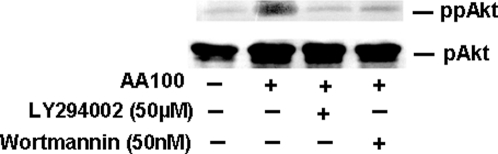
METHODOLOGY/PRINCIPAL FINDINGS: Phagocytosis was measured by cell invasion assays. Construction of PI3K mutant by PCR cloning and expression of dominant negative mutant was detected by Western blot. PI3K activity was measured by 32P labeling and detection of phospholipids products by thin layer chromatography. Infection of macrophages with virulent L. pneumophila stimulated the formation of phosphatidylinositol 3-phosphate (PIP3), a phosphorylated lipid product of PI3K whereas two structurally distinct phosphatidylinositol 3 kinase (PI3K) inhibitors, wortmannin and LY294002, reduced L. pneumophila entry into macrophages in a dose-dependent fashion. Furthermore, PI3K activation led to Akt stimulation, a serine/threonine kinase, which was also inhibited by wortmannin and LY294002. In contrast, PI3K and protein kinase B (PKB/Akt) activities were lower in macrophages infected with an avirulent bacterial strain. Only virulent L. pneumophila increased lipid kinase activity present in immunoprecipitates of the p85alpha subunit of class I PI3K and tyrosine phosphorylated proteins. In addition, macrophages expressing a specific dominant negative mutant of PI3K reduced L. pneumophila entry into these cells.
CONCLUSION/SIGNIFICANCE: Entry of L. pneumophila is mediated by PI3K/Akt signaling pathway. These results suggest an important role for PI3K and Akt in the L. pneumophila infection process. They point to possible novel strategies for undermining L. pneumophila host uptake and reducing pathogenesis of Legionnaires' disease.
嗜肺军团菌是一种细胞内病原体,可导致人类患军团病,这是一种潜在致命的肺炎。嗜肺军团菌有能力进入宿主细胞并在其中复制,这对发病机制至关重要。
方法/主要发现:通过细胞侵袭试验检测吞噬作用。通过PCR克隆构建PI3K突变体,并通过蛋白质印迹法检测显性负性突变体的表达。通过32P标记和薄层层析法检测磷脂产物来测量PI3K活性。用强毒嗜肺军团菌感染巨噬细胞会刺激磷脂酰肌醇3-磷酸(PIP3)的形成,PIP3是PI3K的一种磷酸化脂质产物,而两种结构不同的磷脂酰肌醇3激酶(PI3K)抑制剂渥曼青霉素和LY294002以剂量依赖方式减少嗜肺军团菌进入巨噬细胞。此外,PI3K激活导致丝氨酸/苏氨酸激酶Akt的刺激,渥曼青霉素和LY294002也能抑制该激酶。相比之下,用无毒菌株感染的巨噬细胞中PI3K和蛋白激酶B(PKB/Akt)活性较低。只有强毒嗜肺军团菌能增加I类PI3K的p85α亚基免疫沉淀物中存在的脂质激酶活性以及酪氨酸磷酸化蛋白。此外,表达PI3K特异性显性负性突变体的巨噬细胞减少了嗜肺军团菌进入这些细胞。
结论/意义:嗜肺军团菌的进入由PI3K/Akt信号通路介导。这些结果表明PI3K和Akt在嗜肺军团菌感染过程中起重要作用。它们指出了破坏嗜肺军团菌宿主摄取和降低军团病发病机制的可能新策略。