Sevastsyanovich Yanina R, Krasowiak Renata, Bingle Lewis E H, Haines Anthony S, Sokolov Sergey L, Kosheleva Irina A, Leuchuk Anastassia A, Titok Marina A, Smalla Kornelia, Thomas Christopher M
School of Biosciences, University of Birmingham, Edgbaston, Birmingham B15 2TT, UK.
Skryabin Institute of Biochemistry and Physiology of Microorganisms, Russian Academy of Sciences, Pushchino 142290, Russia.
Microbiology (Reading). 2008 Oct;154(Pt 10):2929-2941. doi: 10.1099/mic.0.2008/017939-0.
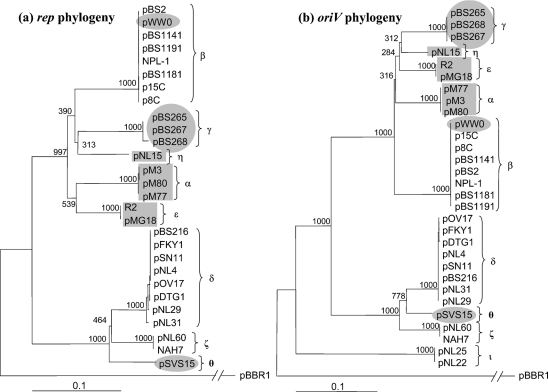
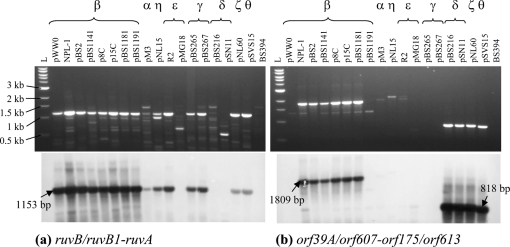
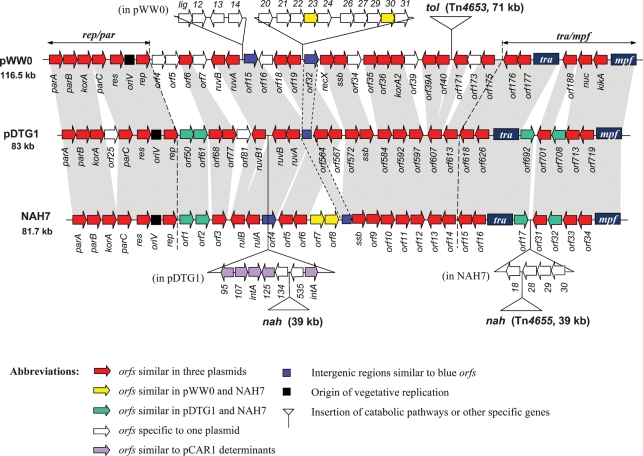
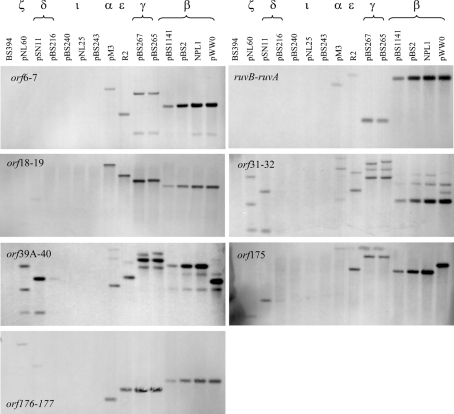
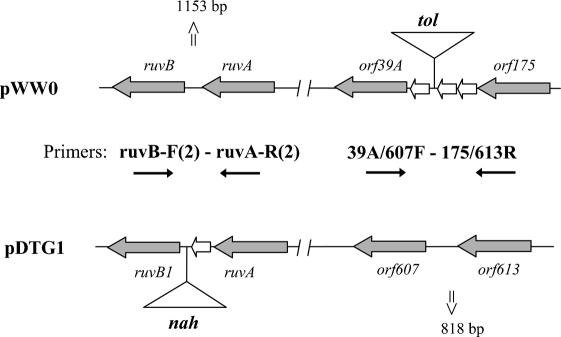
IncP-9 plasmids are important vehicles for degradation and resistance genes that contribute to the adaptability of Pseudomonas species in a variety of natural habitats. The three completely sequenced IncP-9 plasmids, pWW0, pDTG1 and NAH7, show extensive homology in replication, partitioning and transfer loci (an approximately 25 kb region) and to a lesser extent in the remaining backbone segments. We used PCR, DNA sequencing, hybridization and phylogenetic analyses to investigate the genetic diversity of 30 IncP-9 plasmids as well as the possibility of recombination between plasmids belonging to this family. Phylogenetic analysis of rep and oriV sequences revealed nine plasmid subgroups with 7-35 % divergence between them. Only one phenotypic character was normally associated with each subgroup, except for the IncP-9beta cluster, which included naphthalene- and toluene-degradation plasmids. The PCR and hybridization analysis using pWW0- and pDTG1-specific primers and probes targeting selected backbone loci showed that members of different IncP-9 subgroups have considerable similarity in their overall organization, supporting the existence of a conserved ancestral IncP-9 sequence. The results suggested that some IncP-9 plasmids are the product of recombination between plasmids of different IncP-9 subgroups but demonstrated clearly that insertion of degradative transposons has occurred on multiple occasions, indicating that association of this phenotype with these plasmids is not simply the result of divergent evolution from a single successful ancestral degradative plasmid.
IncP-9质粒是降解基因和抗性基因的重要载体,有助于假单胞菌属在各种自然生境中的适应性。已完成全序列测定的三种IncP-9质粒,即pWW0、pDTG1和NAH7,在复制、分配和转移位点(一个约25 kb的区域)显示出广泛的同源性,在其余的主干片段中同源性较低。我们使用聚合酶链反应(PCR)、DNA测序、杂交和系统发育分析来研究30种IncP-9质粒的遗传多样性以及该家族质粒之间重组的可能性。对rep和oriV序列的系统发育分析揭示了九个质粒亚组,它们之间的差异为7%-35%。除了包含萘和甲苯降解质粒的IncP-9β簇外,每个亚组通常只与一种表型特征相关。使用针对选定主干位点的pWW0和pDTG1特异性引物及探针进行的PCR和杂交分析表明,不同IncP-9亚组的成员在整体结构上具有相当大的相似性,这支持了存在一个保守的祖先IncP-9序列。结果表明,一些IncP-9质粒是不同IncP-9亚组质粒之间重组的产物,但清楚地表明降解转座子的插入已经多次发生,这表明这种表型与这些质粒的关联不仅仅是单一成功的祖先降解质粒分歧进化的结果。