Moser Jason S, Hajcak Greg, Huppert Jonathan D, Foa Edna B, Simons Robert F
Department of Psychology, University of Delaware.
Department of Psychology, Stony Brook University.
Emotion. 2008 Oct;8(5):693-700. doi: 10.1037/a0013173.
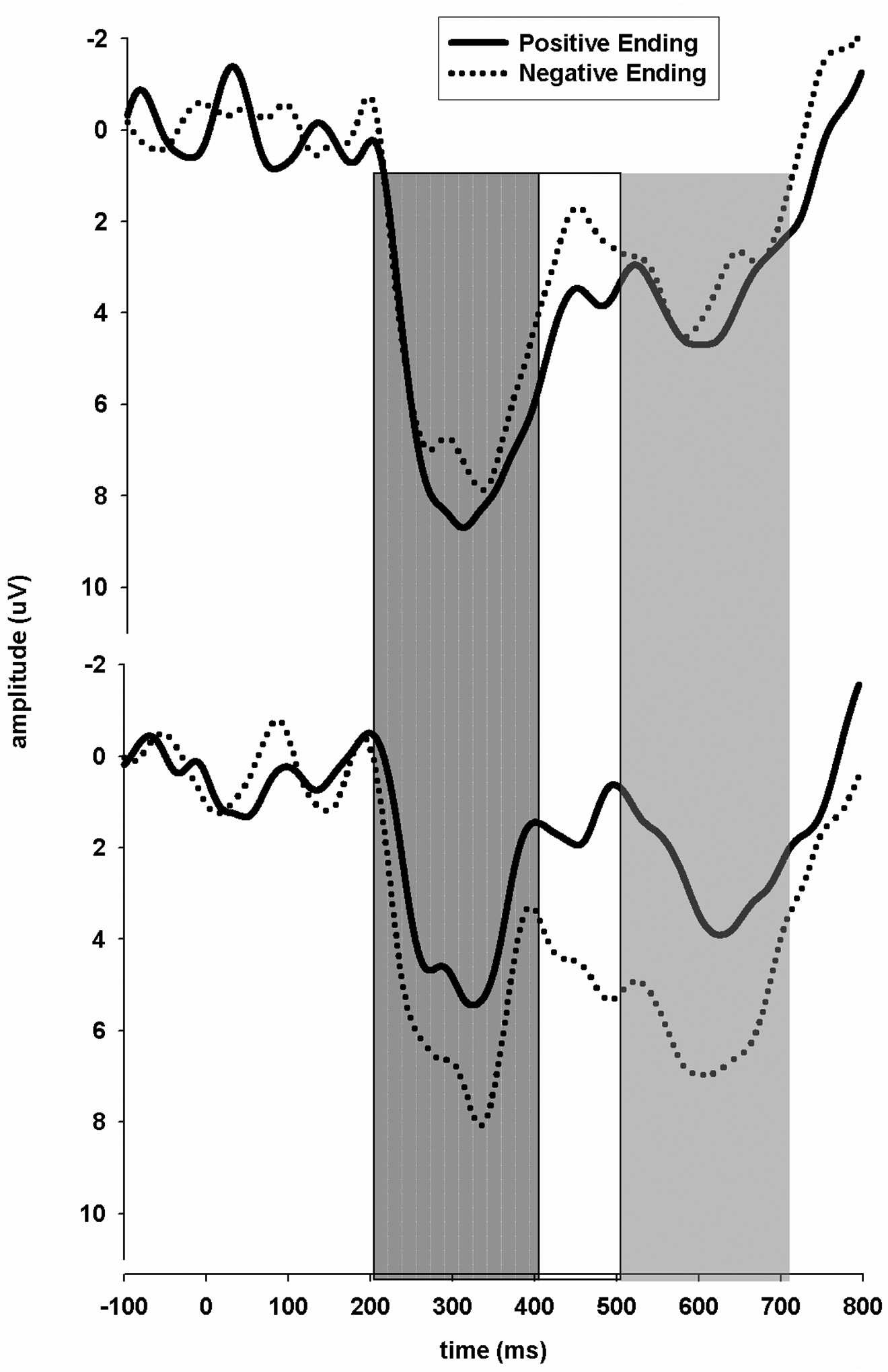
Little is known about psychophysiological correlates of interpretation bias in social anxiety. To address this issue, the authors measured event-related brain potentials (ERPs) in high and low socially anxious individuals during a task wherein ambiguous scenarios were resolved with either a positive or negative ending. Specifically, the authors examined modulations of the P600, an ERP that peaks approximately 600 ms following stimulus onset and indexes violations of expectancy. Low-anxious individuals were characterized by an increased P600 to negative in comparison with positive sentence endings, suggesting a positive interpretation bias. In contrast, the high-anxious group evidenced equivalent P600 magnitude for negative and positive sentence endings, suggesting a lack of positive interpretation bias. Similar, but less reliable results emerged in earlier time windows, that is, 200-500 ms poststimulus. Reaction time, occurring around 900 ms poststimulus, failed to show a reliable interpretation bias. Results suggest that ERPs can detect interpretation biases in social anxiety before the emission of behavioral responses.
关于社交焦虑中解释偏差的心理生理相关性,人们所知甚少。为解决这一问题,作者在一项任务中测量了高社交焦虑和低社交焦虑个体的事件相关脑电位(ERP),在该任务中,模棱两可的情景以积极或消极的结局得到解决。具体而言,作者研究了P600的调制情况,P600是一种ERP,在刺激开始后约600毫秒达到峰值,并指示预期违背。与积极的句子结尾相比,低焦虑个体的特点是对消极结尾的P600增加,表明存在积极解释偏差。相比之下,高焦虑组在消极和积极句子结尾时的P600幅值相当,表明缺乏积极解释偏差。在更早的时间窗口,即刺激后200 - 500毫秒,出现了类似但不太可靠的结果。刺激后约900毫秒出现的反应时间未能显示出可靠的解释偏差。结果表明,ERP可以在行为反应发出之前检测到社交焦虑中的解释偏差。