
解析产分枝杆菌内酯的分枝杆菌中聚酮化合物变异的遗传基础。
Deciphering the genetic basis for polyketide variation among mycobacteria producing mycolactones.
作者信息
Pidot Sacha J, Hong Hui, Seemann Torsten, Porter Jessica L, Yip Marcus J, Men Artem, Johnson Matthew, Wilson Peter, Davies John K, Leadlay Peter F, Stinear Timothy P
机构信息
Department of Microbiology, Monash University, Clayton, 3800, Australia.
出版信息
BMC Genomics. 2008 Oct 7;9:462. doi: 10.1186/1471-2164-9-462.
BACKGROUND
Mycolactones are immunosuppressive and cytotoxic polyketides, comprising five naturally occurring structural variants (named A/B, C, D, E and F), produced by different species of very closely related mycobacteria including the human pathogen, Mycobacterium ulcerans. In M. ulcerans strain Agy99, mycolactone A/B is produced by three highly homologous type I polyketide megasynthases (PKS), whose genes (mlsA1: 51 kb, mlsA2: 7.2 kb and mlsB: 42 kb) are found on a 174 kb plasmid, known as pMUM001.
RESULTS
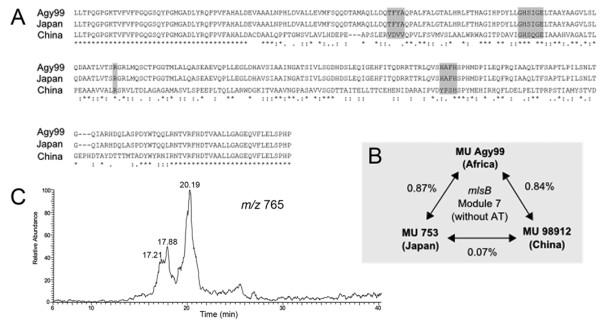
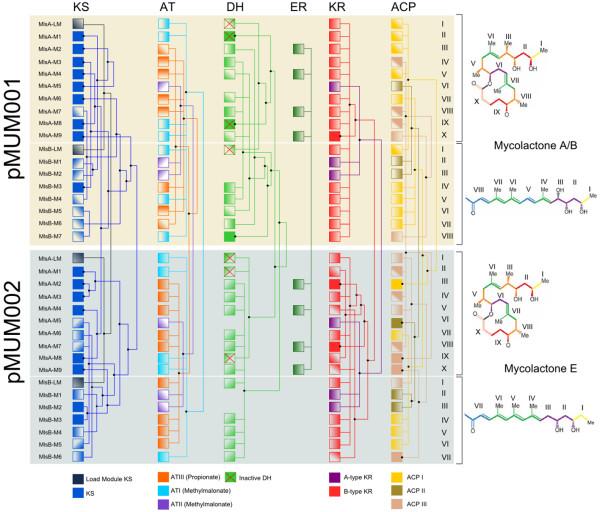
We report here comparative genomic analysis of pMUM001, the complete DNA sequence of a 190 kb megaplasmid (pMUM002) from Mycobacterium liflandii 128FXT and partial sequence of two additional pMUM replicons, combined with liquid chromatography-tandem mass spectrometric (LC-MS/MS) analysis. These data reveal how PKS module and domain differences affecting MlsB correlate with the production of mycolactones E and F. For mycolactone E these differences from MlsB in M. ulcerans Agy99 include replacement of the AT domain of the loading module (acetate to propionate) and the absence of an entire extension module. For mycolactone F there is also a reduction of one extension module but also a swap of ketoreductase domains that explains the characteristic stereochemistry of the two terminal side-chain hydroxyls, an arrangement unique to mycolactone F CONCLUSION: The mycolactone PKS locus on pMUM002 revealed the same large, three-gene structure and extraordinary pattern of near-identical PKS domain sequence repetition as observed in pMUM001 with greater than 98.5% nucleotide identity among domains of the same function. Intra- and inter-strain comparisons suggest that the extreme sequence homogeneity seen among the mls PKS genes is caused by frequent recombination-mediated domain replacement. This work has shed light on the evolution of mycolactone biosynthesis among an unusual group of mycobacteria and highlights the potential of the mls locus to become a toolbox for combinatorial PKS biochemistry.
背景
分枝杆菌内酯是具有免疫抑制和细胞毒性的聚酮化合物,由包括人类病原体溃疡分枝杆菌在内的密切相关的不同分枝杆菌物种产生,包含五种天然存在的结构变体(命名为A/B、C、D、E和F)。在溃疡分枝杆菌Agy99菌株中,分枝杆菌内酯A/B由三种高度同源的I型聚酮合酶(PKS)产生,其基因(mlsA1:51 kb,mlsA2:7.2 kb和mlsB:42 kb)位于一个174 kb的质粒上,称为pMUM001。
结果
我们在此报告了对pMUM001的比较基因组分析、来自利夫兰分枝杆菌128FXT的190 kb大质粒(pMUM002)的完整DNA序列以及另外两个pMUM复制子的部分序列,并结合了液相色谱-串联质谱(LC-MS/MS)分析。这些数据揭示了影响MlsB的PKS模块和结构域差异如何与分枝杆菌内酯E和F的产生相关。对于分枝杆菌内酯E,与溃疡分枝杆菌Agy99中的MlsB相比,这些差异包括装载模块的AT结构域被替换(乙酸盐被丙酸盐取代)以及整个延伸模块的缺失。对于分枝杆菌内酯F,也有一个延伸模块减少,但酮还原酶结构域发生了交换,这解释了两个末端侧链羟基的特征立体化学,这是分枝杆菌内酯F特有的排列方式。结论:pMUM002上的分枝杆菌内酯PKS基因座显示出与pMUM001中观察到的相同的大的三基因结构和近乎相同的PKS结构域序列重复的非凡模式,相同功能结构域之间的核苷酸同一性大于98.5%。菌株内和菌株间的比较表明,mls PKS基因之间极端的序列同质性是由频繁的重组介导的结构域替换引起的。这项工作揭示了一组不寻常的分枝杆菌中分枝杆菌内酯生物合成的进化,并突出了mls基因座成为组合PKS生物化学工具箱的潜力。


 Zotero 插件