Department of Microbiology, Monash University, Clayton, Victoria, Australia.
PLoS Negl Trop Dis. 2009 Nov 24;3(11):e553. doi: 10.1371/journal.pntd.0000553.
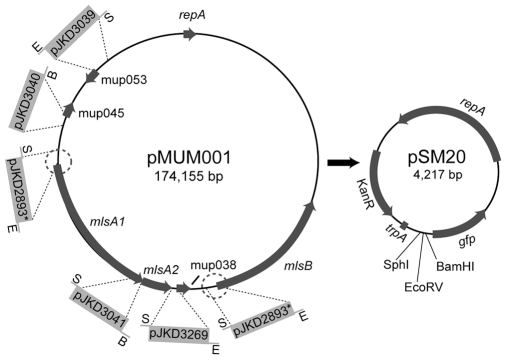
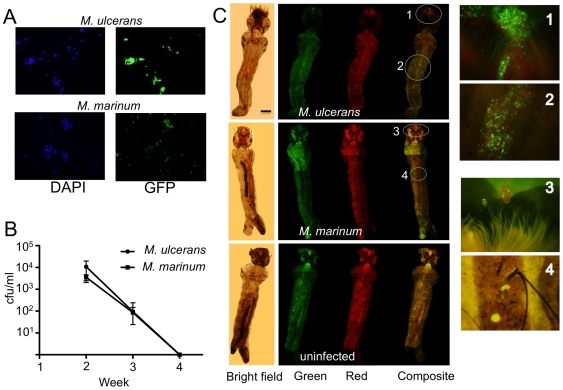
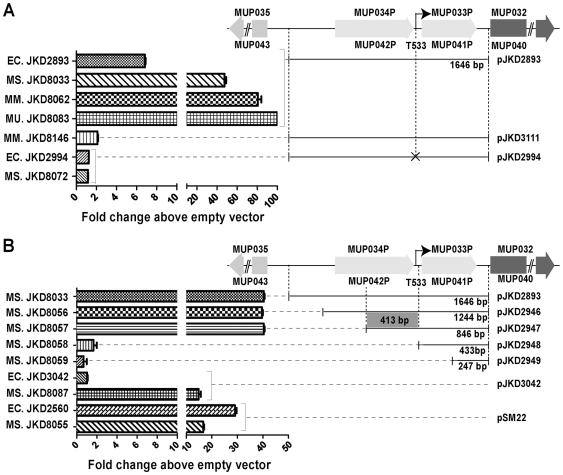
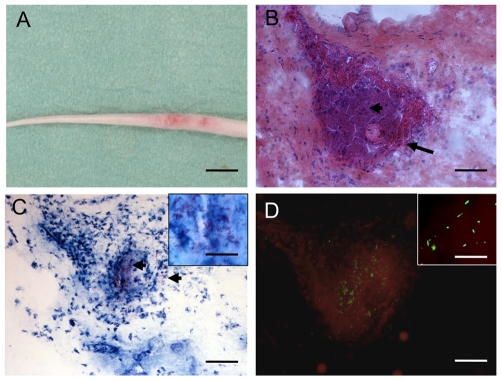
Mycolactone A/B is a lipophilic macrocyclic polyketide that is the primary virulence factor produced by Mycobacterium ulcerans, a human pathogen and the causative agent of Buruli ulcer. In M. ulcerans strain Agy99 the mycolactone polyketide synthase (PKS) locus spans a 120 kb region of a 174 kb megaplasmid. Here we have identified promoter regions of this PKS locus using GFP reporter assays, in silico analysis, primer extension, and site-directed mutagenesis. Transcription of the large PKS genes mlsA1 (51 kb), mlsA2 (7 kb) and mlsB (42 kb) is driven by a novel and powerful SigA-like promoter sequence situated 533 bp upstream of both the mlsA1 and mlsB initiation codons, which is also functional in Escherichia coli, Mycobacterium smegmatis and Mycobacterium marinum. Promoter regions were also identified upstream of the putative mycolactone accessory genes mup045 and mup053. We transformed M. ulcerans with a GFP-reporter plasmid under the control of the mls promoter to produce a highly green-fluorescent bacterium. The strain remained virulent, producing both GFP and mycolactone and causing ulcerative disease in mice. Mosquitoes have been proposed as a potential vector of M. ulcerans so we utilized M. ulcerans-GFP in microcosm feeding experiments with captured mosquito larvae. M. ulcerans-GFP accumulated within the mouth and midgut of the insect over four instars, whereas the closely related, non-mycolactone-producing species M. marinum harbouring the same GFP reporter system did not. This is the first report to identify M. ulcerans toxin gene promoters, and we have used our findings to develop M. ulcerans-GFP, a strain in which fluorescence and toxin gene expression are linked, thus providing a tool for studying Buruli ulcer pathogenesis and potential transmission to humans.
Mycolactone A/B 是一种亲脂性大环聚酮化合物,是人类病原体溃疡分枝杆菌(Mycobacterium ulcerans)产生的主要毒力因子,也是造成布吕利溃疡的病原体。在溃疡分枝杆菌 Agy99 菌株中,mycolactone 聚酮合酶(PKS)基因座跨越 174kb 大片段质粒的 120kb 区域。在这里,我们使用 GFP 报告基因检测、计算机分析、引物延伸和定点突变等方法,鉴定了该 PKS 基因座的启动子区域。mlsa1(51kb)、mlsa2(7kb)和 mlsB(42kb)等大 PKS 基因的转录由位于 mlsA1 和 mlsB 起始密码子上游 533bp 处的一个新型、强大的 SigA 样启动子序列驱动,该启动子在大肠杆菌、耻垢分枝杆菌和海分枝杆菌中也具有功能。在假定的 mycolactone 辅助基因 mup045 和 mup053 上游也鉴定到了启动子区域。我们在 mls 启动子的控制下,将 GFP 报告基因质粒转化到溃疡分枝杆菌中,得到一株高度发绿色荧光的细菌。该菌株仍然具有毒力,既能产生 GFP,又能产生 mycolactone,并在小鼠中引起溃疡性疾病。蚊子被认为是溃疡分枝杆菌的潜在传播媒介,因此我们利用 M. ulcerans-GFP 在捕获的蚊子幼虫的微生境喂养实验中进行了实验。在四个龄期内,GFP 报告基因在昆虫的口器和中肠中积累,而与之密切相关、不产生 mycolactone 的种属海分枝杆菌(Mycobacterium marinum)携带相同的 GFP 报告系统,但并不在其中积累。这是首次鉴定出溃疡分枝杆菌毒素基因启动子的报告,我们利用这一发现开发了 M. ulcerans-GFP,该菌株的荧光和毒素基因表达是相互关联的,从而为研究布吕利溃疡的发病机制和向人类传播的潜力提供了一个工具。