Hailer Frank, Leonard Jennifer A
Department of Evolutionary Biology, Evolutionary Biology Centre, Uppsala University, Uppsala, Sweden.
PLoS One. 2008 Oct 8;3(10):e3333. doi: 10.1371/journal.pone.0003333.
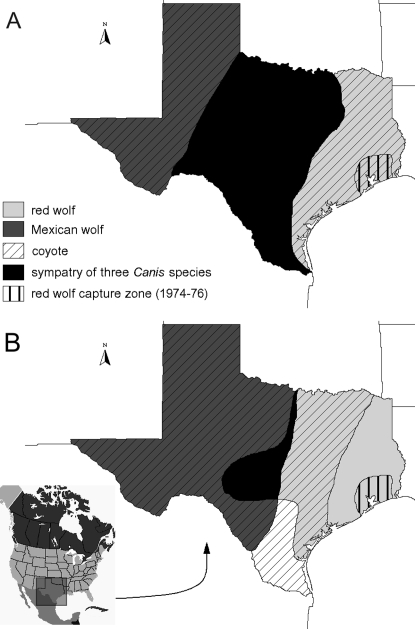
Population densities of many species throughout the world are changing due to direct persecution as well as anthropogenic habitat modification. These changes may induce or increase the frequency of hybridization among taxa. If extensive, hybridization can threaten the genetic integrity or survival of endangered species. Three native species of the genus Canis, coyote (C. latrans), Mexican wolf (C. lupus baileyi) and red wolf (C. rufus), were historically sympatric in Texas, United States. Human impacts caused the latter two to go extinct in the wild, although they survived in captive breeding programs. Morphological data demonstrate historic reproductive isolation between all three taxa. While the red wolf population was impacted by introgressive hybridization with coyotes as it went extinct in the wild, the impact of hybridization on the Texas populations of the other species is not clear.
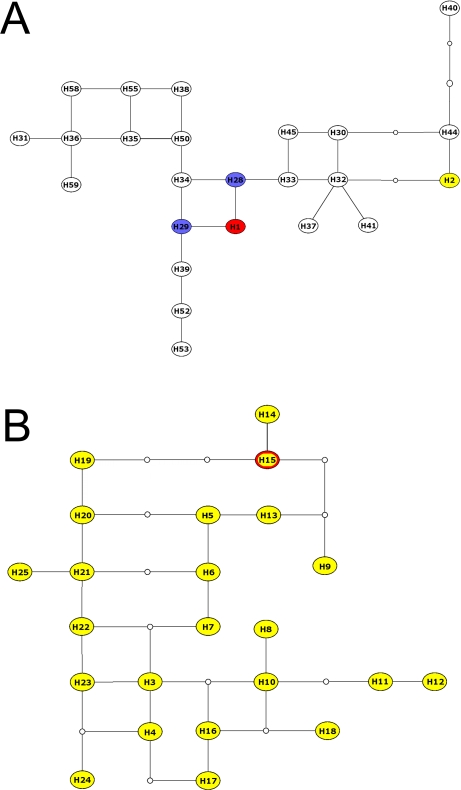
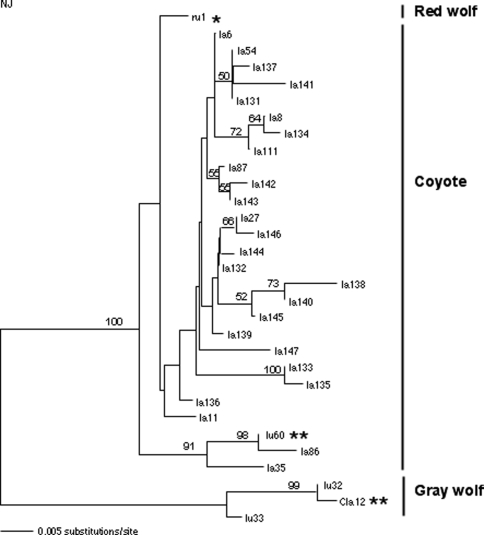
METHODOLOGY/ PRINCIPAL FINDINGS: We surveyed variation at maternally and paternally inherited genetic markers (mitochondrial control region sequence and Y chromosome microsatellites) in coyotes from Texas, Mexican wolves and red wolves from the captive breeding programs, and a reference population of coyotes from outside the historic red wolf range. Levels of variation and phylogenetic analyses suggest that hybridization has occasionally taken place between all three species, but that the impact on the coyote population is very small.
CONCLUSION/SIGNIFICANCE: Our results demonstrate that the factors driving introgressive hybridization in sympatric Texan Canis are multiple and complex. Hybridization is not solely determined by body size or sex, and density-dependent effects do not fully explain the observed pattern either. No evidence of hybridization was identified in the Mexican wolf captive breeding program, but introgression appears to have had a greater impact on the captive red wolves.
由于直接迫害以及人为栖息地改造,全球许多物种的种群密度正在发生变化。这些变化可能会诱导或增加分类群之间杂交的频率。如果杂交范围广泛,可能会威胁到濒危物种的遗传完整性或生存。犬属的三种本土物种,郊狼(C. latrans)、墨西哥狼(C. lupus baileyi)和红狼(C. rufus),历史上在美国得克萨斯州同域分布。人类活动的影响导致后两种物种在野外灭绝,尽管它们在圈养繁殖项目中得以存活。形态学数据表明这三个分类群在历史上存在生殖隔离。虽然红狼种群在野外灭绝时受到了与郊狼渐渗杂交的影响,但杂交对其他物种在得克萨斯州种群的影响尚不清楚。
方法/主要发现:我们调查了来自得克萨斯州的郊狼、圈养繁殖项目中的墨西哥狼和红狼以及历史上红狼分布范围之外的郊狼参考种群中母系和父系遗传标记(线粒体控制区序列和Y染色体微卫星)的变异情况。变异水平和系统发育分析表明,这三个物种之间偶尔会发生杂交,但对郊狼种群的影响非常小。
结论/意义:我们的结果表明,导致得克萨斯州同域分布的犬属物种渐渗杂交的因素是多方面且复杂的。杂交并非仅由体型或性别决定,密度依赖效应也不能完全解释所观察到的模式。在墨西哥狼圈养繁殖项目中未发现杂交证据,但渐渗似乎对圈养的红狼产生了更大影响。