Reidel Kristen, Tamblyn Robyn, Patel Vaishali, Huang Allen
Clinical and Health Informatics Research Group, McGill University, 1140 Pine Avenue West, Montreal, Quebec, H3A 1A3, Canada.
BMC Med Inform Decis Mak. 2008 Oct 9;8:46. doi: 10.1186/1472-6947-8-46.
Sub-optimal adherence to prescribed medications is well documented. Barriers to medication adherence include medication side effects, cost, and forgetting to take or refill medications. Interactive Voice Response (IVR) systems show promise as a tool for reminding individuals to take or refill medications. This pilot study evaluated the feasibility and acceptability of using an IVR system for prescription refill and daily medication reminders. We tested two novel features: personalized, medication-specific reminder messages and communication via voice recognition.
Patients enrolled in a study of electronic prescribing and medication management in Quebec, Canada who were taking chronic disease-related drugs were eligible to participate. Consenting patients had their demographic, telephone, and medication information transferred to an IVR system, which telephoned patients to remind them to take mediations and/or refill their prescriptions. Facilitators and barriers of the IVR system use and acceptability of the IVR system were assessed through a structured survey and open-ended questions administered by telephone interview.
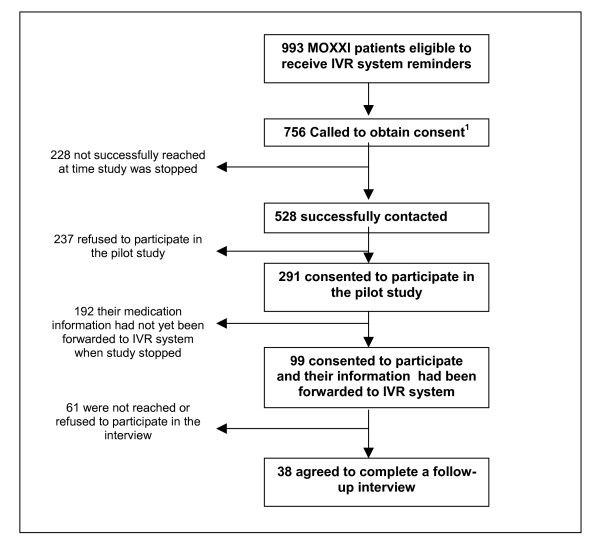
Of the 528 eligible patients who were contacted, 237 refused and 291 consented; 99 participants had started the pilot study when it was terminated because of physician and participant complaints. Thirty-eight participants completed the follow-up interview. The majority found the IVR system's voice acceptable, and did not have problems setting up the time and location of reminder calls. However, many participants experienced technical problems when called for reminders, such as incorrect time of calls and voice recognition difficulties. In addition, most participants had already refilled their prescriptions when they received the reminder calls, reporting that they did not have difficulties remembering to refill prescriptions on their own. Also, participants were not receptive to speaking to an automated voice system.
IVR systems designed to improve medication compliance must address key technical and performance issues and target those individuals with reported memory difficulties or complex medication regimens in order to improve the utility of the system. Future research should also identify characteristics of medication users who are more likely to be receptive to IVR technology.
有充分文献记载,患者对医嘱药物的依从性欠佳。药物依从性的障碍包括药物副作用、费用以及忘记服药或重新配药。交互式语音应答(IVR)系统有望成为提醒个人服药或重新配药的工具。这项试点研究评估了使用IVR系统进行处方重新配药和每日服药提醒的可行性和可接受性。我们测试了两个新功能:个性化的、特定药物提醒信息以及通过语音识别进行通信。
参与加拿大魁北克一项电子处方和药物管理研究且正在服用慢性病相关药物的患者有资格参与。同意参与的患者将其人口统计学信息、电话信息和药物信息传输到IVR系统,该系统会给患者打电话提醒他们服药和/或重新配药。通过结构化调查以及电话访谈中提出的开放式问题,评估使用IVR系统的促进因素和障碍以及IVR系统的可接受性。
在联系的528名符合条件的患者中,237人拒绝,291人同意;99名参与者在试点研究因医生和参与者投诉而终止时已开始参与。38名参与者完成了随访访谈。大多数人认为IVR系统的语音可以接受,并且在设置提醒电话的时间和地点方面没有问题。然而,许多参与者在接收提醒电话时遇到技术问题,如呼叫时间错误和语音识别困难。此外,大多数参与者在收到提醒电话时已经重新配药,他们表示自己在记住重新配药方面没有困难。而且,参与者不接受与自动语音系统交谈。
旨在提高药物依从性的IVR系统必须解决关键的技术和性能问题,并针对那些有记忆困难或用药方案复杂的个体,以提高系统的效用。未来的研究还应确定更有可能接受IVR技术的药物使用者的特征。