Henderson Sarah, Moore Nicola, Lee Emma, Witham Miles D
Section of Ageing and Health, University of Dundee, Ninewells Hospital, Dundee, UK.
BMC Geriatr. 2008 Oct 10;8:26. doi: 10.1186/1471-2318-8-26.
Undernutrition is common in older hospitalised patients, and routine screening is advocated. It is unclear whether screening tools such as the Birmingham Nutrition Risk (BNR) score and the Malnutrition Universal Screening Tool (MUST) can successfully predict outcome in this patient group.
Consecutive admissions to Medicine for the Elderly assessment wards in Dundee were assessed between mid-October 2003 and mid-January 2004. Body Mass Index (BMI), MUST and BNR scores were prospectively collected. Time to death was obtained from the Scottish Death Register and compared across strata of risk.
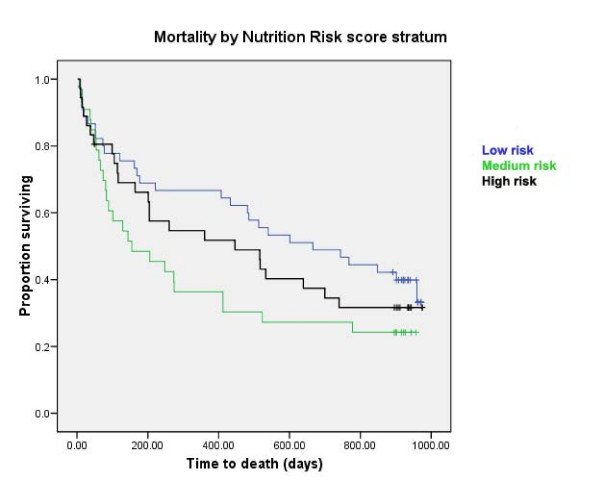
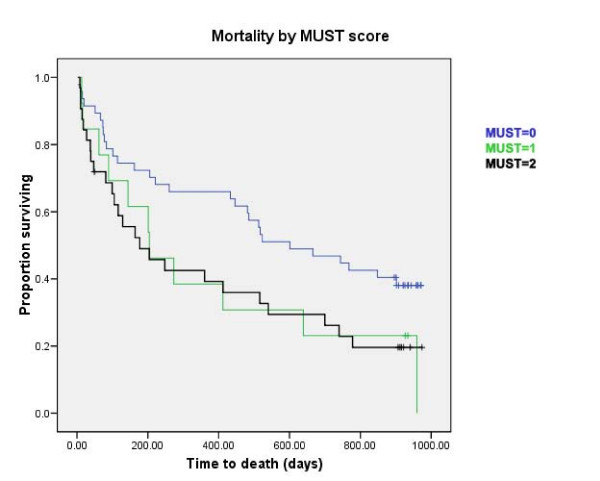
115 patients were analysed, mean age 82.1 years. 39/115 (34%) were male. 20 patients were identified as high risk by both methods of screening. A further 10 were categorised high risk only with the Birmingham classification and 12 only with MUST.80/115 (67%) patients had died at the time of accessing death records. MUST category significantly predicted death (log rank test, p = 0.022). Neither BMI (log rank p = 0.37) or Birmingham nutrition score (log rank p = 0.35) predicted death.
The MUST score, but not the BNR, is able to predict increased mortality in older hospitalised patients.
营养不良在老年住院患者中很常见,提倡进行常规筛查。目前尚不清楚诸如伯明翰营养风险(BNR)评分和营养不良通用筛查工具(MUST)等筛查工具能否成功预测该患者群体的预后。
对2003年10月中旬至2004年1月中旬期间连续入住邓迪老年医学评估病房的患者进行评估。前瞻性收集体重指数(BMI)、MUST和BNR评分。从苏格兰死亡登记处获取死亡时间,并在不同风险分层之间进行比较。
分析了115例患者,平均年龄82.1岁。115例中有39例(34%)为男性。两种筛查方法均将20例患者确定为高危。另有10例仅根据伯明翰分类被归类为高危,12例仅根据MUST被归类为高危。在获取死亡记录时,115例中有80例(67%)患者已经死亡。MUST分类显著预测了死亡(对数秩检验,p = 0.022)。BMI(对数秩p = 0.37)或伯明翰营养评分(对数秩p = 0.35)均未预测死亡。
MUST评分能够预测老年住院患者死亡率增加,而BNR评分则不能。