Takeuchi Ayako, Reyes Nicolás, Artigas Pablo, Gadsby David C
Laboratory of Cardiac/Membrane Physiology, The Rockefeller University, New York, New York 10065, USA.
Nature. 2008 Nov 20;456(7220):413-6. doi: 10.1038/nature07350. Epub 2008 Oct 8.
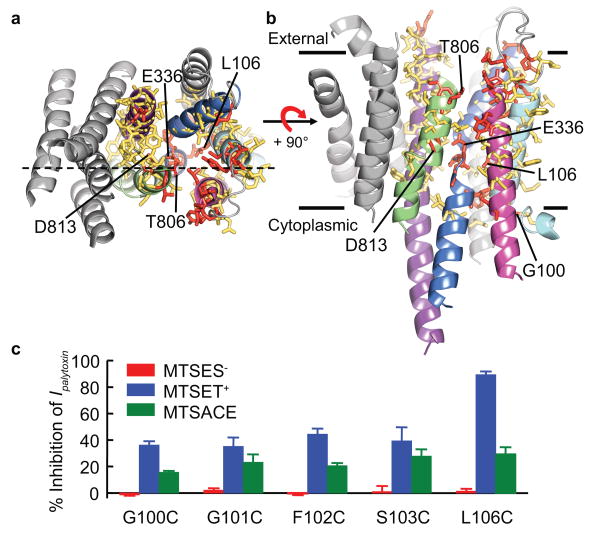
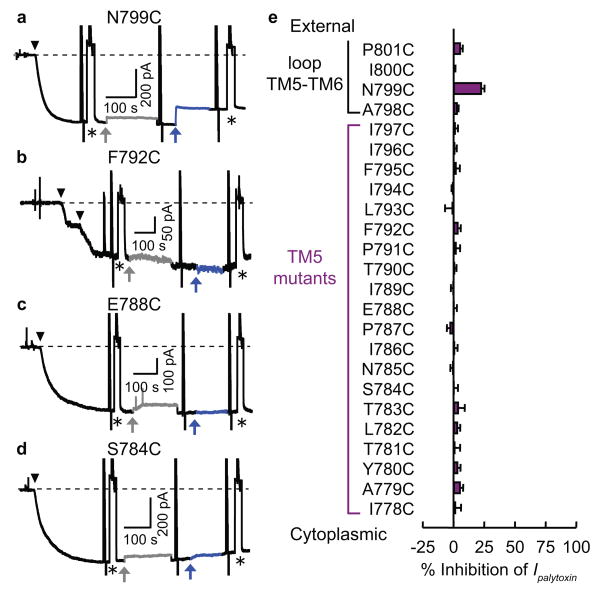
P-type ATPases pump ions across membranes, generating steep electrochemical gradients that are essential for the function of all cells. Access to the ion-binding sites within the pumps alternates between the two sides of the membrane to avoid the dissipation of the gradients that would occur during simultaneous access. In Na(+),K(+)-ATPase pumps treated with the marine agent palytoxin, this strict alternation is disrupted and binding sites are sometimes simultaneously accessible from both sides of the membrane, transforming the pumps into ion channels (see, for example, refs 2, 3). Current recordings in these channels can monitor accessibility of introduced cysteine residues to water-soluble sulphydryl-specific reagents. We found previously that Na(+),K(+) pump-channels open to the extracellular surface through a deep and wide vestibule that emanates from a narrower pathway between transmembrane helices 4 and 6 (TM4 and TM6). Here we report that cysteine scans from TM1 to TM6 reveal a single unbroken cation pathway that traverses palytoxin-bound Na(+),K(+) pump-channels from one side of the membrane to the other. This pathway comprises residues from TM1, TM2, TM4 and TM6, passes through ion-binding site II, and is probably conserved in structurally and evolutionarily related P-type pumps, such as sarcoplasmic- and endoplasmic-reticulum Ca(2+)-ATPases and H(+),K(+)-ATPases.
P型ATP酶跨膜转运离子,产生陡峭的电化学梯度,这对所有细胞的功能至关重要。泵内离子结合位点在膜的两侧交替暴露,以避免在同时暴露时发生梯度消散。在用海洋毒素处理的钠钾ATP酶泵中,这种严格的交替被破坏,结合位点有时可从膜的两侧同时被接近,从而将泵转变为离子通道(例如,参见参考文献2、3)。在这些通道中的电流记录可以监测引入的半胱氨酸残基对水溶性巯基特异性试剂的可及性。我们之前发现,钠钾泵通道通过一个深而宽的前庭向细胞外表面开放,该前庭源自跨膜螺旋4和6(TM4和TM6)之间较窄的通道。在此我们报告,从TM1到TM6的半胱氨酸扫描揭示了一条单一的连续阳离子通道,该通道从膜的一侧穿过被多管毒素结合的钠钾泵通道到达另一侧。这条通道由TM1、TM2、TM4和TM6的残基组成,穿过离子结合位点II,并且可能在结构和进化相关的P型泵中保守,如肌浆网和内质网钙ATP酶以及氢钾ATP酶。