Hanson Eric P, Monaco-Shawver Linda, Solt Laura A, Madge Lisa A, Banerjee Pinaki P, May Michael J, Orange Jordan S
Division of Rheumatology, Joseph Stokes Jr Research Institute, Children's Hospital of Philadelphia, University of Pennsylvania School of Medicine, Philadelphia, PA 19104, USA.
J Allergy Clin Immunol. 2008 Dec;122(6):1169-1177.e16. doi: 10.1016/j.jaci.2008.08.018. Epub 2008 Oct 11.
Human hypomorphic nuclear factor-kappaB essential modulator (NEMO) mutations cause diverse clinical and immunologic phenotypes, but understanding of their scope and mechanistic links to immune function and genotype is incomplete.
We created and analyzed a database of hypomorphic NEMO mutations to determine the spectrum of phenotypes and their associated genotypes and sought to establish a standardized NEMO reconstitution system to obtain mechanistic insights.
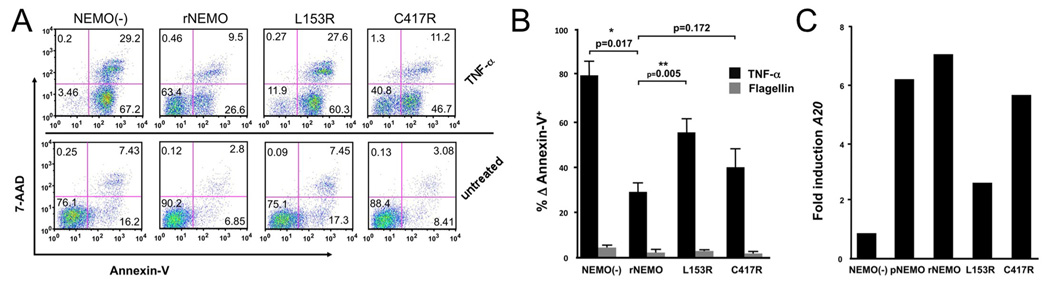
Phenotypes of 72 individuals with NEMO mutations were compiled. NEMO L153R and C417R were investigated further in a reconstitution system. TNF-alpha or Toll-like receptor (TLR)-5 signals were evaluated for nuclear factor-kappaB activation, programmed cell death, and A20 gene expression.
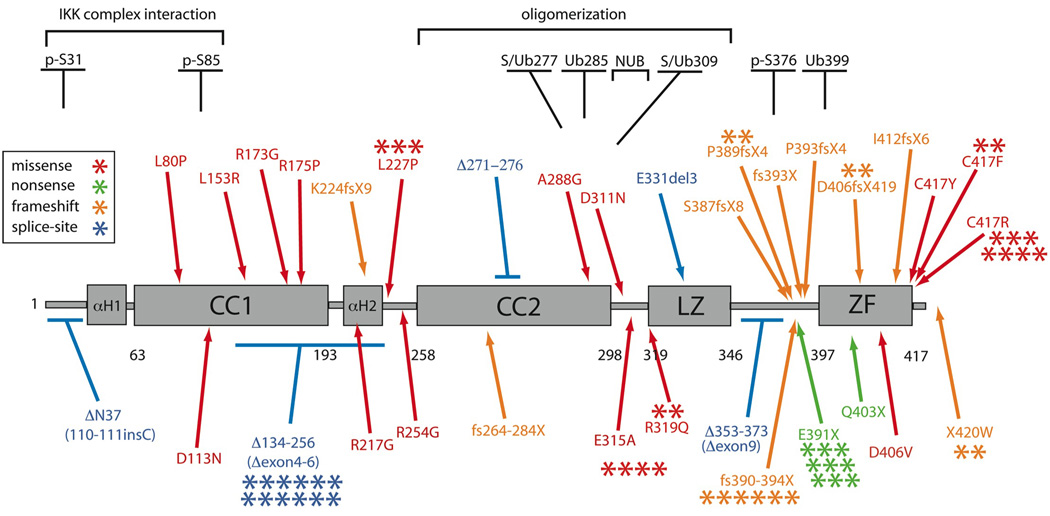
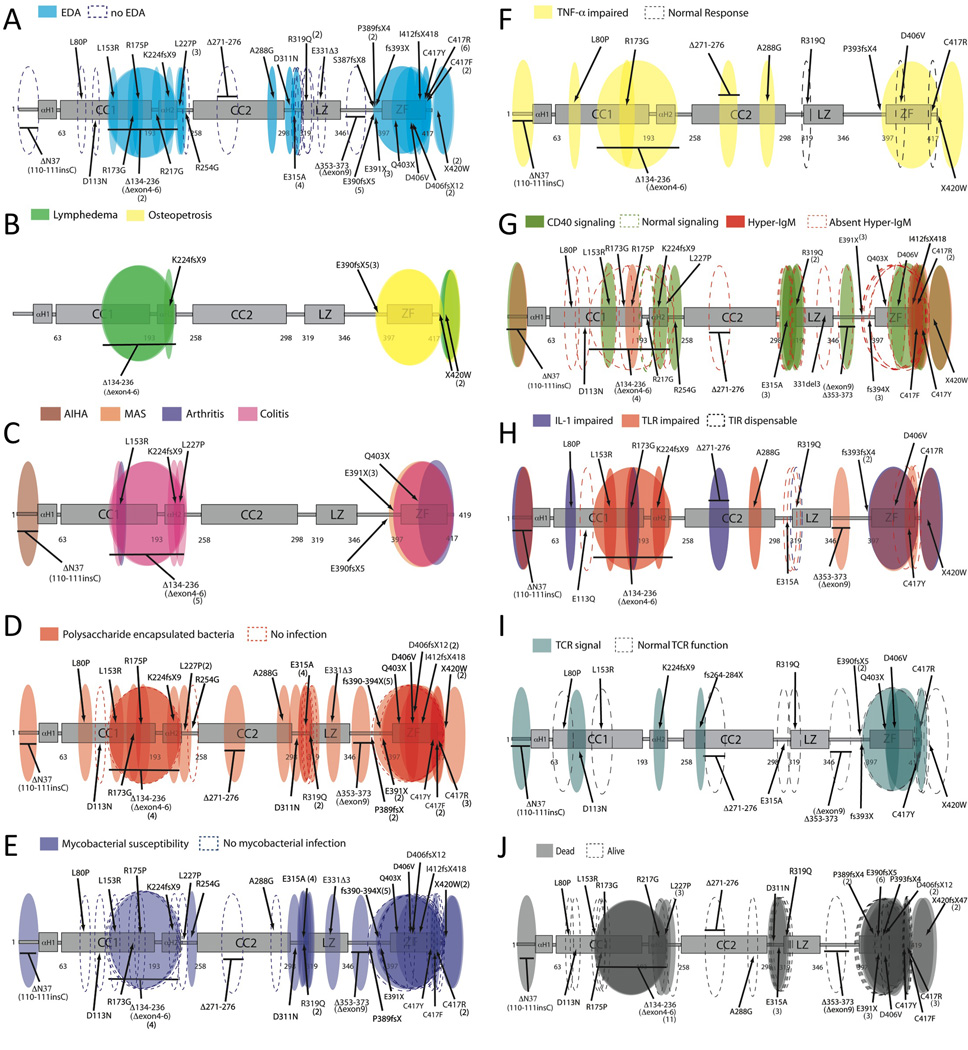
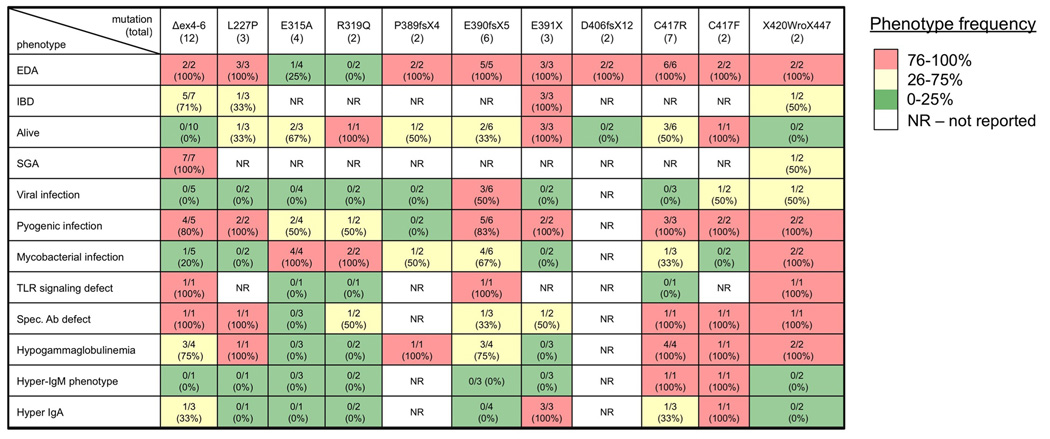
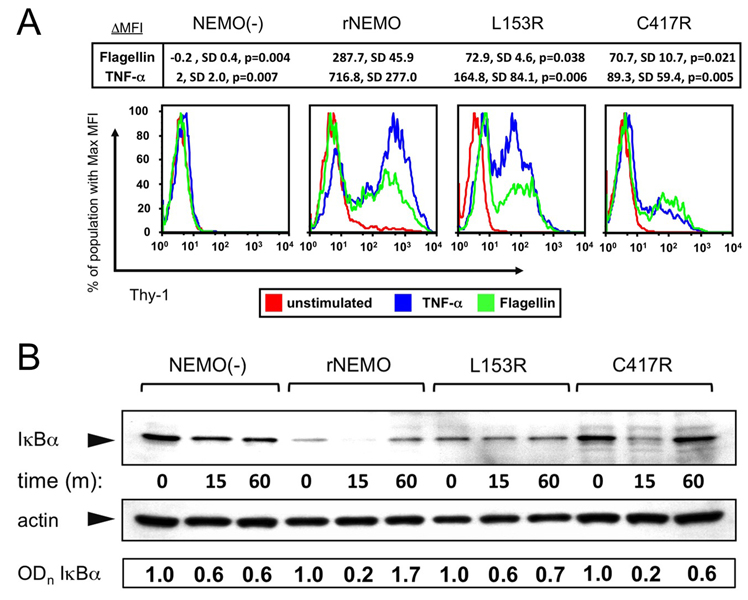
Thirty-two different mutations were identified; 53% affect the zinc finger domain. Seventy-seven percent were associated with ectodermal dysplasia, 86% with serious pyogenic infection, 39% with mycobacterial infection, 19% with serious viral infection, and 23% with inflammatory diseases. Thirty-six percent of individuals died at a mean age of 6.4 years. CD40, IL-1, TNF-alpha, TLR, and T-cell receptor signals were impaired in 15 of 16 (94%), 6 of 7 (86%), 9 of 11 (82%), 9 of 14 (64%), and 7 of 18 (39%), respectively. Hypomorphism-reconstituted NEMO-deficient cells demonstrated partial restoration of NEMO functions. Although both L153R and C417R impaired TLR and TNF-alpha-induced NF-kappaB activation, L153R also increased TNF-alpha-induced programmed cell death with decreased A20 expression.
Distinct NEMO hypomorphs define specific disease and genetic characteristics. A reconstitution system can identify attributes of hypomorphisms independent of an individual's genetic background. Apoptosis susceptibility in L153R reconstituted cells defines a specific phenotype of this mutation that likely contributes to the excessive inflammation with which it is clinically associated.
人类低功能核因子-κB必需调节因子(NEMO)突变会导致多种临床和免疫表型,但对其范围以及与免疫功能和基因型的机制联系的了解尚不完整。
我们创建并分析了一个低功能NEMO突变数据库,以确定表型谱及其相关基因型,并试图建立一个标准化的NEMO重组系统以获得机制性见解。
汇总了72例携带NEMO突变个体的表型。在重组系统中进一步研究了NEMO L153R和C417R。评估了肿瘤坏死因子-α(TNF-α)或Toll样受体(TLR)-5信号的核因子-κB激活、程序性细胞死亡和A20基因表达。
鉴定出32种不同的突变;53%影响锌指结构域。77%与外胚层发育不良相关,86%与严重化脓性感染相关,39%与分枝杆菌感染相关,19%与严重病毒感染相关,23%与炎症性疾病相关。36%的个体在平均年龄6.4岁时死亡。在16例中的15例(94%)、7例中的6例(86%)、11例中的9例(82%)、14例中的9例(64%)和18例中的7例(39%)中,CD40、白细胞介素-1、TNF-α、TLR和T细胞受体信号分别受损。低功能重组的NEMO缺陷细胞显示出NEMO功能的部分恢复。尽管L153R和C417R均损害TLR和TNF-α诱导的核因子-κB激活,但L153R还增加了TNF-α诱导的程序性细胞死亡,并降低了A20表达。
不同的NEMO低功能突变体定义了特定的疾病和遗传特征。重组系统可以识别低功能突变体的特性,而不受个体遗传背景的影响。L153R重组细胞中的凋亡易感性定义了该突变的一种特定表型,这可能导致其临床相关的过度炎症反应。