Monteiro Aparecida Cristina Sampaio, Russomano Fábio Bastos, Camargo Maria José de, Silva Kátia Silveira da, Veiga Fernanda Rangel, Oliveira Rebecca Guimarães
Department of Gynecology and Obstetrics, Cervical Pathology Sector, Instituto Fernandes Figueira, Fundação Oswaldo Cruz, Rio de Janeiro, Brazil.
Sao Paulo Med J. 2008 Jul;126(4):209-14. doi: 10.1590/s1516-31802008000400002.
Cervical stenosis is a postoperative complication of procedures for treating preinvasive lesions of the cervix and takes on particular importance due to the clinical repercussions associated with it. Furthermore, it causes limitations in relation to cytological and colposcopic follow-up. The aim here was to assess the incidence of cervical stenosis among a cohort of patients who underwent electrosurgical conization and to identify possible prognostic factors associated with its occurrence.
Retrospective study at Gynecology and Obstetrics Department, Instituto Fernandes Figueira, Rio de Janeiro.
This was an observational study among a cohort of patients who underwent electrosurgical conization of the uterine cervix. The possible predictive variables were analyzed as bivariate means between the groups with and without stenosis. We also calculated the incidence density rate ratio for cervical stenosis in relation to each possible predictive variable and the respective confidence intervals (95%). Levels of 5% were considered significant.
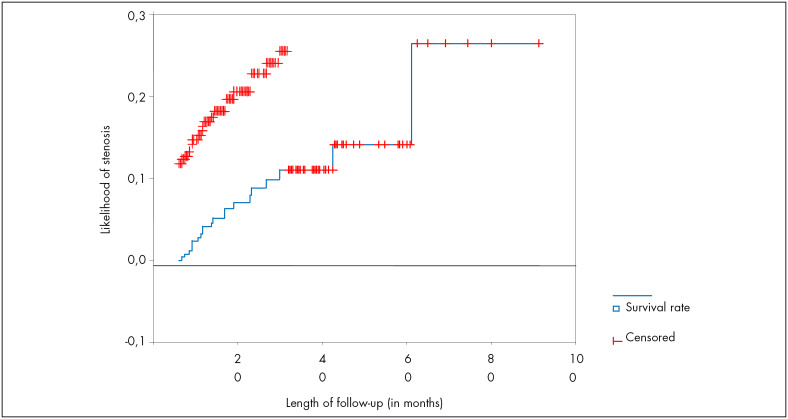
274 patients who underwent electrosurgical conization of the uterine cervix with a minimum follow-up period of six months were included. The crude incidence of cervical stenosis was 7.66% and the incidence density was 3.3/1,000 patients-month.
We did not find associations between the variables for stenosis. However, we observed borderline significance levels relating to hemorrhagic complications before and after the operation (p = 0.089).
宫颈狭窄是宫颈浸润前病变治疗手术的术后并发症,因其相关的临床影响而具有特殊重要性。此外,它在细胞学和阴道镜随访方面造成限制。本研究旨在评估接受电刀锥切术的一组患者中宫颈狭窄的发生率,并确定与其发生相关的可能预后因素。
在里约热内卢费尔南德斯·菲格雷拉研究所妇产科进行的回顾性研究。
这是一项对接受子宫颈电刀锥切术的一组患者的观察性研究。对有狭窄和无狭窄组之间的可能预测变量进行双变量分析。我们还计算了宫颈狭窄相对于每个可能预测变量的发病率密度率比及其各自的置信区间(95%)。5%的水平被认为具有统计学意义。
纳入274例接受子宫颈电刀锥切术且最短随访期为6个月的患者。宫颈狭窄的粗发病率为7.66%,发病率密度为3.3/1000患者·月。
我们未发现狭窄变量之间存在关联。然而,我们观察到手术前后出血并发症的临界显著性水平(p = 0.089)。