Faure Eric
LATP, CNRS-UMR 6632, IFR48 Infectiopole, Evolution biologique et modélisation, Université de Provence, Marseille, France.
Virol J. 2008 Oct 16;5:119. doi: 10.1186/1743-422X-5-119.
In Europe, the north-south downhill cline frequency of the chemokine receptor CCR5 allele with a 32-bp deletion (CCR5-Delta32) raises interesting questions for evolutionary biologists. We had suggested first that, in the past, the European colonizers, principally Romans, might have been instrumental of a progressively decrease of the frequencies southwards. Indeed, statistical analyses suggested strong negative correlations between the allele frequency and historical parameters including the colonization dates by Mediterranean civilisations. The gene flows from colonizers to native populations were extremely low but colonizers are responsible of the spread of several diseases suggesting that the dissemination of parasites in naive populations could have induced a breakdown rupture of the fragile pathocenosis changing the balance among diseases. The new equilibrium state has been reached through a negative selection of the null allele.
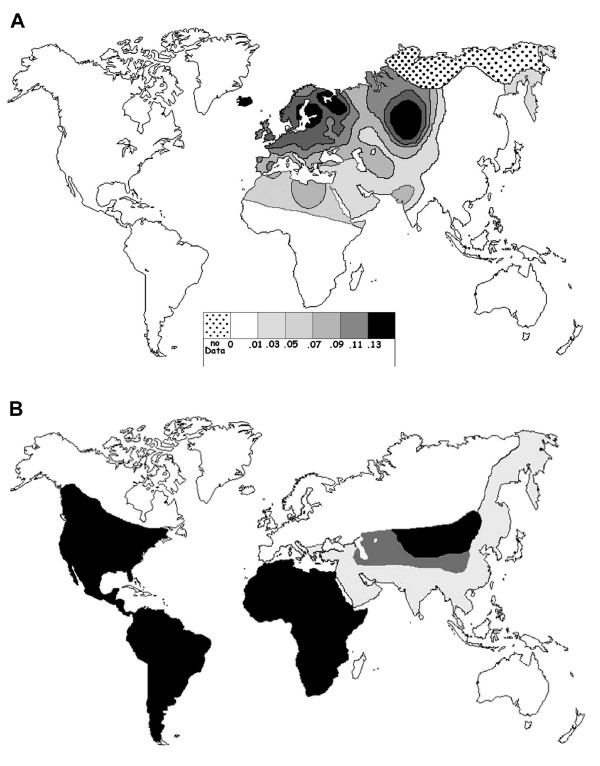
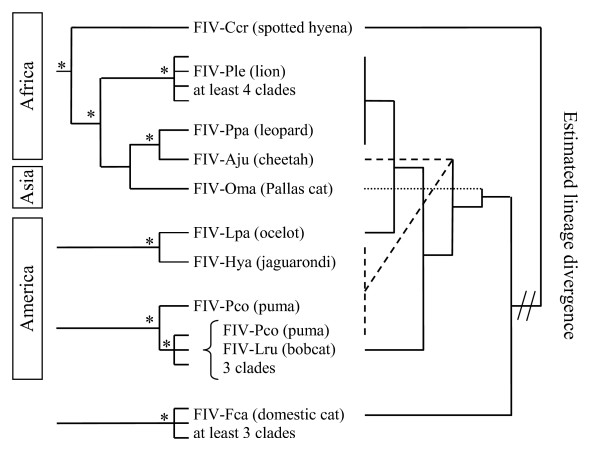
Most of the human diseases are zoonoses and cat might have been instrumental in the decrease of the allele frequency, because its diffusion through Europe was a gradual process, due principally to Romans; and that several cat zoonoses could be transmitted to man. The possible implication of a feline lentivirus (FIV) which does not use CCR5 as co-receptor is discussed. This virus can infect primate cells in vitro and induces clinical signs in macaque. Moreover, most of the historical regions with null or low frequency of CCR5-Delta32 allele coincide with historical range of the wild felid species which harbor species-specific FIVs.
We proposed the hypothesis that the actual European CCR5 allelic frequencies are the result of a negative selection due to a disease spreading. A cat zoonosis, could be the most plausible hypothesis. Future studies could provide if CCR5 can play an antimicrobial role in FIV pathogenesis. Moreover, studies of ancient DNA could provide more evidences regarding the implications of zoonoses in the actual CCR5-Delta32 distribution.
在欧洲,趋化因子受体CCR5基因32碱基对缺失(CCR5 - Δ32)等位基因的南北下坡频率梯度引发了进化生物学家的诸多有趣问题。我们首先提出,过去欧洲殖民者,主要是罗马人,可能对该等位基因频率向南逐渐降低起到了推动作用。事实上,统计分析表明等位基因频率与包括地中海文明殖民日期在内的历史参数之间存在强烈的负相关。殖民者向当地人群的基因流动极低,但殖民者导致了多种疾病的传播,这表明寄生虫在未接触过的人群中的传播可能引发了脆弱病理群落的崩溃,改变了疾病之间的平衡。新的平衡状态是通过对无效等位基因的负选择而达成的。
大多数人类疾病是人畜共患病,猫可能对该等位基因频率的降低起到了作用,因为它在欧洲的传播是一个渐进过程,主要归因于罗马人;而且几种猫源性人畜共患病可以传播给人类。文中讨论了一种不将CCR5作为共受体的猫慢病毒(FIV)的可能影响。这种病毒可在体外感染灵长类细胞并在猕猴身上引发临床症状。此外,CCR5 - Δ32等位基因频率为零或低的大多数历史区域与携带物种特异性FIV的野生猫科动物的历史分布范围相重合。
我们提出了这样一个假说,即当前欧洲CCR5等位基因频率是疾病传播导致负选择的结果。猫源性人畜共患病可能是最合理的假说。未来的研究可以确定CCR5在FIV发病机制中是否能发挥抗菌作用。此外,古代DNA研究可以提供更多关于人畜共患病在当前CCR5 - Δ32分布中的影响的证据。