Troyer Jennifer L, Vandewoude Sue, Pecon-Slattery Jill, McIntosh Carl, Franklin Sam, Antunes Agostinho, Johnson Warren, O'Brien Stephen J
Laboratory of Genomic Diversity, SAIC-Frederick, Inc., NCI-Frederick, Frederick, MD 21702, United States.
Vet Immunol Immunopathol. 2008 May 15;123(1-2):159-66. doi: 10.1016/j.vetimm.2008.01.023. Epub 2008 Jan 19.
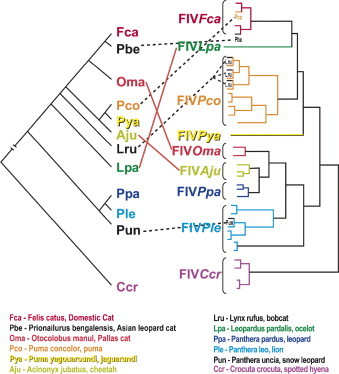
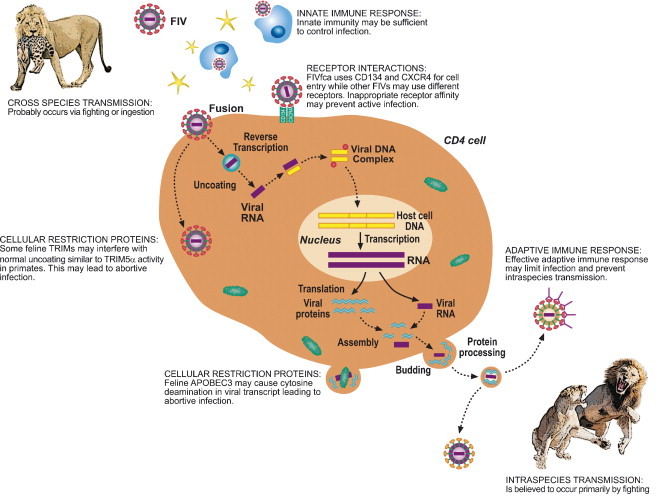
Feline and primate immunodeficiency viruses (FIVs, SIVs, and HIV) are transmitted via direct contact (e.g. fighting, sexual contact, and mother-offspring transmission). This dynamic likely poses a behavioral barrier to cross-species transmission in the wild. Recently, several host intracellular anti-viral proteins that contribute to species-specificity of primate lentiviruses have been identified revealing adaptive mechanisms that further limit spread of lentiviruses between species. Consistent with these inter-species transmission barriers, phylogenetic evidence supports the prediction that FIV transmission is an exceedingly rare event between free-ranging cat species, though it has occurred occasionally in captive settings. Recently we documented that puma and bobcats in Southern California share an FIV strain, providing an opportunity to evaluate evolution of both viral strains and host intracellular restriction proteins. These studies are facilitated by the availability of the 2x cat genome sequence annotation. In addition, concurrent viral and host genetic analyses have been used to track patterns of migration of the host species and barriers to transmission of the virus within the African lion. These studies illustrate the utility of FIV as a model to discover the variables necessary for establishment and control of lentiviral infections in new species.
猫科动物和灵长类动物免疫缺陷病毒(猫免疫缺陷病毒、猴免疫缺陷病毒和人类免疫缺陷病毒)通过直接接触传播(例如打斗、性接触和母婴传播)。这种动态情况可能在野外对跨物种传播构成行为障碍。最近,已经鉴定出几种有助于灵长类慢病毒物种特异性的宿主细胞内抗病毒蛋白,揭示了进一步限制慢病毒在物种间传播的适应性机制。与这些种间传播障碍一致,系统发育证据支持这样的预测:在自由放养的猫科动物物种之间,猫免疫缺陷病毒的传播是极其罕见的事件,尽管在圈养环境中偶尔会发生。最近我们记录了南加州的美洲狮和短尾猫共享一种猫免疫缺陷病毒毒株,这为评估病毒毒株和宿主细胞内限制蛋白的进化提供了一个机会。2倍体猫基因组序列注释的可用性推动了这些研究。此外,同时进行的病毒和宿主基因分析已被用于追踪宿主物种的迁移模式以及非洲狮体内病毒传播的障碍。这些研究说明了猫免疫缺陷病毒作为一种模型的实用性,可用于发现新物种中建立和控制慢病毒感染所需的变量。