Matrangola Sara L, Madigan Michael L, Nussbaum Maury A, Ross Robert, Davy Kevin P
Virginia Tech-Wake Forest School of Biomedical Engineering and Sciences, Blacksburg, VA, USA.
J Biomech. 2008 Nov 14;41(15):3278-81. doi: 10.1016/j.jbiomech.2008.08.026. Epub 2008 Oct 17.
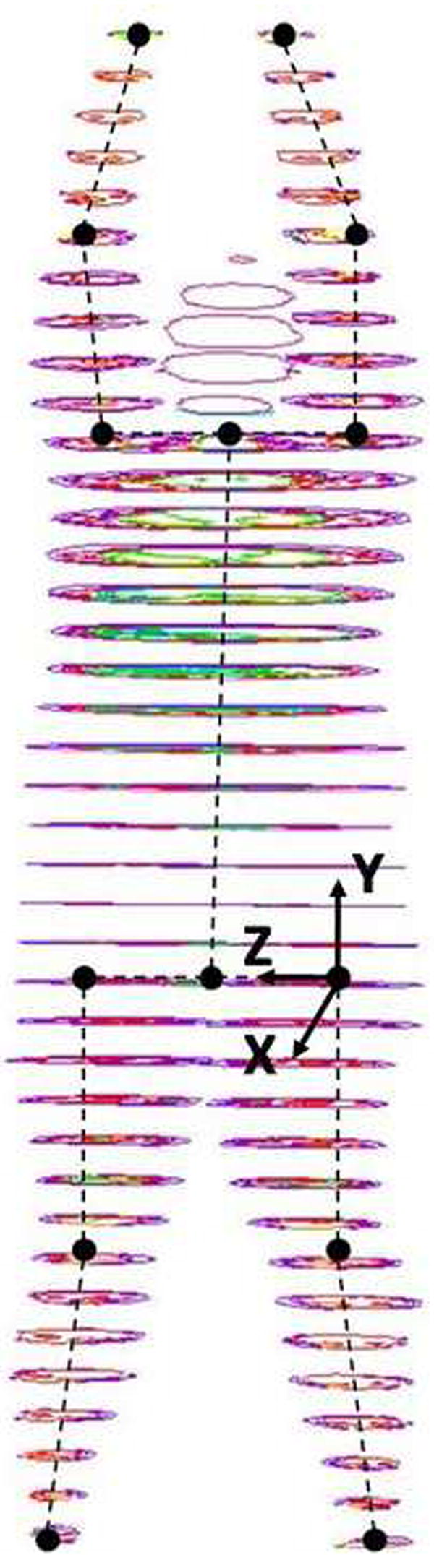
Forward dynamic simulation of human movement has the potential to investigate the biomechanical effects of weight loss in obese individuals. However, guidelines for altering body segment inertial parameters (BSIPs) of a biomechanical model to approximate changes that occur with weight loss are currently unavailable. Therefore, the goal of this study was to quantify three-dimensional changes in BSIPs with weight loss. Nineteen Caucasian men of age 43.6+/-7.5 years (mean+/-standard deviation) were evaluated. Body mass and body mass index prior to weight loss were 102.7+/-3.6 kg and 32.6+/-3.2 kg/m2, respectively. Both before and after weight loss, magnetic resonance imaging scans were acquired along the length of the body to discriminate muscle, bone, organ, and adipose tissues. Segment masses, center of mass (COM) positions, and radii of gyration were determined from these scans using published tissue densities and established methods. A number of significant changes in BSIPs occurred with the 13.8+/-2.4% average weight loss. Mass decreased in all segments. COM position moved distally for the thigh and upper arm, superiorly for the trunk, and inferiorly for the whole body. Radius of gyration, in general, decreased in all segments. The changes in BSIPs with weight loss reported here could be used in forward dynamic simulations investigating the biomechanical implications of weight loss.
人体运动的正向动力学模拟有潜力研究肥胖个体体重减轻的生物力学效应。然而,目前尚无关于改变生物力学模型的身体节段惯性参数(BSIPs)以近似体重减轻时发生变化的指导原则。因此,本研究的目的是量化体重减轻时BSIPs的三维变化。对19名年龄为43.6±7.5岁(平均值±标准差)的白人男性进行了评估。体重减轻前的体重和体重指数分别为102.7±3.6 kg和32.6±3.2 kg/m²。在体重减轻前后,均沿身体长度进行磁共振成像扫描,以区分肌肉、骨骼、器官和脂肪组织。利用已发表的组织密度和既定方法,从这些扫描中确定节段质量、质心(COM)位置和回转半径。随着平均体重减轻13.8±2.4%,BSIPs发生了许多显著变化。所有节段的质量均下降。大腿和上臂的COM位置向远端移动,躯干向上移动,全身向下移动。总体而言,所有节段的回转半径均减小。本文报道的体重减轻时BSIPs的变化可用于研究体重减轻生物力学影响的正向动力学模拟。