Chan Angela, Boulé Jean-Baptiste, Zakian Virginia A
Department of Molecular Biology, Princeton University, Princeton, NJ, USA.
PLoS Genet. 2008 Oct;4(10):e1000236. doi: 10.1371/journal.pgen.1000236. Epub 2008 Oct 24.
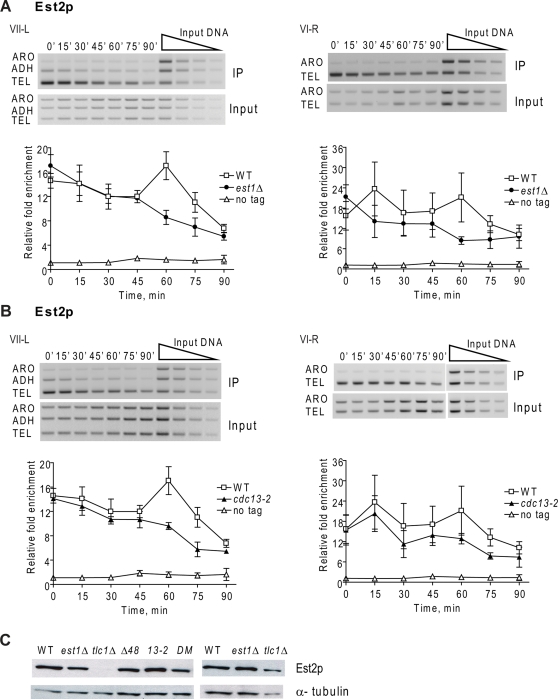
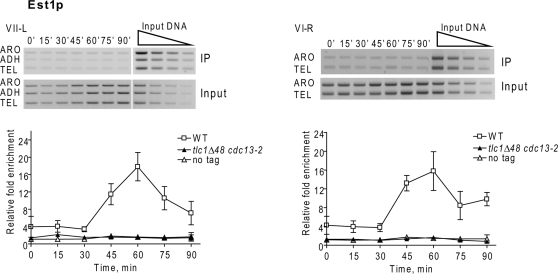
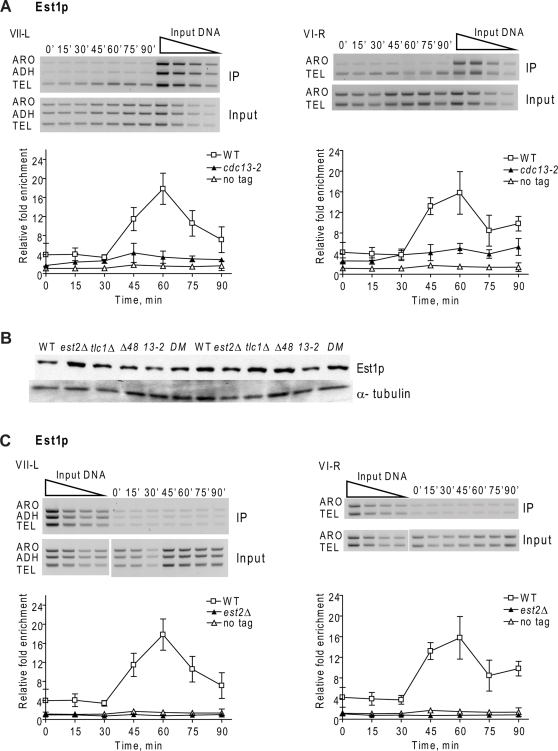
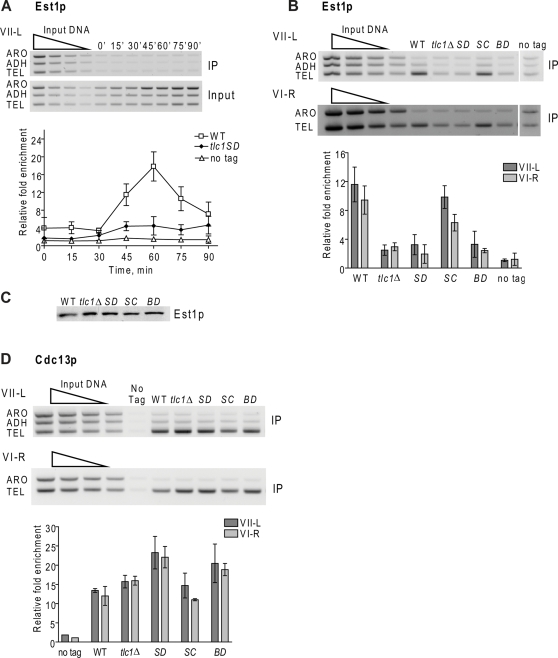
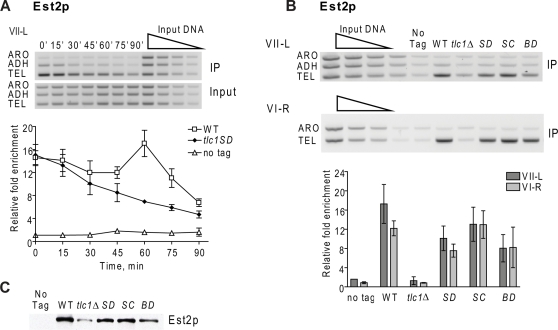
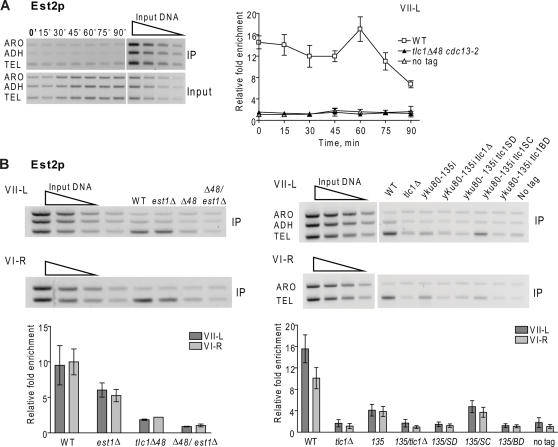
The catalytic subunit of yeast telomerase, Est2p, is a telomere associated throughout most of the cell cycle, while the Est1p subunit binds only in late S/G2 phase, the time of telomerase action. Est2p binding in G1/early S phase requires a specific interaction between telomerase RNA (TLC1) and Ku80p. Here, we show that in four telomerase-deficient strains (cdc13-2, est1A, tlc1-SD, and tlc1-BD), Est2p telomere binding was normal in G1/early S phase but reduced to about 40-50% of wild type levels in late S/G2 phase. Est1p telomere association was low in all four strains. Wild type levels of Est2p telomere binding in late S/G2 phase was Est1p-dependent and required that Est1p be both telomere-bound and associated with a stem-bulge region in TLC1 RNA. In three telomerase-deficient strains in which Est1p is not Est2p-associated (tlc1-SD, tlc1-BD, and est2A), Est1p was present at normal levels but its telomere binding was very low. When the G1/early S phase and the late S/G2 phase telomerase recruitment pathways were both disrupted, neither Est2p nor Est1p was telomere-associated. We conclude that reduced levels of Est2p and low Est1p telomere binding in late S/G2 phase correlated with an est phenotype, while a WT level of Est2p binding in G1 was not sufficient to maintain telomeres. In addition, even though Cdc13p and Est1p interact by two hybrid, biochemical and genetic criteria, this interaction did not occur unless Est1p was Est2p-associated, suggesting that Est1p comes to the telomere only as part of the holoenzyme. Finally, the G1 and late S/G2 phase pathways for telomerase recruitment are distinct and are likely the only ones that bring telomerase to telomeres in wild-type cells.
酵母端粒酶的催化亚基Est2p在细胞周期的大部分时间里都与端粒相关,而Est1p亚基仅在S/G2期晚期(端粒酶发挥作用的时间)结合。Est2p在G1/早期S期的结合需要端粒酶RNA(TLC1)与Ku80p之间的特定相互作用。在此,我们表明,在四个端粒酶缺陷菌株(cdc13-2、est1A、tlc1-SD和tlc1-BD)中,Est2p在G1/早期S期的端粒结合正常,但在S/G2期晚期降至野生型水平的约40-50%。Est1p在所有四个菌株中的端粒结合都很低。Est2p在S/G2期晚期的野生型水平的端粒结合依赖于Est1p,并且要求Est1p既结合在端粒上,又与TLC1 RNA中的茎环区域相关。在三个Est1p不与Est2p相关的端粒酶缺陷菌株(tlc1-SD、tlc1-BD和est2A)中,Est1p水平正常但其端粒结合非常低。当G1/早期S期和S/G2期晚期的端粒酶募集途径都被破坏时,Est2p和Est1p都不与端粒相关。我们得出结论,S/G2期晚期Est2p水平降低和Est1p端粒结合低与est表型相关,而G1期Est2p结合的野生型水平不足以维持端粒。此外,尽管Cdc13p和Est1p通过双杂交、生化和遗传标准相互作用,但除非Est1p与Est2p相关,否则这种相互作用不会发生,这表明Est1p仅作为全酶的一部分来到端粒。最后,端粒酶募集的G1期和S/G2期晚期途径是不同的,并且可能是野生型细胞中唯一能将端粒酶带到端粒的途径。