Boulerice F, Li X G, Lvovich A, Wainberg M A
Lady Davis Institute-Jewish General Hospital, Montreal, Quebec, Canada.
J Virol. 1991 Oct;65(10):5589-92. doi: 10.1128/JVI.65.10.5589-5592.1991.
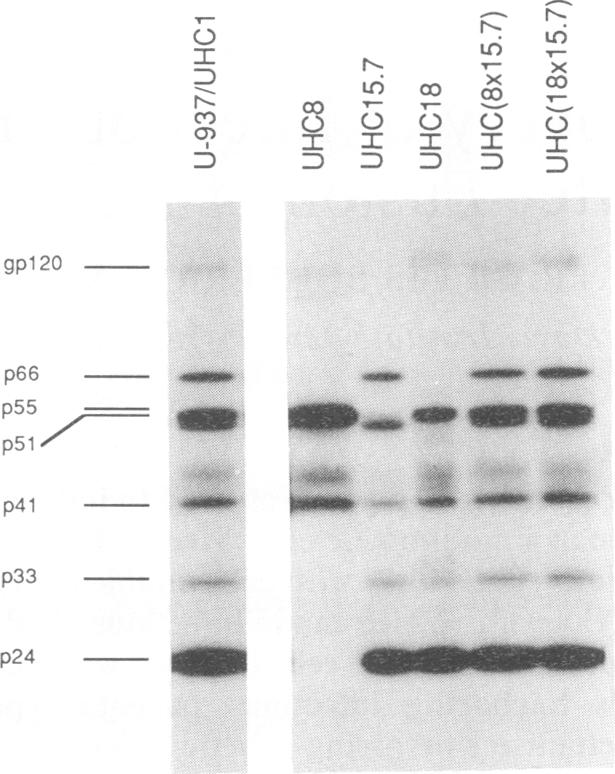
Polyethylene glycol was used to induce polykaryon formation among U-937 cell subclones carrying defective human immunodeficiency virus (HIV) type 1 proviral DNA. Fusion of cells which produced gp120-defective virions (UHC15.7) with cells unable to generate reverse transcriptase (RT) activity (UHC8 and UHC18) yielded polykaryons which made infectious viral progeny that showed normal protein profiles. Southern blot analysis of proviral DNA of cells infected with such fusion-derived virus revealed a restriction map identical to that of cells harboring infectious parental-type HIV type 1 (U-937/UHC1). These results suggest that repair mechanisms involving genetic recombination(s) play a role in the generation of infectious virus after fusion of cells which harbor defective HIV.
聚乙二醇被用于在携带缺陷型人类免疫缺陷病毒1型(HIV-1)前病毒DNA的U-937细胞亚克隆中诱导多核体形成。产生gp120缺陷型病毒粒子的细胞(UHC15.7)与无法产生逆转录酶(RT)活性的细胞(UHC8和UHC18)融合,产生了多核体,这些多核体产生了具有正常蛋白质谱的感染性病毒后代。对感染这种融合衍生病毒的细胞的前病毒DNA进行Southern印迹分析,结果显示其限制性图谱与携带感染性亲代型HIV-1(U-937/UHC1)的细胞相同。这些结果表明,涉及基因重组的修复机制在携带缺陷型HIV的细胞融合后感染性病毒的产生中发挥作用。