Tomat Elisa, Nolan Elizabeth M, Jaworski Jacek, Lippard Stephen J
Department of Chemistry, Massachusetts Institute of Technology, 77 Massachusetts Avenue, Cambridge, Massachusetts 02139, USA.
J Am Chem Soc. 2008 Nov 26;130(47):15776-7. doi: 10.1021/ja806634e.
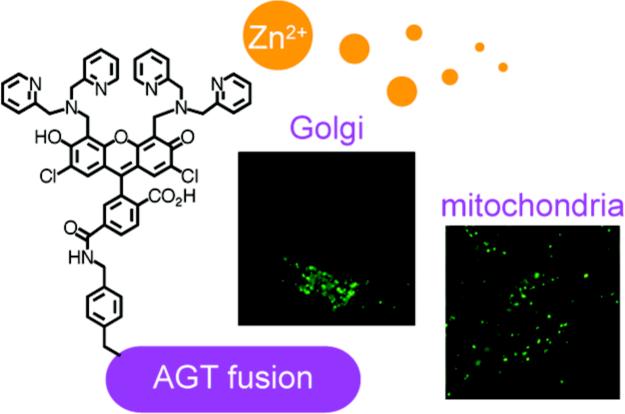
A protein labeling approach is employed for the localization of a zinc-responsive fluorescent probe in the mitochondria and in the Golgi apparatus of living cells. ZP1, a zinc sensor of the Zinpyr family, was functionalized with a benzylguanine moiety and thus converted into a substrate (ZP1BG) for the human DNA repair enzyme alkylguaninetransferase (AGT or SNAP-Tag). The labeling reaction of purified glutathione S-transferase tagged AGT with ZP1BG and the zinc response of the resulting protein-bound sensor were confirmed in vitro. The new detection system, which combines a protein labeling methodology with a zinc fluorescent sensor, was tested in live HeLa cells expressing AGT in specific locations. The enzyme was genetically fused to site-directing proteins that anchor the probe onto targeted organelles. Localization of the zinc sensors in the Golgi apparatus and in the mitochondria was demonstrated by fluorescence microscopy. The protein-bound fluorescence detection system is zinc-responsive in living cells.
一种蛋白质标记方法被用于在活细胞的线粒体和高尔基体中定位锌响应荧光探针。ZP1是锌吡咯家族的锌传感器,用苄基鸟嘌呤部分进行功能化,从而转化为人DNA修复酶烷基鸟嘌呤转移酶(AGT或SNAP标签)的底物(ZP1BG)。在体外证实了纯化的谷胱甘肽S-转移酶标记的AGT与ZP1BG的标记反应以及所得蛋白质结合传感器的锌响应。这种将蛋白质标记方法与锌荧光传感器相结合的新检测系统,在特定位置表达AGT的活HeLa细胞中进行了测试。该酶通过基因融合到将探针锚定到靶向细胞器的位点导向蛋白上。通过荧光显微镜证实了锌传感器在高尔基体和线粒体中的定位。蛋白质结合荧光检测系统在活细胞中对锌有响应。