Coassin Stefan, Brandstätter Anita, Kronenberg Florian
Division of Genetic Epidemiology, Department of Medical Genetics, Molecular and Clinical Pharmacology, Innsbruck Medical University, Innsbruck, Austria.
BMC Genomics. 2008 Oct 30;9:510. doi: 10.1186/1471-2164-9-510.
Single nucleotide polymorphisms (SNPs) are the most common form of genetic variability in the human genome and play a prominent role in the heritability of phenotypes. Especially rare alleles with frequencies less than 5% may exhibit a particularly strong influence on the development of complex diseases. The detection of rare alleles by standard DNA sequencing is time-consuming and cost-intensive. Here we discuss an alternative approach for a high throughput detection of rare mutations in large population samples using Ecotilling embedded in a collection of bioinformatic analysis tools. Ecotilling originally was introduced as TILLING for the screening for rare chemically induced mutations in plants and later adopted for human samples, showing an outstanding suitability for the detection of rare alleles in humans. An actual problem in the use of Ecotilling for large mutation screening projects in humans without bioinformatic support is represented by the lack of solutions to quickly yet comprehensively evaluate each newly found variation and place it into the correct genomic context.
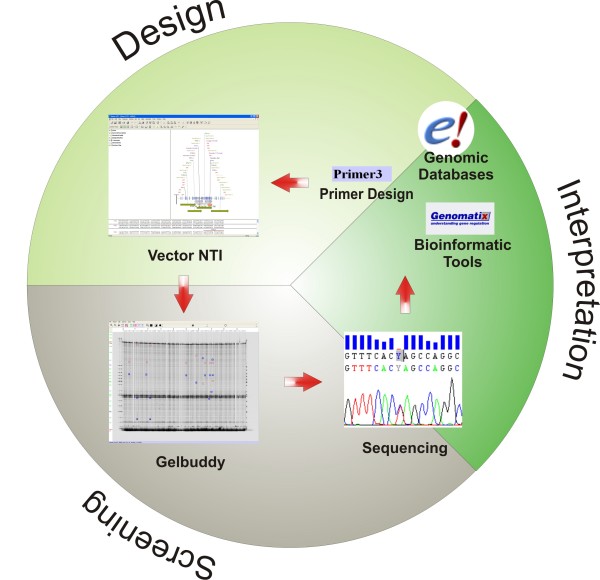
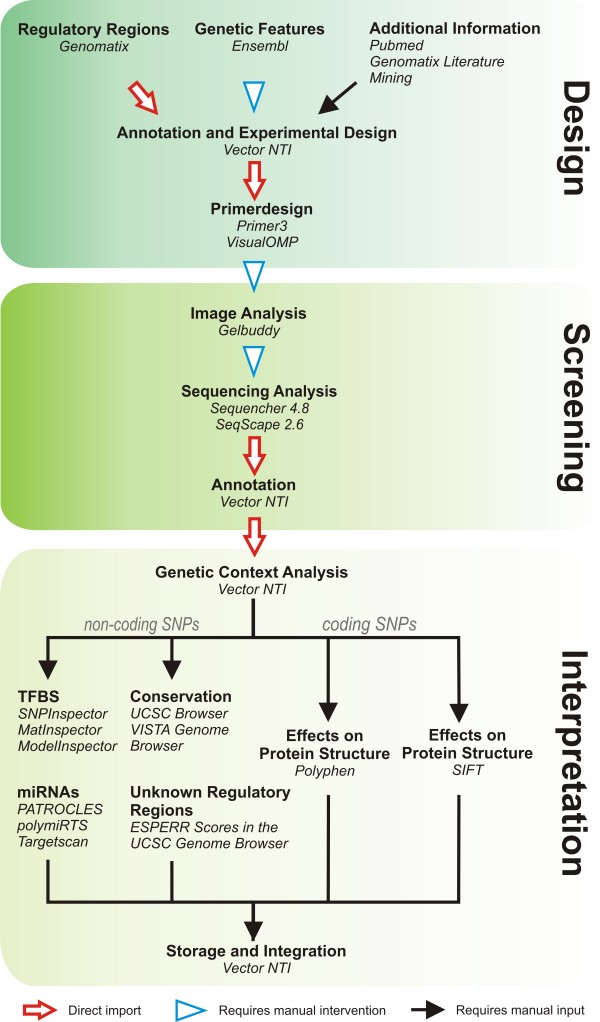
We present an optimized strategy for the design, evaluation and interpretation of Ecotilling results by integrating several mostly freely available bioinformatic tools. A major focus of our investigations was the evaluation and meaningful economical combination of these software tools for the inference of different possible regulatory functions for each newly detected mutation.
Our streamlined procedure significantly facilitates the experimental design and evaluation of Ecotilling assays and strongly improves the decision process on prioritizing the newly found SNPs for further downstream analysis.
单核苷酸多态性(SNPs)是人类基因组中最常见的遗传变异形式,在表型的遗传力中起着重要作用。特别是频率低于5%的罕见等位基因可能对复杂疾病的发展产生特别强烈的影响。通过标准DNA测序检测罕见等位基因既耗时又成本高昂。在此,我们讨论一种替代方法,即使用嵌入一系列生物信息学分析工具中的Ecotilling技术,对大量人群样本中的罕见突变进行高通量检测。Ecotilling最初作为TILLING被引入,用于筛选植物中罕见的化学诱导突变,后来被应用于人类样本,显示出在检测人类罕见等位基因方面具有出色的适用性。在没有生物信息学支持的情况下,将Ecotilling用于人类大规模突变筛查项目时,一个实际问题是缺乏快速且全面评估每个新发现变异并将其置于正确基因组背景下的解决方案。
我们通过整合几个大多免费的生物信息学工具,提出了一种优化策略,用于Ecotilling结果的设计、评估和解释。我们研究的一个主要重点是对这些软件工具进行评估并进行有意义的经济组合,以便为每个新检测到的突变推断不同的可能调控功能。
我们简化的程序显著促进了Ecotilling检测的实验设计和评估,并极大地改善了对新发现的SNP进行优先级排序以进行进一步下游分析的决策过程。