van de Sande-Bruinsma Nienke, Grundmann Hajo, Verloo Didier, Tiemersma Edine, Monen Jos, Goossens Herman, Ferech Matus
National Institute of Public Health and the Environment, Bilthoven, the Netherlands.
Emerg Infect Dis. 2008 Nov;14(11):1722-30. doi: 10.3201/eid1411.070467.
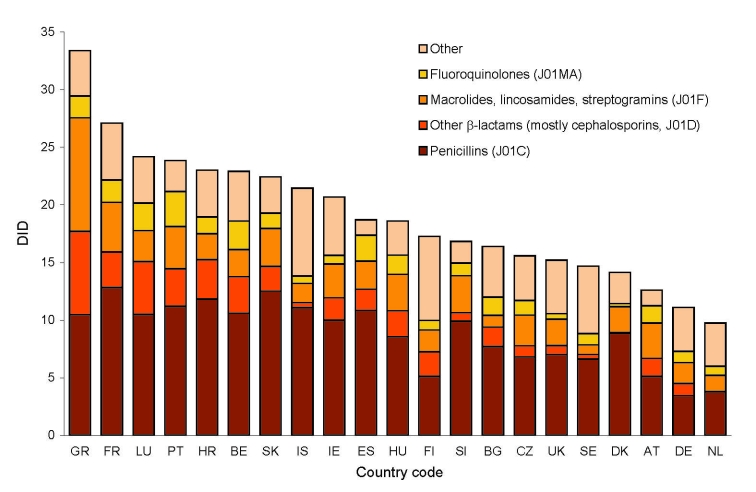
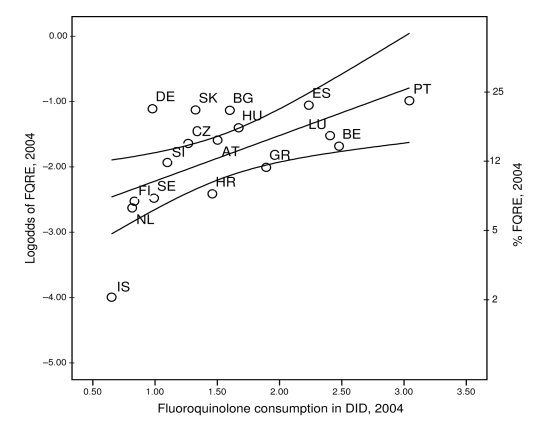
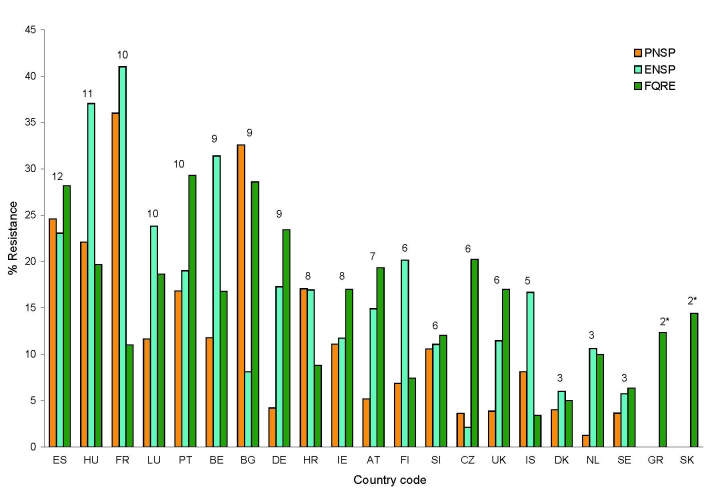
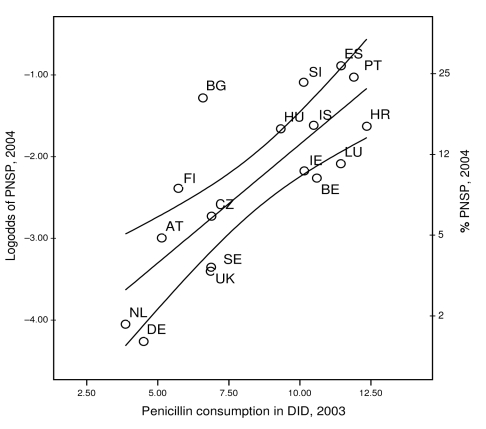
Our study confronts the use of antimicrobial agents in ambulatory care with the resistance trends of 2 major pathogens, Streptococcus pneumoniae and Escherichia coli, in 21 European countries in 2000-2005 and explores whether the notion that antimicrobial drug use determines resistance can be supported by surveillance data at national aggregation levels. The data obtained from the European Surveillance of Antimicrobial Consumption and the European Antimicrobial Resistance Surveillance System suggest that variation of consumption coincides with the occurrence of resistance at the country level. Linear regression analysis showed that the association between antimicrobial drug use and resistance was specific and robust for 2 of 3 compound pathogen combinations, stable over time, but not sensitive enough to explain all of the observed variations. Ecologic studies based on routine surveillance data indicate a relation between use and resistance and support interventions designed to reduce antimicrobial drug consumption at a national level in Europe.
我们的研究将2000 - 2005年21个欧洲国家门诊护理中抗菌药物的使用情况与两种主要病原体肺炎链球菌和大肠杆菌的耐药趋势进行了对比,并探讨了抗菌药物使用决定耐药性这一观点是否能得到国家汇总层面监测数据的支持。从欧洲抗菌药物消费监测和欧洲抗菌药物耐药性监测系统获得的数据表明,在国家层面,消费量的变化与耐药性的出现相吻合。线性回归分析显示,抗菌药物使用与耐药性之间的关联对于三种复合病原体组合中的两种是特定且稳健的,随时间稳定,但灵敏度不足以解释所有观察到的变化。基于常规监测数据的生态学研究表明了使用与耐药性之间的关系,并支持旨在减少欧洲国家层面抗菌药物消费的干预措施。