Mader Eduard, Lukas Brigitte, Novak Johannes
Institute for Applied Botany and Pharmacognosy, University of Veterinary Medicine, Veterinärplatz 1, A-1210 Vienna, Austria.
BMC Genet. 2008 Nov 3;9:69. doi: 10.1186/1471-2156-9-69.
High resolution melting curve analysis (HRM) is a technique that measures exactly the decreasing fluorescence of intercalating dye in the process of dissociation of double stranded DNA. The measurement is immediately following PCR in a one-step, closed-tube method. The shape of the melting curve depends on the GC content, length and sequence of the amplicon. Hence it is a powerful, fast and cheap method to detect Single Nucleotide Polymorphisms (SNPs) and other mutations.
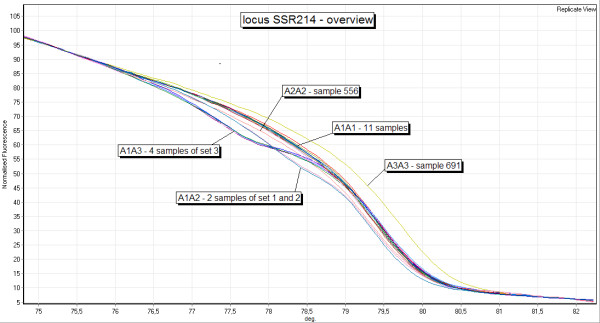
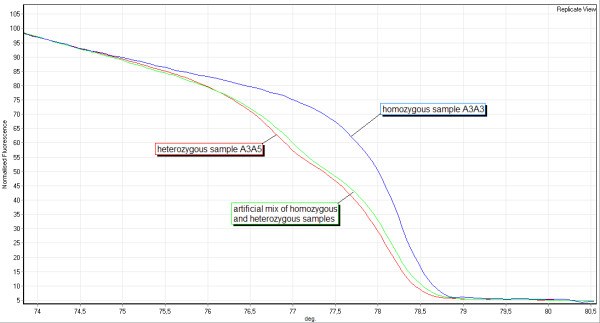
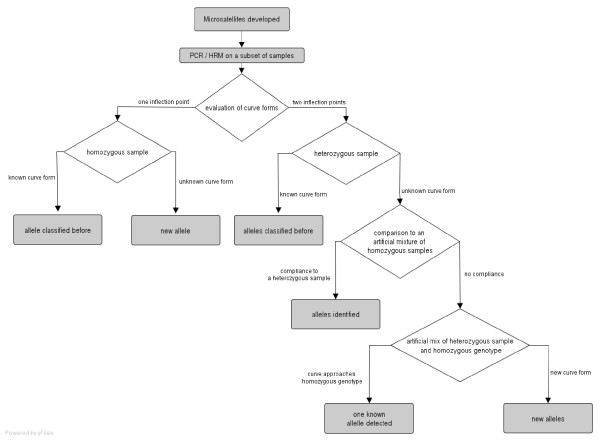
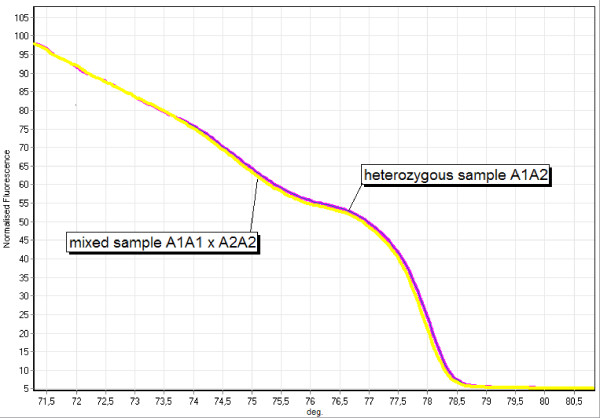
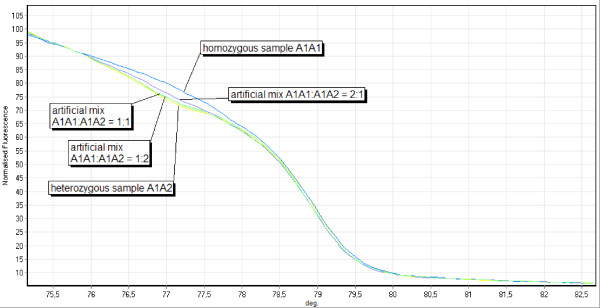
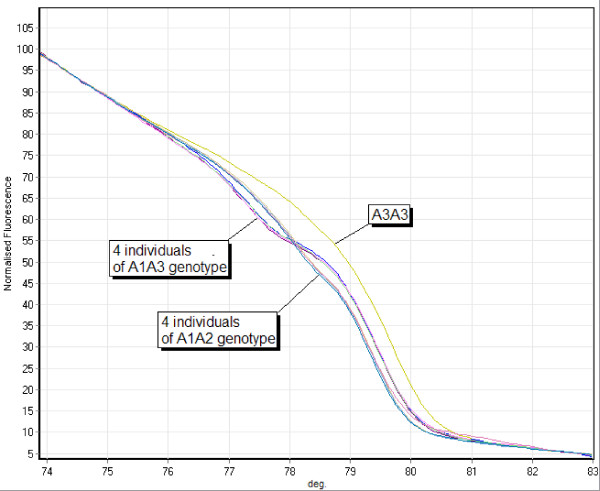
Here we present a strategy to set up microsatellite analysis for HRM including the correct assignment of heterozygous samples by comparative analysis and artificial mixtures of samples. The approach is demonstrated on two Simple Sequence Repeat (SSR) loci of different complexity in the genus Origanum. Following this strategy all alleles of our sample sets could be classified correctly.
HRM can be used in microsatellite analysis and other codominant marker systems implementing a protocol of comparative melting curve assignment with artificial mixtures of samples to overcome difficulties in correctly assigning heterozygous samples. The method is faster, more sensitive and cheaper than standard protocols for microsatellite analysis.
高分辨率熔解曲线分析(HRM)是一种在双链DNA解离过程中精确测量嵌入染料荧光衰减的技术。该测量在PCR后以一步式闭管法立即进行。熔解曲线的形状取决于扩增子的GC含量、长度和序列。因此,它是检测单核苷酸多态性(SNP)和其他突变的一种强大、快速且廉价的方法。
在此,我们提出了一种为HRM建立微卫星分析的策略,包括通过比较分析和样本人工混合对杂合样本进行正确分类。该方法在牛至属两个不同复杂程度的简单序列重复(SSR)位点上得到了验证。按照此策略,我们样本集中的所有等位基因都能被正确分类。
HRM可用于微卫星分析和其他共显性标记系统,通过采用样本人工混合的比较熔解曲线分类方案来克服正确分类杂合样本的困难。该方法比微卫星分析的标准方案更快、更灵敏且更便宜。