Chen Zhi-Hua, Kim Hong Pyo, Ryter Stefan W, Choi Augustine M K
Division of Pulmonary, Allergy and Critical Care Medicine, Department of Medicine, University of Pittsburgh, Pittsburgh, PA, USA.
Int J Chron Obstruct Pulmon Dis. 2008;3(3):359-70. doi: 10.2147/copd.s1758.
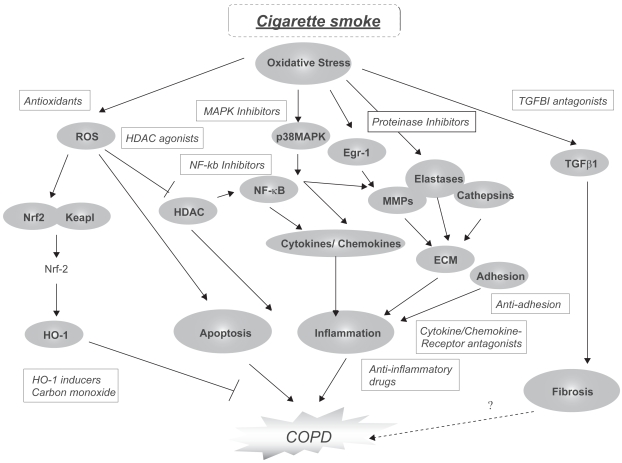
Despite the status of chronic obstructive pulmonary disease (COPD) as a major global health problem, no currently available therapies can limit COPD progression. Therefore, an urgent need exists for the development of new and effective treatments for COPD. An improved understanding in the molecular pathogenesis of COPD can potentially identify molecular targets to facilitate the development of new therapeutic modalities. Among the best approaches for understanding the molecular basis of COPD include gene expression profiling techniques, such as serial analysis of gene expression or microarrays. Using these methods, recent studies have mapped comparative gene expression profiles of lung tissues from patients with different stages of COPD relative to healthy smokers or non-smokers. Such studies have revealed a number of differentially-regulated genes associated with COPD progression, which include genes involved in the regulation of inflammation, extracellular matrix, cytokines, chemokines, apoptosis, and stress responses. These studies have shed new light on the molecular mechanisms of COPD, and suggest novel targets for clinical treatments.
尽管慢性阻塞性肺疾病(COPD)是一个重大的全球健康问题,但目前尚无可用疗法能够限制COPD的进展。因此,迫切需要开发针对COPD的新型有效治疗方法。对COPD分子发病机制的深入了解可能有助于确定分子靶点,从而推动新治疗方法的开发。了解COPD分子基础的最佳方法之一包括基因表达谱分析技术,如基因表达序列分析或微阵列技术。利用这些方法,最近的研究绘制了COPD不同阶段患者肺组织相对于健康吸烟者或非吸烟者的比较基因表达谱。此类研究揭示了许多与COPD进展相关的差异调节基因,包括参与炎症调节、细胞外基质、细胞因子、趋化因子、细胞凋亡和应激反应的基因。这些研究为COPD的分子机制提供了新的见解,并为临床治疗提出了新的靶点。