Nickol Annabel H, Hart Nicholas, Hopkinson Nicholas S, Hamnegård Carl-Hugo, Moxham John, Simonds Anita, Polkey Michael I
Respiratory Muscle Laboratory, Royal Brompton Hospital, London, UK.
Int J Chron Obstruct Pulmon Dis. 2008;3(3):453-62. doi: 10.2147/copd.s2705.
Noninvasive ventilation (NIV) improves gas-exchange and symptoms in selected chronic obstructive pulmonary disease (COPD) patients with hypercapnic respiratory failure. We hypothesized NIV reverses respiratory failure by one or all of increased ventilatory response to carbon-dioxide, reduced respiratory muscle fatigue, or improved pulmonary mechanics.
Nineteen stable COPD patients (forced expiratory volume in one second 35% predicted) were studied at baseline (DO), 5-8 days (D5) and 3 months (3M) after starting NIV.
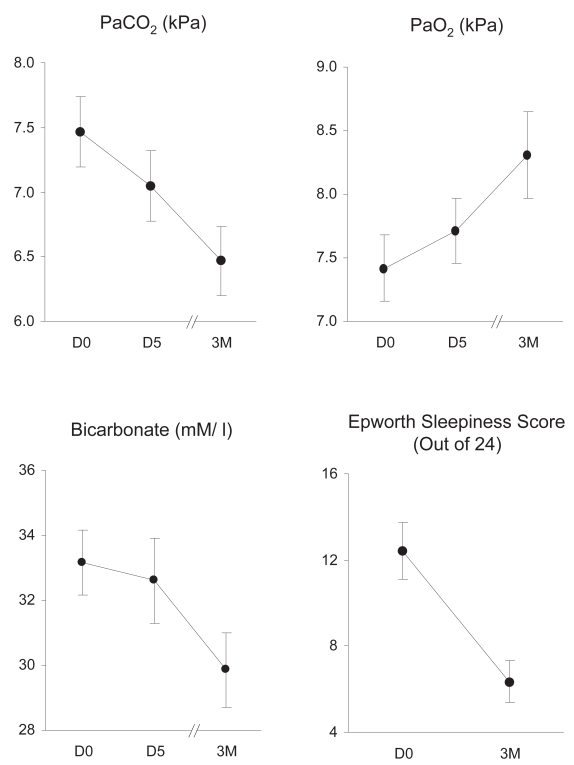
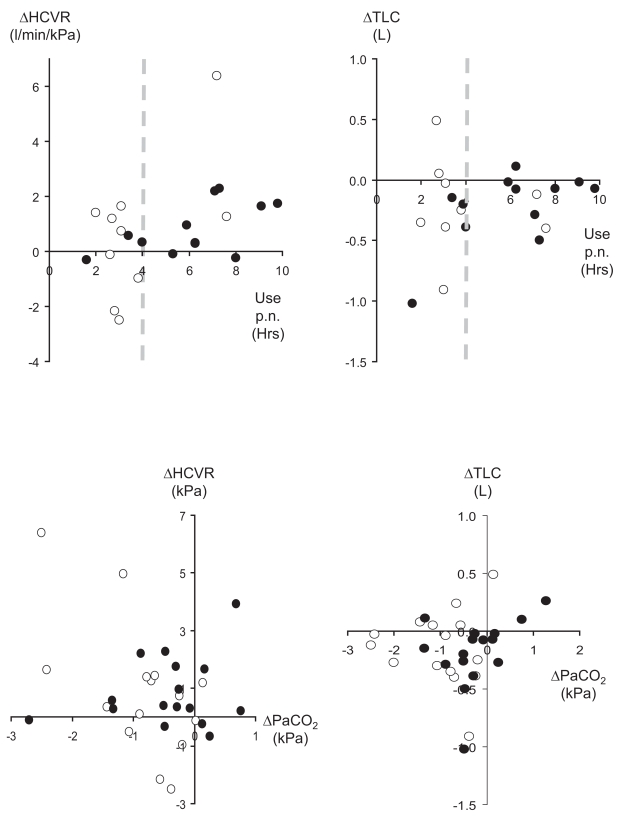
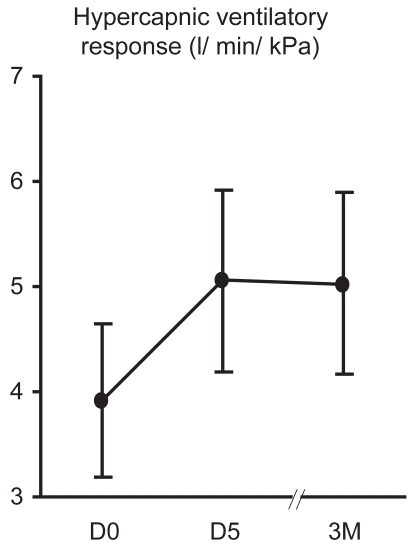
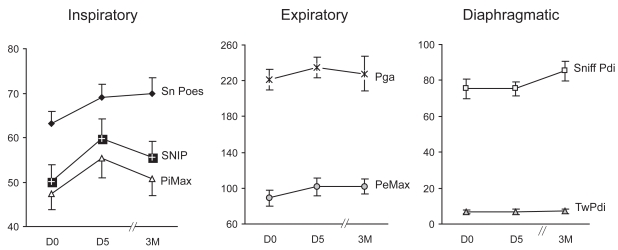
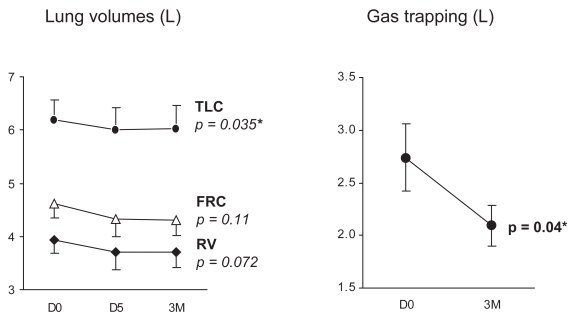
Ventilator use was 6.2 (3.7) hours per night at D5 and 3.4 (1.6) at 3M (p = 0.12). Mean (SD) daytime arterial carbon-dioxide tension (PaCO2) was reduced from 7.4 (1.2) kPa to 7.0 (1.1) kPa at D5 and 6.5 (1.1) kPa at 3M (p = 0.001). Total lung capacity decreased from 107 (28) % predicted to 103 (28) at D5 and 103 (27) % predicted at 3M (p = 0.035). At D5 there was an increase in the hypercapnic ventilatory response and some volitional measures of inspiratory and expiratory muscle strength, but not isolated diaphragmatic strength whether assessed by volitional or nonvolitional methods.
These findings suggest decreased gas trapping and increased ventilatory sensitivity to CO2 are the principal mechanism underlying improvements in gas-exchange in patients with COPD following NIV. Changes in some volitional but not nonvolitional muscle strength measures may reflect improved patient effort.
无创通气(NIV)可改善部分患有高碳酸血症呼吸衰竭的慢性阻塞性肺疾病(COPD)患者的气体交换及症状。我们推测NIV通过对二氧化碳的通气反应增加、呼吸肌疲劳减轻或肺力学改善中的一种或全部来逆转呼吸衰竭。
对19例稳定期COPD患者(一秒用力呼气容积占预计值的35%)在开始NIV后的基线期(DO)、5 - 8天(D5)和3个月(3M)进行研究。
D5时每晚呼吸机使用时间为6.2(3.7)小时,3M时为3.4(1.6)小时(p = 0.12)。平均(标准差)日间动脉血二氧化碳分压(PaCO2)在D5时从7.4(1.2)kPa降至7.0(1.1)kPa,在3M时为6.5(1.1)kPa(p = 0.001)。肺总量从预计值的107(28)%降至D5时的103(28)%,3M时为预计值的103(27)%(p = 0.035)。在D5时,对高碳酸血症的通气反应增加,吸气和呼气肌力量的一些自主测量指标也有所增加,但无论是通过自主还是非自主方法评估,单独的膈肌力量均未增加。
这些发现表明,气体潴留减少和对CO2的通气敏感性增加是COPD患者接受NIV后气体交换改善的主要机制。一些自主而非非自主肌肉力量测量指标的变化可能反映了患者努力程度的改善。