Molfino Nestor A, Coyle Anthony J
MedImmune, Gaithersburg, MD 20878, USA.
Int J Chron Obstruct Pulmon Dis. 2008;3(3):491-7. doi: 10.2147/copd.s2528.
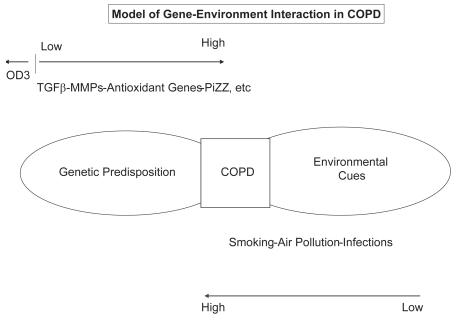
Chronic obstructive pulmonary disease (COPD) is one of the leading causes of death throughout the world and is largely associated with cigarette smoking. Despite the appreciation of the central role of smoking in the development of COPD, only a relatively small number of smokers (15%-20%) develop COPD. Recent studies depicting familial aggregation suggest that some subjects may have a genetic predisposition to developing COPD. In this respect, a number of single nucleotide polymorphisms have been reported in association with different COPD features (subphenotypes), although much of this data remains controversial. Classical genetic studies (including twin and family studies) assume an "equal-environment" scenario, but as gene-environment interactions occur in COPD, this assumption needs revision. Thus, new integrated models are needed to examine the major environmental factors associated with COPD which include smoking as well as air pollution, and respiratory infections, and not only genetic predisposition. Revisiting this area, may help answer the question of what has more bearing in the pathogenesis of COPD--the environment or the genomic sequence of the affected subjects. It is anticipated that an improved understanding of this interaction will both enable improved identification of individuals susceptible to developing this disease, as well as improved future treatments for this disease.
慢性阻塞性肺疾病(COPD)是全球主要死因之一,且在很大程度上与吸烟相关。尽管人们认识到吸烟在COPD发病过程中的核心作用,但只有相对少数的吸烟者(15%-20%)会患上COPD。最近描述家族聚集性的研究表明,一些个体可能具有患COPD的遗传易感性。在这方面,已有多项单核苷酸多态性被报道与不同的COPD特征(亚表型)相关,尽管其中许多数据仍存在争议。经典的遗传学研究(包括双胞胎和家族研究)假定处于“同等环境”的情况,但由于COPD存在基因-环境相互作用,这一假设需要修正。因此,需要新的综合模型来研究与COPD相关的主要环境因素,这些因素包括吸烟、空气污染和呼吸道感染,而不仅仅是遗传易感性。重新审视这一领域,可能有助于回答在COPD发病机制中哪个因素更具影响——环境还是患病个体的基因组序列。预计对这种相互作用的更好理解将既能改善对易患该病个体的识别,也能改善该病未来的治疗方法。