Leurs Mariken T W, Mur-Veeman Ingrid M, van der Sar Rosalie, Schaalma Herman P, de Vries Nanne K
Youth Department, Netherlands Organization for Health Research and Development, PO Box 93245; 2509 AE The Hague, The Netherlands.
BMC Public Health. 2008 Nov 7;8:382. doi: 10.1186/1471-2458-8-382.
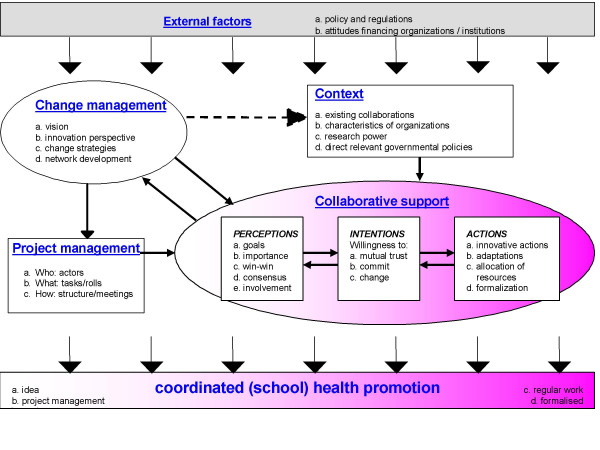
Collaborations are important to health promotion in addressing multi-party problems. Interest in collaborative processes in health promotion is rising, but still lacks monitoring instruments. The authors developed the DIagnosis of Sustainable Collaboration (DISC) model to enable comprehensive monitoring of public health collaboratives. The model focuses on opportunities and impediments for collaborative change, based on evidence from interorganizational collaboration, organizational behavior and planned organizational change. To illustrate and assess the DISC-model, the 2003/2004 application of the model to the Dutch whole-school health promotion collaboration is described.
The study combined quantitative research, using a cross-sectional survey, with qualitative research using the personal interview methodology and document analysis. A DISC-based survey was sent to 55 stakeholders in whole-school health promotion in one Dutch region. The survey consisted of 22 scales with 3 to 8 items. Only scales with a reliability score of 0.60 were accepted. The analysis provided for comparisons between stakeholders from education, public service and public health.The survey was followed by approaching 14 stakeholders for a semi-structured DISC-based interview. As the interviews were timed after the survey, the interviews were used to clarify unexpected and unclear outcomes of the survey as well.Additionally, a DISC-based document analysis was conducted including minutes of meetings, project descriptions and correspondence with schools and municipalities.
Response of the survey was 77% and of the interviews 86%. Significant differences between respondents of different domains were found for the following scales: organizational characteristics scale, the change strategies, network development, project management, willingness to commit and innovative actions and adaptations. The interviews provided a more specific picture of the state of the art of the studied collaboration regarding the DISC-constructs.
The DISC-model is more than just the sum of the different parameters provided in the literature on interorganizational collaboration, organization change, networking and setting-approaches. Monitoring a collaboration based on the DISC-model yields insight into windows of opportunity and current impediments for collaborative change. DISC-based monitoring is a promising strategy enabling project managers and social entrepreneurs to plan change management strategies systematically.
合作对于解决多方问题的健康促进至关重要。健康促进领域对合作过程的兴趣日益浓厚,但仍缺乏监测工具。作者开发了可持续合作诊断(DISC)模型,以全面监测公共卫生合作。该模型基于组织间合作、组织行为和有计划的组织变革的证据,关注合作变革的机遇和障碍。为了说明和评估DISC模型,本文描述了该模型在2003/2004年荷兰全校健康促进合作中的应用情况。
本研究将使用横断面调查的定量研究与采用个人访谈方法和文档分析的定性研究相结合。向荷兰一个地区全校健康促进领域的55名利益相关者发送了基于DISC的调查问卷。该问卷由22个量表组成,每个量表包含3至8个项目。仅接受信度得分在0.60及以上的量表。分析用于比较教育、公共服务和公共卫生领域的利益相关者。调查之后,对14名利益相关者进行了基于DISC的半结构化访谈。由于访谈在调查之后进行,因此访谈也用于澄清调查中意外和不明确的结果。此外,还进行了基于DISC的文档分析,包括会议记录、项目描述以及与学校和市政当局的通信。
调查的回复率为77%,访谈的回复率为86%。在以下量表上发现不同领域的受访者之间存在显著差异:组织特征量表、变革策略、网络发展、项目管理、承诺意愿以及创新行动与适应。访谈提供了关于所研究合作在DISC结构方面的更具体的现状描述。
DISC模型不仅仅是组织间合作、组织变革、网络建设和环境方法等文献中提供的不同参数的总和。基于DISC模型对合作进行监测,可以洞察合作变革的机遇之窗和当前障碍。基于DISC的监测是一种有前景的策略,能使项目经理和社会企业家系统地规划变革管理策略。