Schempf Ashley, Strobino Donna, O'Campo Patricia
Population, Family and Reproductive Health, Johns Hopkins Bloomberg School of Public Health, 615 N. Wolfe St., Baltimore, MD 21205, USA.
Soc Sci Med. 2009 Jan;68(1):100-10. doi: 10.1016/j.socscimed.2008.10.006. Epub 2008 Nov 6.
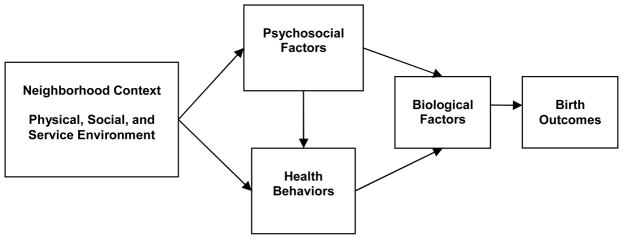
Neighborhood characteristics have been proposed to influence birth outcomes through psychosocial and behavioral pathways, yet empirical evidence is lacking. Using data from an urban, low-income sample, this study examined the impact of the neighborhood environment on birthweight and evaluated mediation by psychosocial and behavioral factors. The sample included 726 women who delivered a live birth at Johns Hopkins Hospital in Baltimore, Maryland, USA between 1995 and 1996. Census-tract data were used to create a principal component index of neighborhood risk based on racial and economic stratification (% Black, % poverty), social disorder (violent crime rate), and physical deterioration (% boarded-up housing) (alpha=0.82). Information on sociodemographic, psychosocial, and behavioral factors was gathered from a postpartum interview and medical records. Random intercept multilevel models were used to estimate neighborhood effects and assess potential mediation. Controlling for sociodemographic characteristics, a standard deviation increase in neighborhood risk conferred a 76g birthweight decrement. This represents an approximate 300g difference between the best and worst neighborhoods. Although stress (daily hassles), perceived locus-of-control, and social support were related to birthweight, their adjustment reduced the neighborhood coefficient by only 12%. In contrast, the neighborhood effect was reduced by an additional 30% and was no longer statistically significant after adjustment for the behavioral factors of smoking, drug use, and delayed prenatal care. These findings suggest that neighborhood factors may influence birthweight by shaping maternal behavioral risks. Thus, neighborhood level interventions should be considered to address multiple maternal and infant health risks. Future studies should examine more direct measures of neighborhood stress, such as perceived neighborhood disorder, and evaluate alternative mechanisms by which neighborhood factors influence behavior (e.g., social norms and access to goods and services).
有人提出邻里特征会通过心理社会和行为途径影响出生结局,但缺乏实证证据。本研究利用来自城市低收入样本的数据,考察了邻里环境对出生体重的影响,并评估了心理社会和行为因素的中介作用。样本包括1995年至1996年期间在美国马里兰州巴尔的摩市约翰·霍普金斯医院分娩活产儿的726名妇女。人口普查区数据用于根据种族和经济分层(黑人百分比、贫困百分比)、社会混乱(暴力犯罪率)和物质恶化(废弃房屋百分比)创建邻里风险主成分指数(α=0.82)。从产后访谈和病历中收集社会人口学、心理社会和行为因素的信息。使用随机截距多级模型来估计邻里效应并评估潜在的中介作用。在控制社会人口学特征的情况下,邻里风险标准差增加会导致出生体重下降76克。这代表了最佳和最差邻里之间约300克的差异。尽管压力(日常烦恼)、感知控制源和社会支持与出生体重有关,但对它们进行调整后,邻里系数仅降低了12%。相比之下,在对吸烟、吸毒和产前护理延迟等行为因素进行调整后,邻里效应又降低了30%,且不再具有统计学意义。这些发现表明,邻里因素可能通过塑造母亲的行为风险来影响出生体重。因此,应考虑采取邻里层面的干预措施来应对多种母婴健康风险。未来的研究应考察邻里压力的更直接测量方法,如感知到的邻里混乱,并评估邻里因素影响行为的其他机制(如社会规范以及商品和服务的可及性)。