Greenberg Joshua I, Shields David J, Barillas Samuel G, Acevedo Lisette M, Murphy Eric, Huang Jianhua, Scheppke Lea, Stockmann Christian, Johnson Randall S, Angle Niren, Cheresh David A
Department of Surgery, School of Medicine, Moore's UCSD Cancer Center, USA.
Nature. 2008 Dec 11;456(7223):809-13. doi: 10.1038/nature07424. Epub 2008 Nov 9.
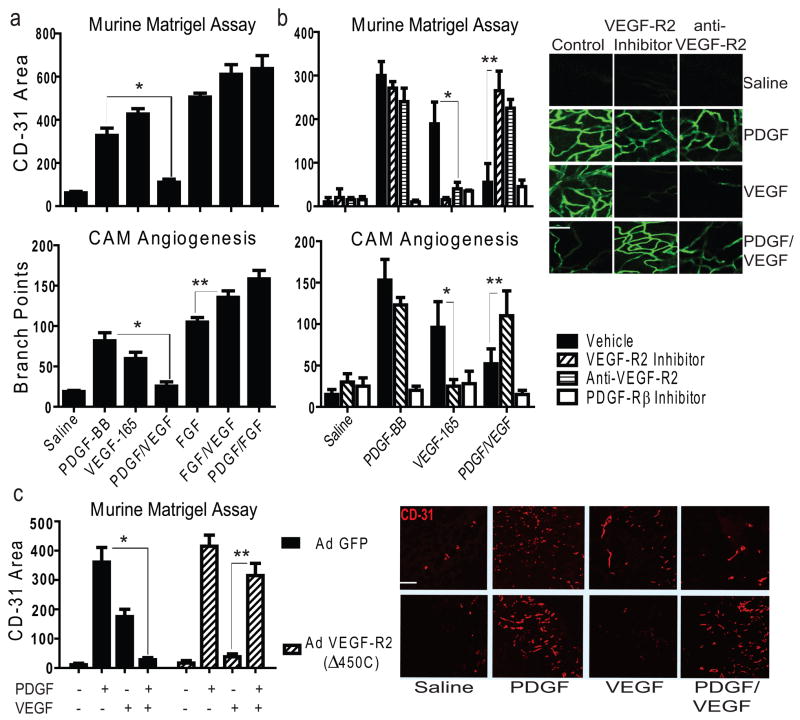
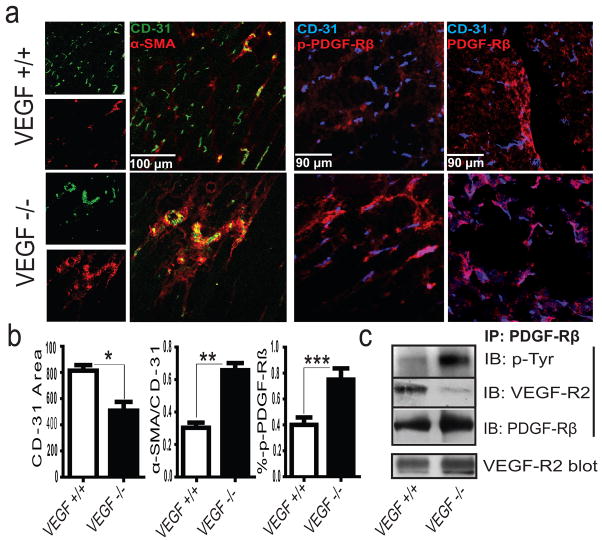
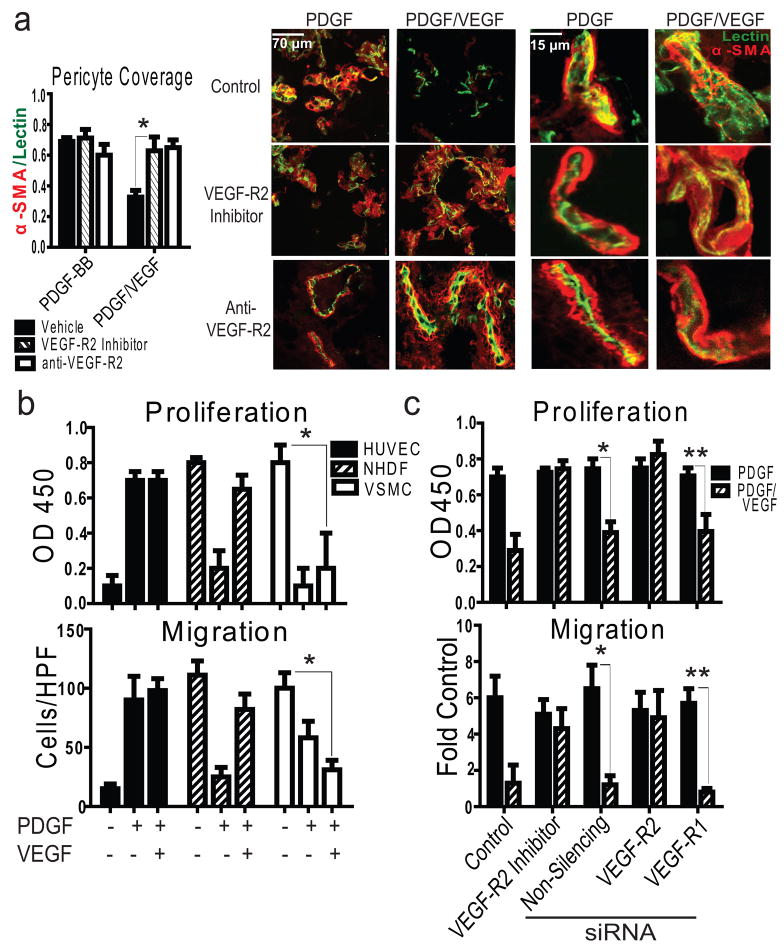
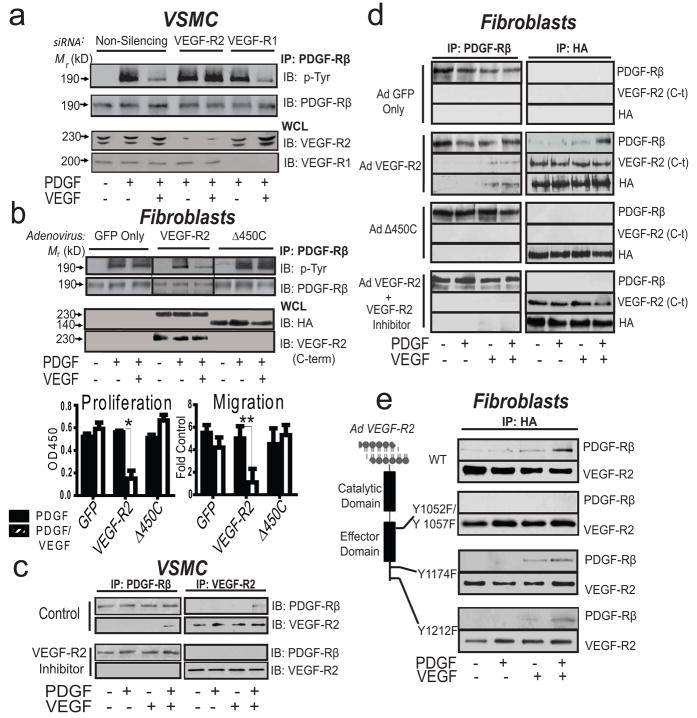
Angiogenesis does not only depend on endothelial cell invasion and proliferation: it also requires pericyte coverage of vascular sprouts for vessel stabilization. These processes are coordinated by vascular endothelial growth factor (VEGF) and platelet-derived growth factor (PDGF) through their cognate receptors on endothelial cells and vascular smooth muscle cells (VSMCs), respectively. PDGF induces neovascularization by priming VSMCs/pericytes to release pro-angiogenic mediators. Although VEGF directly stimulates endothelial cell proliferation and migration, its role in pericyte biology is less clear. Here we define a role for VEGF as an inhibitor of neovascularization on the basis of its capacity to disrupt VSMC function. Specifically, under conditions of PDGF-mediated angiogenesis, VEGF ablates pericyte coverage of nascent vascular sprouts, leading to vessel destabilization. At the molecular level, VEGF-mediated activation of VEGF-R2 suppresses PDGF-Rbeta signalling in VSMCs through the assembly of a previously undescribed receptor complex consisting of PDGF-Rbeta and VEGF-R2. Inhibition of VEGF-R2 not only prevents assembly of this receptor complex but also restores angiogenesis in tissues exposed to both VEGF and PDGF. Finally, genetic deletion of tumour cell VEGF disrupts PDGF-Rbeta/VEGF-R2 complex formation and increases tumour vessel maturation. These findings underscore the importance of VSMCs/pericytes in neovascularization and reveal a dichotomous role for VEGF and VEGF-R2 signalling as both a promoter of endothelial cell function and a negative regulator of VSMCs and vessel maturation.
它还需要周细胞覆盖血管芽以稳定血管。这些过程由血管内皮生长因子(VEGF)和血小板衍生生长因子(PDGF)分别通过它们在内皮细胞和血管平滑肌细胞(VSMC)上的同源受体进行协调。PDGF通过促使VSMC/周细胞释放促血管生成介质来诱导新血管形成。尽管VEGF直接刺激内皮细胞增殖和迁移,但其在周细胞生物学中的作用尚不清楚。在此,我们基于VEGF破坏VSMC功能的能力,确定其作为新血管形成抑制剂的作用。具体而言,在PDGF介导的血管生成条件下,VEGF消除新生血管芽的周细胞覆盖,导致血管不稳定。在分子水平上,VEGF介导的VEGF-R2激活通过由PDGF-Rβ和VEGF-R2组成的先前未描述的受体复合物的组装,抑制VSMC中的PDGF-Rβ信号传导。抑制VEGF-R2不仅可防止该受体复合物的组装,还可恢复暴露于VEGF和PDGF的组织中的血管生成。最后,肿瘤细胞VEGF的基因缺失破坏了PDGF-Rβ/VEGF-R2复合物的形成并增加了肿瘤血管的成熟。这些发现强调了VSMC/周细胞在新血管形成中的重要性,并揭示了VEGF和VEGF-R2信号传导作为内皮细胞功能促进剂以及VSMC和血管成熟负调节剂的双重作用。