Rosenbluth Jennifer M, Pietenpol Jennifer A
Department of Biochemistry, Center in Molecular Toxicology, Vanderbilt-Ingram Cancer Center, Vanderbilt University School of Medicine, Nashville, TN 37232, USA.
Autophagy. 2009 Jan;5(1):114-6. doi: 10.4161/auto.5.1.7294. Epub 2009 Jan 30.
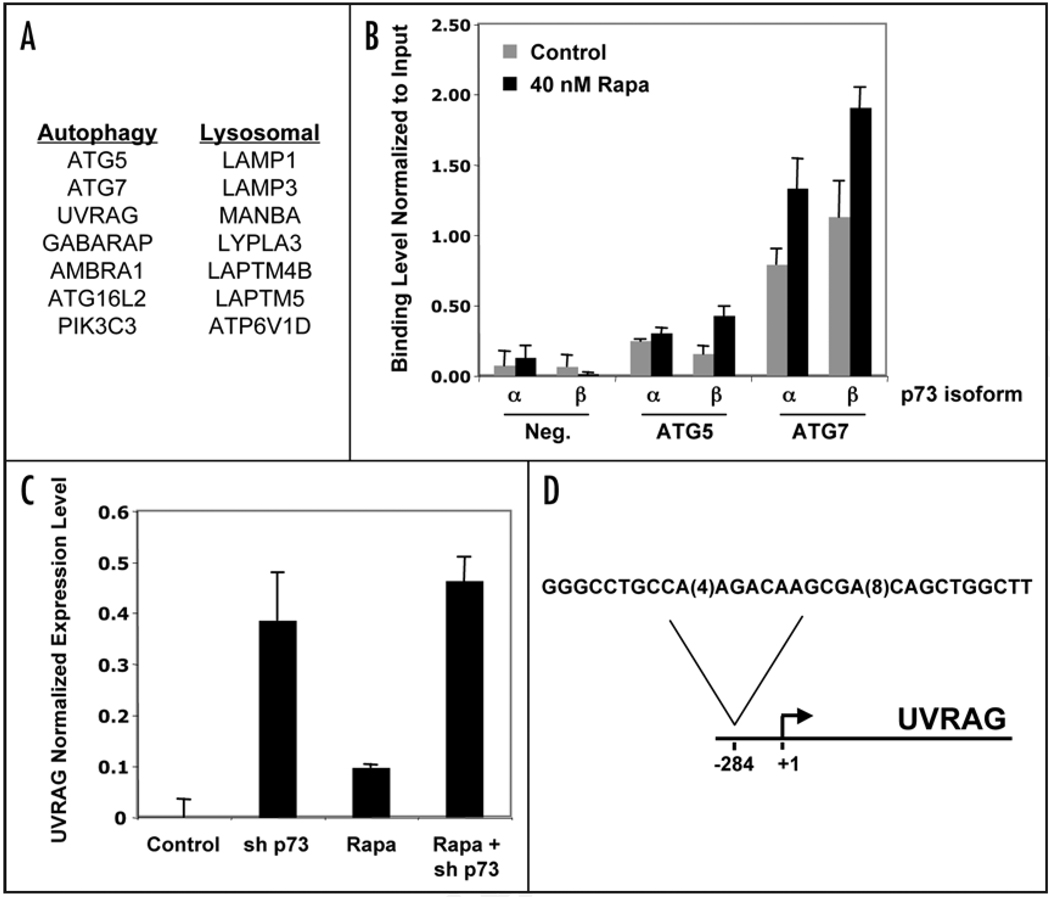
The p53 family consists of three transcription factors, p53, p63 and p73 that share domain architecture and sequence identity. The mTOR (mammalian target of rapamycin) kinase responds to growth factors and nutrient levels to regulate cellular growth and autophagy. Whereas p53 acts both upstream and downstream of mTOR, gene signature-based analyses have revealed that p73 is inhibited by mTOR activity. p53 can both activate and repress autophagy levels depending on cellular context. While less is known about p73, recent studies have shown that it induces cellular autophagy and multiple autophagy-associated genes downstream of mTOR. Chromatin immunoprecipitation analyses demonstrate that endogenous p73 binds the regulatory regions of genes such as ATG5, ATG7 and UVRAG. How p73 regulates the expression levels of these genes in response to different cellular stresses remains unknown. Because p53 family members play key roles in tumor suppression, development, aging and neurodegeneration, the context and manner by which these transcription factors regulate autophagy may have implications for a wide range of human diseases.
p53家族由p53、p63和p73这三种转录因子组成,它们具有共同的结构域结构和序列同源性。mTOR(哺乳动物雷帕霉素靶蛋白)激酶对生长因子和营养水平作出反应,以调节细胞生长和自噬。虽然p53在mTOR的上游和下游均发挥作用,但基于基因特征的分析表明,p73受到mTOR活性的抑制。p53可根据细胞环境激活或抑制自噬水平。虽然对p73的了解较少,但最近的研究表明,它在mTOR下游诱导细胞自噬和多个自噬相关基因。染色质免疫沉淀分析表明,内源性p73结合ATG5、ATG7和UVRAG等基因的调控区域。p73如何响应不同的细胞应激来调节这些基因的表达水平仍不清楚。由于p53家族成员在肿瘤抑制、发育、衰老和神经退行性变中发挥关键作用, 这些转录因子调节自噬的背景和方式可能与多种人类疾病有关。