Cheng Jian, Hu Weidong, Toung Thomas J, Zhang Zhizheng, Parker Susan M, Roselli Charles E, Hurn Patricia D
Department of Anesthesiology and Peri-Operative Medicine, Oregon Health and Science University, Portland, Oregon 97239-3098, USA.
J Cereb Blood Flow Metab. 2009 Mar;29(3):486-94. doi: 10.1038/jcbfm.2008.138. Epub 2008 Nov 12.
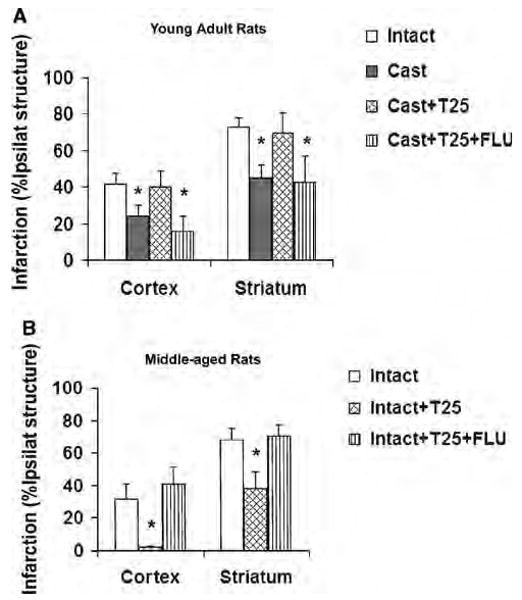
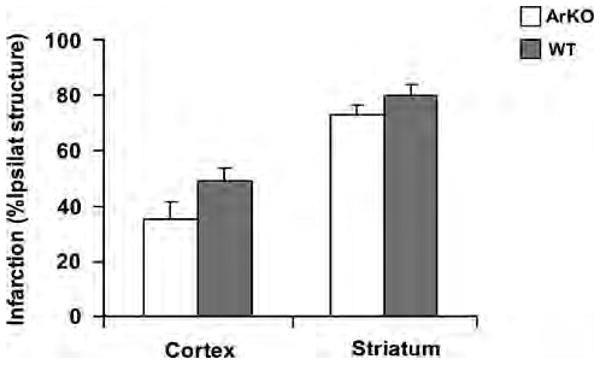
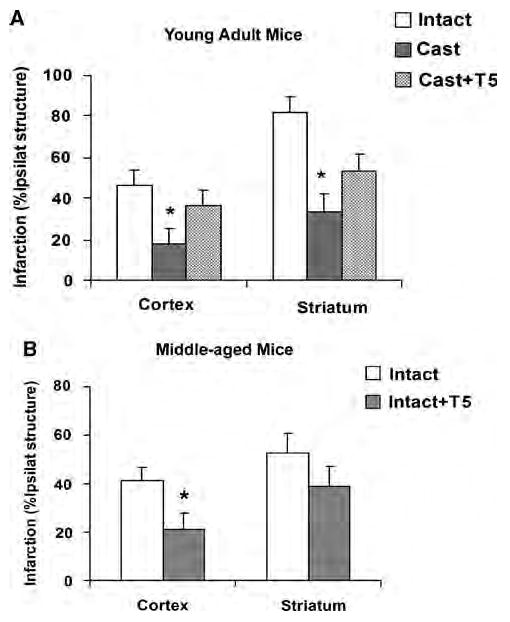
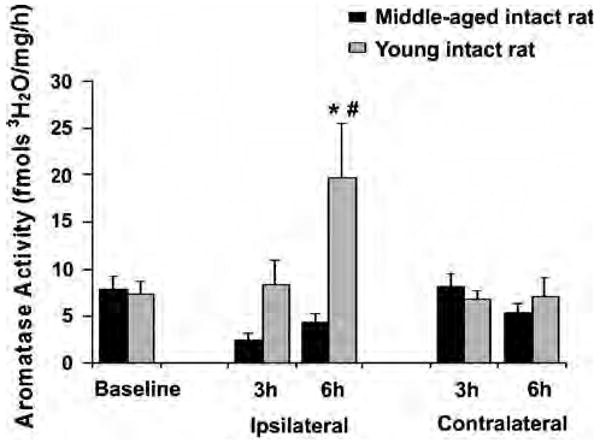
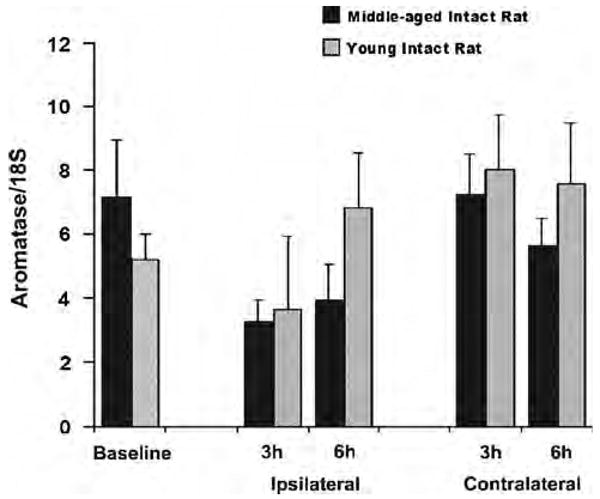
Although male sex is a well-recognized risk factor for stroke, the role of androgens in cerebral ischemia remains unclear. Therefore, we evaluated effects of testosterone on infarct size in both young adult and middle-aged rats (Wistar, 3-month versus 14-month old) and mice (C57/BL6, 3-month versus 12-month old) subjected to middle cerebral artery occlusion. In young adult groups, castrates displayed less ischemic damage as compared with intact males and castrates with testosterone replacement (Cortex: 24% in castrates versus 42% in intact versus 40% with testosterone; Striatum: 45% versus 73% versus 70%) at 22 h reperfusion. Surprisingly, supplementing testosterone in middle-aged rats to the physiologic levels ordinarily seen in young males reduced infarction (Cortex: 2% with testosterone versus 31%; Striatum: 38% with testosterone versus 68%). Testosterone effects on infarct size were blocked by the androgen receptor (AR) antagonist flutamide and further confirmed in young versus middle-aged mice. Baseline cerebral aromatase mRNA levels and activity were not different between young and middle-aged rats. Aromatase activity increased in ischemic tissue, but only in young males. Lastly, stroke damage was not different in aging aromatase knockout mice versus wild-type controls. Our findings indicate that testosterone's effects in experimental stroke are age dependent, mediated via AR, but not cerebral aromatase.
虽然男性是公认的中风风险因素,但雄激素在脑缺血中的作用仍不清楚。因此,我们评估了睾酮对成年和中年大鼠(Wistar大鼠,3个月和14个月大)以及小鼠(C57/BL6小鼠,3个月和12个月大)大脑中动脉闭塞后梗死灶大小的影响。在成年组中,去势大鼠在再灌注22小时时显示出比完整雄性大鼠和接受睾酮替代的去势大鼠更少的缺血损伤(皮质:去势大鼠为24%,完整雄性大鼠为42%,睾酮替代组为40%;纹状体:分别为45%、73%和70%)。令人惊讶的是,在中年大鼠中补充睾酮至年轻雄性大鼠通常所见的生理水平可减少梗死(皮质:睾酮组为2%,对照组为31%;纹状体:睾酮组为38%,对照组为68%)。雄激素受体(AR)拮抗剂氟他胺可阻断睾酮对梗死灶大小的影响,并在年轻和中年小鼠中得到进一步证实。年轻和中年大鼠的基线脑芳香化酶mRNA水平和活性没有差异。缺血组织中的芳香化酶活性增加,但仅在年轻雄性大鼠中增加。最后,衰老的芳香化酶基因敲除小鼠与野生型对照相比,中风损伤没有差异。我们的研究结果表明,睾酮在实验性中风中的作用是年龄依赖性的,通过AR介导,但不通过脑芳香化酶。