Ortega Martinez de Victoria Emilio, Xu Xiaoyuan, Koska Juraj, Francisco Ann Marie, Scalise Michael, Ferrante Anthony W, Krakoff Jonathan
Phoenix Epidemiology and Clinical Research Branch, National Institute of Diabetes and Digestive and Kidney Diseases, National Institutes of Health, Department of Health and Human Services, Phoenix, Arizona, USA.
Diabetes. 2009 Feb;58(2):385-93. doi: 10.2337/db08-0536. Epub 2008 Nov 13.
In severely obese individuals and patients with diabetes, accumulation and activation of macrophages in adipose tissue has been implicated in the development of obesity-associated complications, including insulin resistance. We sought to determine whether in a healthy population, adiposity, sex, age, or insulin action is associated with adipose tissue macrophage content (ATMc) and/or markers of macrophage activation.
Subcutaneous ATMc from young adult Pima Indians with a wide range of adiposity (13-46% body fat, by whole-body dual-energy X-ray absorptiometry) and insulin action (glucose disposal rate 1.6-9 mg/kg estimated metabolic body size/min, by glucose clamp) were measured. We also measured expression in adipose tissue of factors implicated in macrophage recruitment and activation to determine any association with ATMc and insulin action.
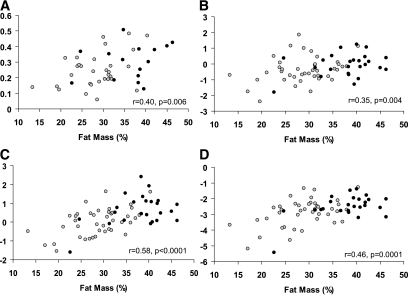
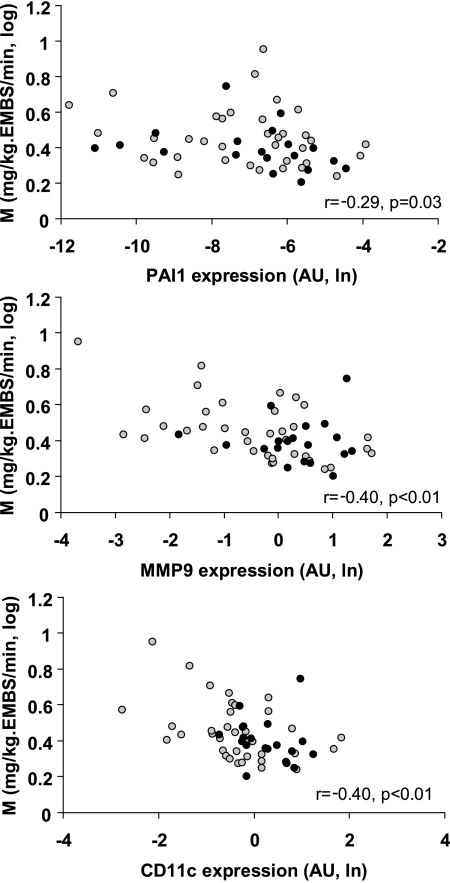
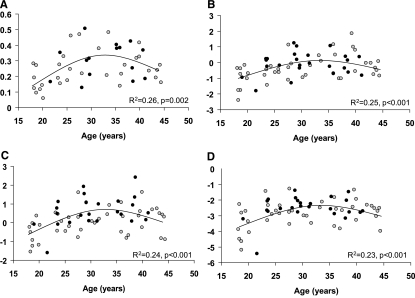
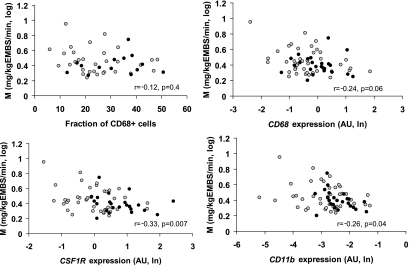
ATMc, as assessed by immunohistochemistry (Mphi) and by macrophage-specific gene expression (CD68, CD11b, and CSF1R), were correlated with percent body fat, age, and female sex. Gene expression of CD68, CD11b, and CSF1R but not Mphi was correlated negatively with glucose disposal rate but not after adjustment for percent body fat, age, and sex. However, adipose tissue expression of plasminogen activator inhibitor type-1 (PAI-1) and CD11 antigen-like family member C (CD11c), markers produced by macrophages, were negatively correlated with adjusted glucose disposal rate (r = -0.28, P = 0.05 and r = -0.31, P = 0.03).
ATMc is correlated with age and adiposity but not with insulin action independent of adiposity in healthy human subjects. However, PAI-1 and CD11c expression are independent predictors of insulin action, indicating a possible role for adipose tissue macrophage activation.
在重度肥胖个体和糖尿病患者中,脂肪组织中巨噬细胞的积聚和活化与肥胖相关并发症(包括胰岛素抵抗)的发生有关。我们试图确定在健康人群中,肥胖、性别、年龄或胰岛素作用是否与脂肪组织巨噬细胞含量(ATMc)和/或巨噬细胞活化标志物相关。
测量了年轻成年皮马印第安人的皮下ATMc,这些人具有广泛的肥胖程度(通过全身双能X线吸收法测量,体脂率为13 - 46%)和胰岛素作用(通过葡萄糖钳夹法测量,葡萄糖处置率为1.6 - 9 mg/kg估计代谢体重/分钟)。我们还测量了脂肪组织中与巨噬细胞募集和活化相关的因子的表达,以确定其与ATMc和胰岛素作用的任何关联。
通过免疫组织化学(Mphi)和巨噬细胞特异性基因表达(CD68、CD11b和CSF1R)评估的ATMc与体脂百分比、年龄和女性性别相关。CD68、CD11b和CSF1R的基因表达而非Mphi与葡萄糖处置率呈负相关,但在调整体脂百分比、年龄和性别后则无相关性。然而,巨噬细胞产生的标志物纤溶酶原激活物抑制剂1型(PAI - 1)和CD11抗原样家族成员C(CD11c)在脂肪组织中的表达与调整后的葡萄糖处置率呈负相关(r = -0.28,P = 0.05;r = -0.31,P = 0.03)。
在健康人类受试者中,ATMc与年龄和肥胖相关,但与独立于肥胖的胰岛素作用无关。然而,PAI - 1和CD11c的表达是胰岛素作用的独立预测因子,表示脂肪组织巨噬细胞活化可能起作用。