Jeong Hyo-Jin, Chenu David, Johnson Emma E, Connor Mark, Vaughan Christopher W
Pain Management Research Institute, Kolling Institute of Medical Research, Northern Clinical School, The University of Sydney at Royal North Shore Hospital, NSW 2065, Australia.
Mol Pain. 2008 Nov 11;4:54. doi: 10.1186/1744-8069-4-54.
There is evidence to suggest that the midbrain periaqueductal grey (PAG) has a role in migraine and the actions of the anti-migraine drug sumatriptan. In the present study we examined the serotonergic modulation of GABAergic and glutamatergic synaptic transmission in rat midbrain PAG slices in vitro.
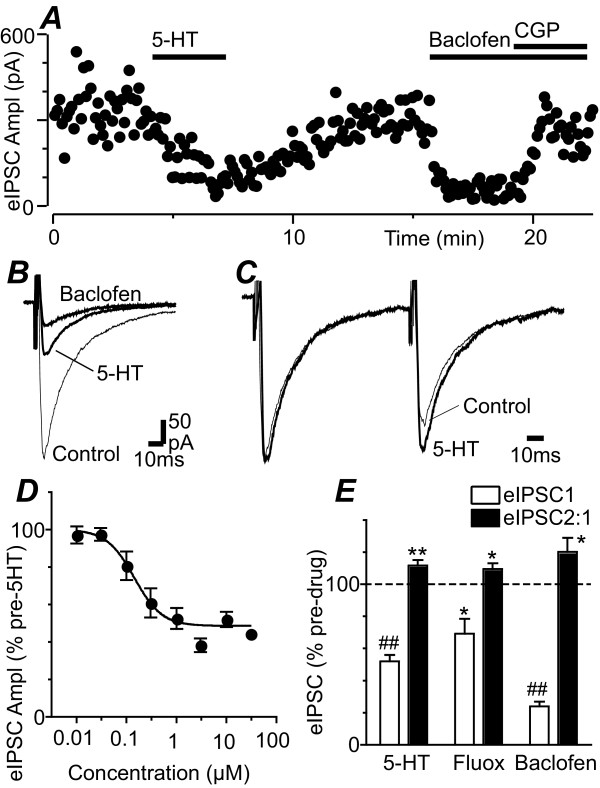
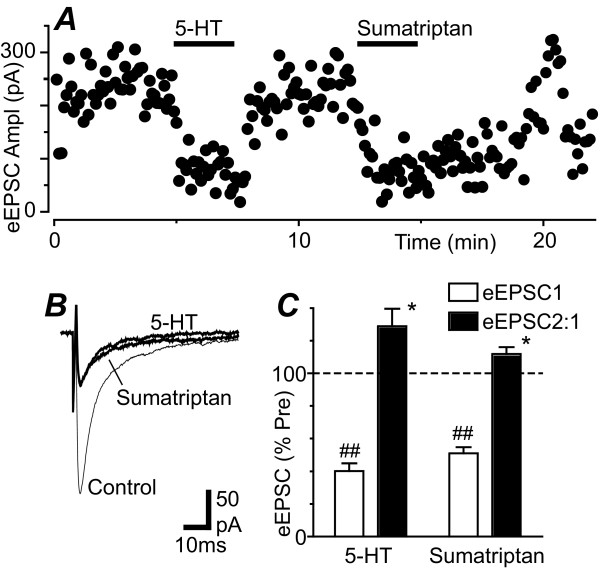
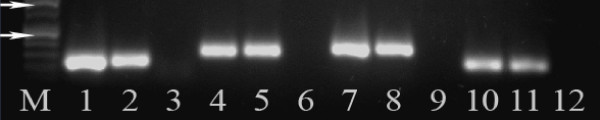
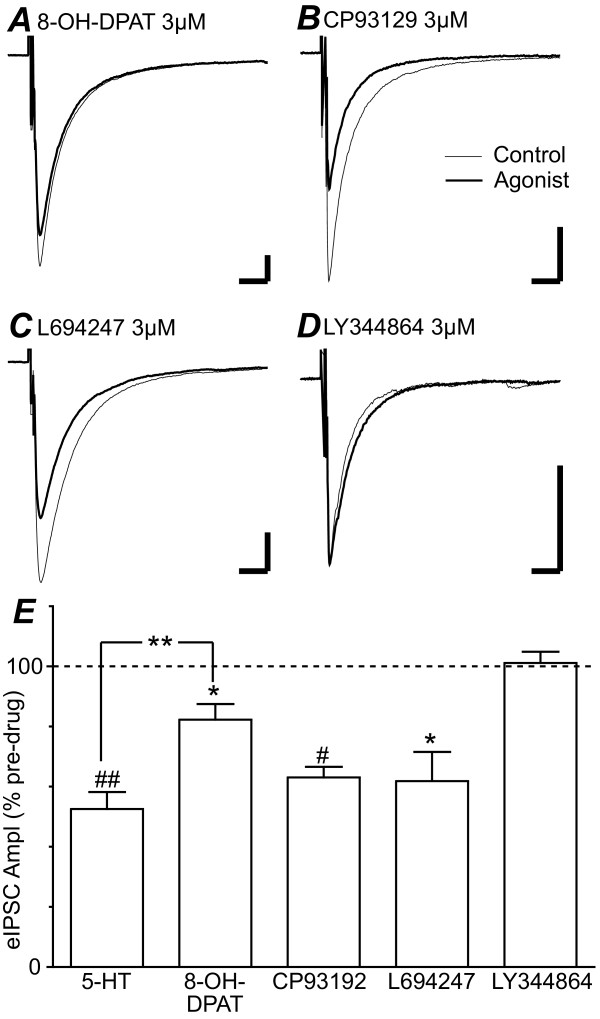
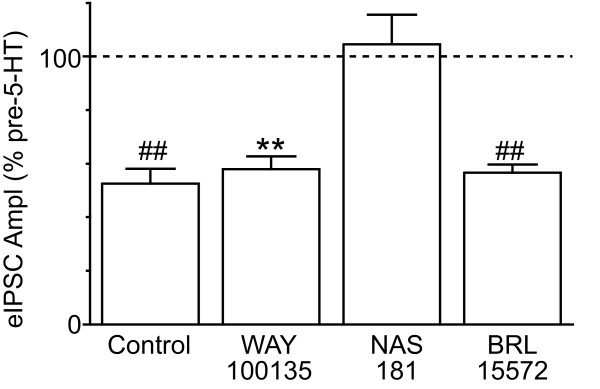
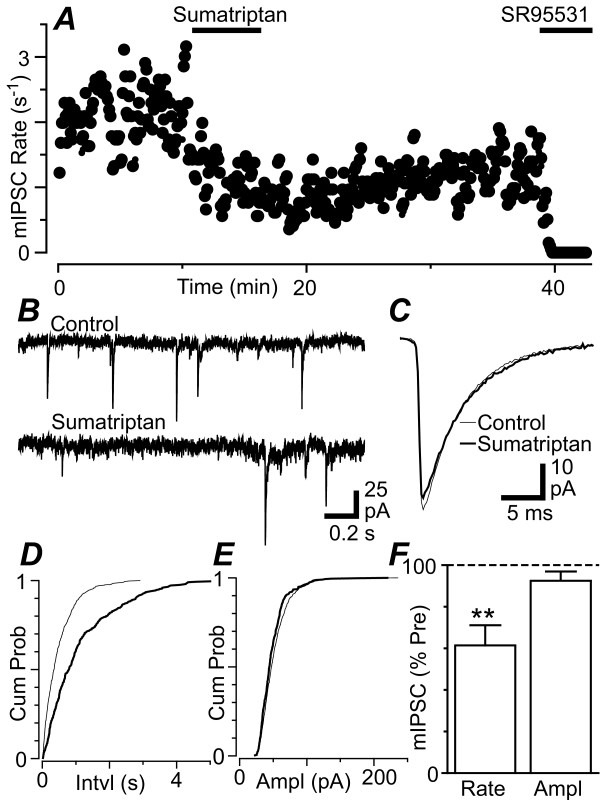
Serotonin (5-hydroxytriptamine, 5-HT, IC50 = 142 nM) and the selective serotonin reuptake inhibitor fluoxetine (30 microM) produced a reduction in the amplitude of GABAA-mediated evoked inhibitory postsynaptic currents (IPSCs) in all PAG neurons which was associated with an increase in the paired-pulse ratio of evoked IPSCs. Real time PCR revealed that 5-HT1A, 5-HT1B, 5-HT1D and 5-HT1F receptor mRNA was present in the PAG. The 5-HT1A, 5-HT1B and 5-HT1D receptor agonists 8-OH-DPAT (3 microM), CP93129 (3 microM) and L694247 (3 microM), but not the 5-HT1F receptor agonist LY344864 (1 - 3 microM) inhibited evoked IPSCs. The 5-HT (1 microM) induced inhibition of evoked IPSCs was abolished by the 5-HT1B antagonist NAS181 (10 microM), but not by the 5-HT1A and 5-HT1D antagonists WAY100135 (3 microM) and BRL15572 (10 microM). Sumatriptan also inhibited evoked IPSCs with an IC50 of 261 nM, and reduced the rate, but not the amplitude of spontaneous miniature IPSCs. The sumatriptan (1 microM) induced inhibition of evoked IPSCs was abolished by NAS181 (10 microM) and BRL15572 (10 microM), together, but not separately. 5-HT (10 microM) and sumatriptan (3 microM) also reduced the amplitude of non-NMDA mediated evoked excitatory postsynaptic currents (EPSCs) in all PAG neurons tested.
These results indicate that sumatriptan inhibits GABAergic and glutamatergic synaptic transmission within the PAG via a 5-HT1B/D receptor mediated reduction in the probability of neurotransmitter release from nerve terminals. These actions overlap those of other analgesics, such as opioids, and provide a mechanism by which centrally acting 5-HT1B and 5-HT1D ligands might lead to novel anti-migraine pharmacotherapies.
有证据表明中脑导水管周围灰质(PAG)在偏头痛及抗偏头痛药物舒马曲坦的作用中发挥作用。在本研究中,我们在体外检测了大鼠中脑PAG切片中GABA能和谷氨酸能突触传递的5-羟色胺能调节。
5-羟色胺(5-羟色胺,5-HT,IC50 = 142 nM)和选择性5-羟色胺再摄取抑制剂氟西汀(30 microM)使所有PAG神经元中GABAA介导的诱发抑制性突触后电流(IPSC)幅度降低,这与诱发IPSC的配对脉冲比率增加有关。实时PCR显示PAG中存在5-HT1A、5-HT1B、5-HT1D和5-HT1F受体mRNA。5-HT1A、5-HT1B和5-HT1D受体激动剂8-OH-DPAT(3 microM)、CP93129(3 microM)和L694247(3 microM)可抑制诱发的IPSC,但5-HT1F受体激动剂LY344864(1 - 3 microM)则无此作用。5-HT(1 microM)诱导的诱发IPSC抑制作用被5-HT1B拮抗剂NAS181(十微摩尔)消除,但未被5-HT1A和5-HT1D拮抗剂WAY100135(3 microM)和BRL15572(10 microM)消除。舒马曲坦也抑制诱发的IPSC,IC50为261 nM,并降低自发微小IPSC的频率,但不改变其幅度。舒马曲坦(1 microM)诱导的诱发IPSC抑制作用被NAS181(10 microM)和BRL15572(10 microM)联合使用消除,但单独使用时无此作用。5-HT(10 microM)和舒马曲坦(3 microM)也降低了所有测试的PAG神经元中非NMDA介导的诱发兴奋性突触后电流(EPSC)的幅度。
这些结果表明,舒马曲坦通过5-HT1B/D受体介导降低神经末梢神经递质释放概率,从而抑制PAG内的GABA能和谷氨酸能突触传递。这些作用与其他镇痛药如阿片类药物的作用重叠,并为中枢作用的5-HT1B和5-HT1D配体可能导致新型抗偏头痛药物治疗提供了一种机制