Pichler Klemens, Schneider Grit, Grassmann Ralph
Institute of Clinical and Molecular Virology, University Erlangen-Nuremberg, Schlossgarten 4, Erlangen, Germany.
Retrovirology. 2008 Nov 12;5:100. doi: 10.1186/1742-4690-5-100.
Human T-lymphotropic virus type 1 (HTLV-1) is the etiologic agent of a severe and fatal lymphoproliferative disease of mainly CD4+ T cell origin, adult T cell leukemia, which develops after prolonged viral persistence. Transformation of infected cells involves HTLV-1's oncoprotein Tax, which perturbs cell cycle regulation and modulates cellular gene expression. The latter function is also a hallmark of microRNAs, a rather new layer in the regulation of gene expression. Affecting e.g. proliferation, microRNAs constitute a potential target for viral interference on the way to persistence and transformation. Hence, we explored the interconnections between HTLV-1 and cellular microRNAs.
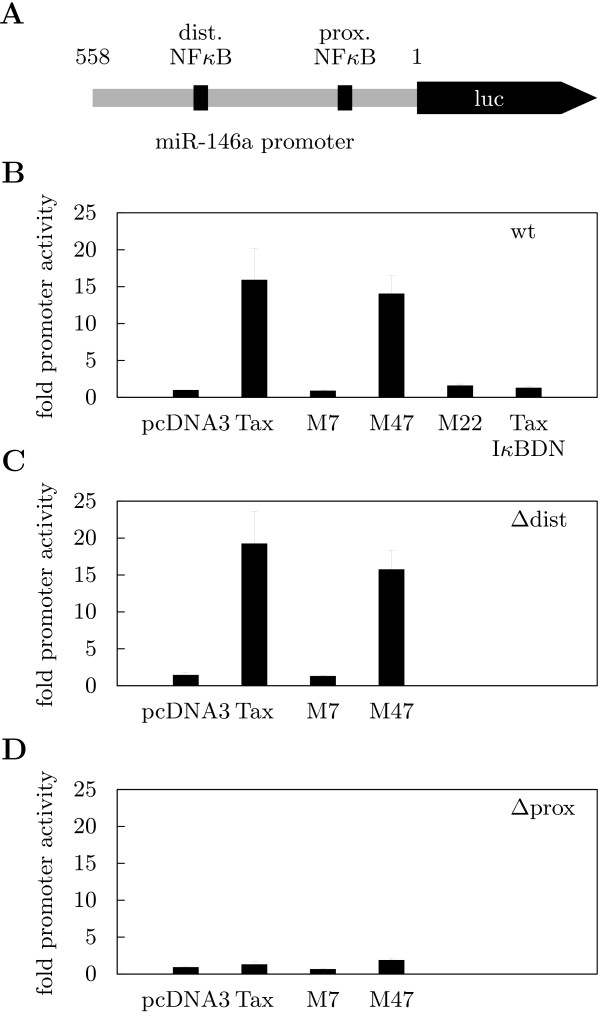
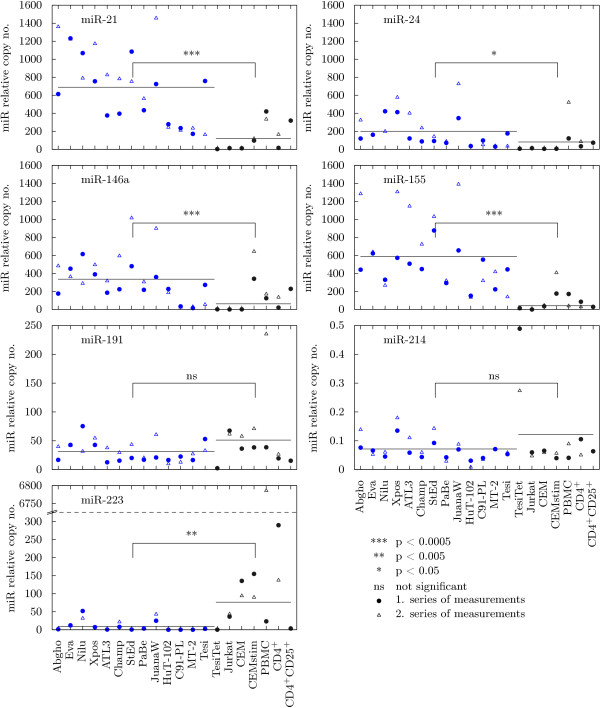
We report that several microRNAs--miRs 21, 24, 146a, 155 and 223--are deregulated in HTLV-1-transformed cells. They are all upregulated except for miR-223, which is downregulated. Each of those microRNAs has ties to cancer. Their expression pattern forms a uniform phenotype among HTLV-transformed cells when compared to HTLV-negative control cells. In particular, miR-146a expression was found to be directly stimulated by Tax via NF-kappaB-mediated transactivation of its promoter; a single NF-kappaB site proximal to the transcription start point was necessary and sufficient for this to happen. An in silico analysis of potential target genes revealed candidates that might be coregulated by two or more of the aforementioned overexpressed microRNAs.
These data demonstrate that cellular microRNAs are deregulated in HTLV-1-transformed T cells. In the case of miR-146a, this could be directly attributed to HTLV's oncoprotein Tax. Interference with cellular microRNAs may be crucial to maintaining persistence or may facilitate transformation of host cells.
人类嗜T淋巴细胞病毒1型(HTLV-1)是一种严重且致命的主要起源于CD4+T细胞的淋巴增殖性疾病——成人T细胞白血病的病原体,该疾病在病毒长期持续存在后发生。被感染细胞的转化涉及HTLV-1的致癌蛋白Tax,它扰乱细胞周期调控并调节细胞基因表达。后一种功能也是微小RNA的一个标志,微小RNA是基因表达调控中一个相当新的层面。例如,微小RNA影响细胞增殖,在病毒持续存在和转化过程中构成病毒干扰的一个潜在靶点。因此,我们探究了HTLV-1与细胞微小RNA之间的相互联系。
我们报告称,几种微小RNA——miR-21、miR-24、miR-146a、miR-155和miR-223——在HTLV-1转化的细胞中表达失调。除了下调的miR-223外,它们均上调。这些微小RNA中的每一种都与癌症有关。与HTLV阴性对照细胞相比,它们的表达模式在HTLV转化的细胞中形成了一种统一的表型。特别是,发现miR-146a的表达通过Tax经由NF-κB介导的其启动子的反式激活而直接受到刺激;转录起始点近端的单个NF-κB位点对于此过程的发生是必要且充分的。对潜在靶基因的计算机分析揭示了可能由上述两种或更多种过表达的微小RNA共同调控的候选基因。
这些数据表明,细胞微小RNA在HTLV-1转化的T细胞中表达失调。就miR-146a而言,这可能直接归因于HTLV的致癌蛋白Tax。对细胞微小RNA的干扰可能对于维持病毒持续存在至关重要,或者可能促进宿主细胞的转化。