Horvath David P, Chao Wun S, Suttle Jeffrey C, Thimmapuram Jyothi, Anderson James V
Biosciences Research Laboratory, USDA-Agricultural Research Service, Fargo ND, USA.
BMC Genomics. 2008 Nov 12;9:536. doi: 10.1186/1471-2164-9-536.
Dormancy of buds is a critical developmental process that allows perennial plants to survive extreme seasonal variations in climate. Dormancy transitions in underground crown buds of the model herbaceous perennial weed leafy spurge were investigated using a 23 K element cDNA microarray. These data represent the first large-scale transcriptome analysis of dormancy in underground buds of an herbaceous perennial species. Crown buds collected monthly from August through December, over a five year period, were used to monitor the changes in the transcriptome during dormancy transitions.
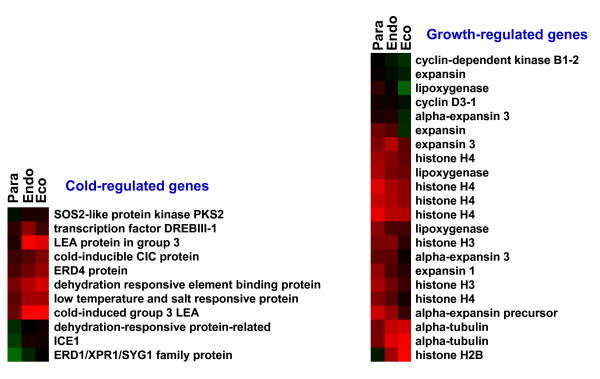
Nearly 1,000 genes were differentially-expressed through seasonal dormancy transitions. Expected patterns of gene expression were observed for previously characterized genes and physiological processes indicated that resolution in our analysis was sufficient for identifying shifts in global gene expression.
Gene ontology of differentially-expressed genes suggests dormancy transitions require specific alterations in transport functions (including induction of a series of mitochondrial substrate carriers, and sugar transporters), ethylene, jasmonic acid, auxin, gibberellic acid, and abscisic acid responses, and responses to stress (primarily oxidative and cold/drought). Comparison to other dormancy microarray studies indicated that nearly half of the genes identified in our study were also differentially expressed in at least two other plant species during dormancy transitions. This comparison allowed us to identify a particular MADS-box transcription factor related to the DORMANCY ASSOCIATED MADS-BOX genes from peach and hypothesize that it may play a direct role in dormancy induction and maintenance through regulation of FLOWERING LOCUS T.
芽休眠是一个关键的发育过程,使多年生植物能够在极端的季节性气候变化中存活。利用一个包含23K个元件的cDNA微阵列,对模式草本多年生杂草叶状大戟地下冠芽的休眠转变进行了研究。这些数据代表了对草本多年生植物地下芽休眠的首次大规模转录组分析。在五年时间里,从8月到12月每月收集的冠芽用于监测休眠转变过程中转录组的变化。
在季节性休眠转变过程中,近1000个基因差异表达。对于先前已鉴定的基因,观察到了预期的基因表达模式,生理过程表明我们分析的分辨率足以识别全局基因表达的变化。
差异表达基因的基因本体分析表明,休眠转变需要在运输功能(包括一系列线粒体底物载体和糖转运蛋白的诱导)、乙烯、茉莉酸、生长素、赤霉素和脱落酸反应以及应激反应(主要是氧化应激和冷/旱应激)方面发生特定改变。与其他休眠微阵列研究的比较表明,我们研究中鉴定的近一半基因在其他至少两种植物物种的休眠转变过程中也差异表达。这种比较使我们能够鉴定出一个与桃的休眠相关MADS盒基因相关的特定MADS盒转录因子,并推测它可能通过调控开花位点T在休眠诱导和维持中发挥直接作用。