NIVEL (Netherlands Institute for Health Services Research), P,O,Box 1568, 3500 BN Utrecht, The Netherlands.
Biopsychosoc Med. 2008 Nov 17;2:22. doi: 10.1186/1751-0759-2-22.
Physicians in primary and secondary care are frequently confronted with patients with medically unexplained symptoms (MUS). In order to solve their patients' problems and out of a fear of overlooking a serious disease, many physicians give their patients full physical examinations and interventions, thereby incorrectly confirming the somatic nature of their condition. Preventing somatization could be achieved by examining the patient's symptom presentation for clues to underlying psychosocial issues and by an appropriate physician response.
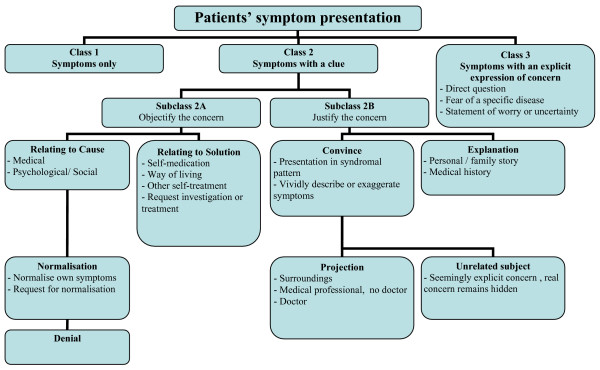
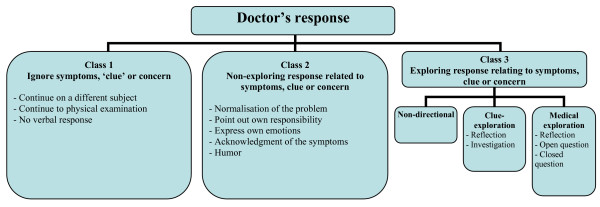
Ninety-seven videotaped medical visits from primary care patients presenting MUS for the first time were analyzed. Patients' presentations were categorized in: (1) symptoms only; (2) symptoms with a clue to an underlying concern; or (3) symptoms with an explicit concern. General practitioners' (GPs') responses to patients' presentation were classified into ignoring or more or less exploring responses. Exploring responses were further subdivided in non-directional explorations, clue explorations and medical explorations.
Results show that most patients presented their symptoms together with a reference to an underlying concern. Yet, most of them did so in an implicit way. GPs usually explored the concern presented by the patients, but most often in a medical way only.
To address the potential psychological basis of patients' medically unexplained symptoms, GPs should pay more attention to the specific clues patients present to them. Likewise, in order to receive full attention, patients should try to present their concerns more explicitly.
初级保健和二级保健医生经常会遇到患有无法解释的医学症状(MUS)的患者。为了解决患者的问题,并避免忽视严重疾病的可能性,许多医生会对患者进行全面的身体检查和干预,从而错误地确认其病症具有躯体性质。通过检查患者症状表现中潜在的心理社会问题的线索,并采取适当的医生反应,可以预防躯体化。
分析了 97 名首次出现 MUS 的初级保健患者的录像医疗就诊。将患者的表现分为以下几类:(1)仅症状;(2)症状伴有潜在关注的线索;或(3)症状伴有明确的关注。将全科医生(GP)对患者表现的反应分为忽略或或多或少的探索性反应。探索性反应进一步细分为非定向探索、线索探索和医学探索。
结果表明,大多数患者在出现症状的同时提到了潜在的关注。然而,他们中的大多数人是以隐含的方式提到的。GP 通常会探讨患者提出的担忧,但大多数情况下只是以医学方式进行探讨。
为了解决患者无法解释的医学症状的潜在心理基础,全科医生应该更加关注患者向他们提供的具体线索。同样,为了引起充分的关注,患者应该尝试更明确地表达自己的担忧。