Department of Biological Sciences, Illinois State University, Normal, IL, USA.
Immun Ageing. 2008 Nov 17;5:15. doi: 10.1186/1742-4933-5-15.
Ageing is associated with dysfunction in the humoral response leading to decreased protection against infectious diseases. Defects in T cell function due to age have been well characterized but it is unclear if dysfunctions in antibody responses are due to deficiencies in a helper environment or intrinsic B cell defects. Previous studies from our laboratory have shown that aged B lymphocytes are able to differentiate into high affinity antibody-secreting cells at a frequency similar to their young counterparts. However, expansion of B cells in vivo was reduced in aged animals when compared to young.
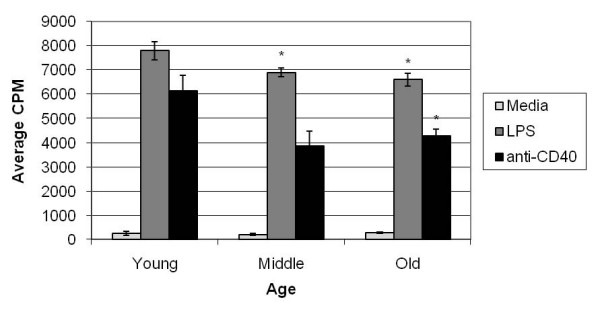
To further investigate the cause of this reduced expansion, we have now examined early activation events of aged B cells in response to anti-CD40 monoclonal antibody (mAb) and lipopolysaccharide (LPS) stimulation in vitro. To do this spleen cells were harvested from young, middle-aged and aged quasi-monoclonal (QM) mice and cultured in complete RPMI for 24 and 48 hours. Cultures contained either LPS or anti-CD40 mAb and murine IL-4. Cells were collected and analyzed using flow cytometry. To examine the proliferative capacity of aged B cells spleen cells were collected as before and cultured in 96 well microtiter plates with either LPS or anti-CD40 mAb and murine IL-4 for 24 hours. Tritiated thymidine ([3H]-Tdr) was added to each well and incubated for another 24 hours after which cells were collected and analyzed using a scintillation counter.
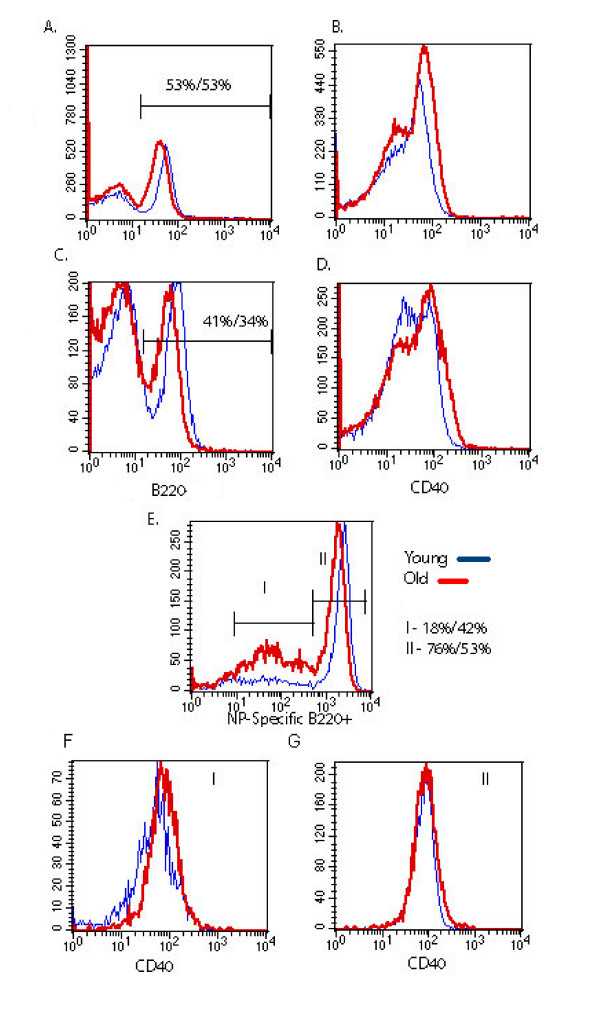
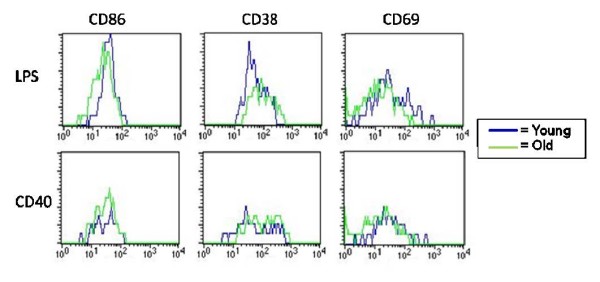
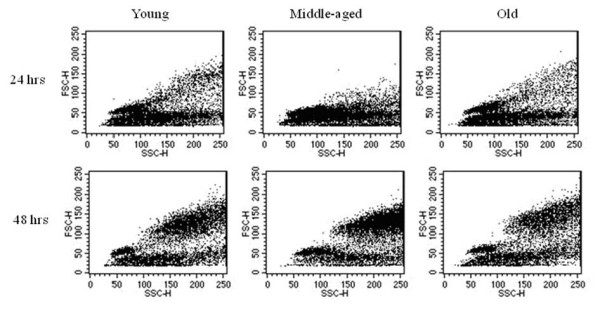
Resting aged B cells exhibited similar levels of CD40 expression when compared to young cells and efficiently up-regulated CD86 and CD69 and also down-regulated CD38 upon stimulation. However, aged B cells proliferated less than young B cells and showed a consistent, but not statistically significant, reduction in their ability to form blast cells.
Aged B cells exhibited a reduced response in some early activation events but produced at least a partial response in all cases. Thus, therapeutic intervention may be possible, despite intrinsically different responses in aged B cells.
衰老与体液反应功能障碍有关,导致对传染病的保护力下降。由于年龄导致的 T 细胞功能缺陷已经得到了很好的描述,但尚不清楚抗体反应的功能障碍是由于辅助环境的缺陷还是固有 B 细胞缺陷。我们实验室的先前研究表明,衰老的 B 淋巴细胞能够以与年轻 B 淋巴细胞相似的频率分化为高亲和力的抗体分泌细胞。然而,与年轻动物相比,衰老动物体内 B 细胞的扩增减少了。
为了进一步研究这种扩增减少的原因,我们现在研究了衰老 B 细胞在体外对抗 CD40 单克隆抗体(mAb)和脂多糖(LPS)刺激的早期激活事件。为此,从年轻、中年和老年准单克隆(QM)小鼠中采集脾细胞,并在完全 RPMI 中培养 24 和 48 小时。培养物中含有 LPS 或抗 CD40 mAb 和鼠 IL-4。收集细胞并使用流式细胞术进行分析。为了检查衰老 B 细胞的增殖能力,以前一样收集脾细胞,并在 96 孔微量滴定板中与 LPS 或抗 CD40 mAb 和鼠 IL-4 一起培养 24 小时。向每个孔中加入[3H]-胸苷([3H]-Tdr)并孵育 24 小时后,收集细胞并使用闪烁计数器进行分析。
与年轻细胞相比,静止的衰老 B 细胞表现出相似水平的 CD40 表达,并在受到刺激后有效地上调 CD86 和 CD69,同时下调 CD38。然而,衰老 B 细胞的增殖能力低于年轻 B 细胞,并且形成母细胞的能力呈一致但无统计学意义的降低。
衰老 B 细胞在一些早期激活事件中表现出反应减少,但在所有情况下都产生了至少部分反应。因此,尽管衰老 B 细胞的反应本质上不同,但仍可能进行治疗干预。