White J H, Johnson A L, Lowndes N F, Johnston L H
Laboratory of Cell Propagation, National Institute for Medical Research, The Ridgeway, Mill Hill, London, UK.
Nucleic Acids Res. 1991 Jan 25;19(2):359-64. doi: 10.1093/nar/19.2.359.
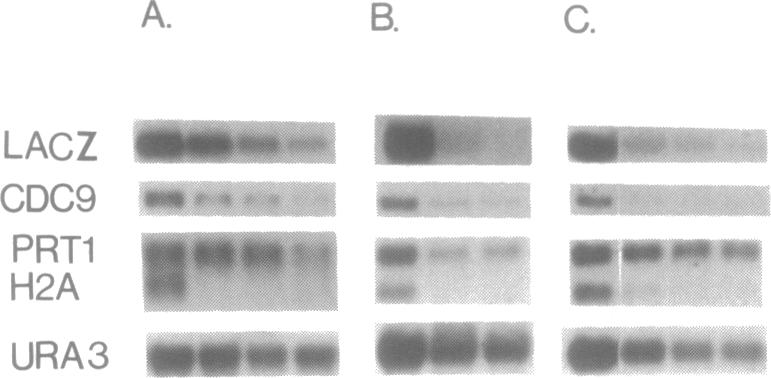
By fusing the CDC9 structural gene to the PGK upstream sequences and the CDC9 upstream to lacZ, we showed that the cell cycle expression of CDC9 is largely due to transcriptional regulation. To investigate the role of six ATGATT upstream repeats in CDC9 regulation, synthetic copies of the sequence were attached to a heterologous gene. The repeats stimulated transcription strongly and additively, but, unlike conventional yeast UAS elements, only when present in one orientation. Transcription driven by the repeats declines in cells held at START of the cell cycle or in stationary phase, as occurs with CDC9. However, the repeats by themselves cannot impart cell cycle regulation to a heterologous gene. CDC9 may therefore be controlled by an activating system operating through the repeats that is sensitive to cellular proliferation and a separate mechanism that governs the periodic expression in the cell cycle.
通过将CDC9结构基因与PGK上游序列融合,并将CDC9上游序列与lacZ融合,我们发现CDC9的细胞周期表达很大程度上归因于转录调控。为了研究六个ATGATT上游重复序列在CDC9调控中的作用,将该序列的合成拷贝连接到一个异源基因上。这些重复序列强烈且累加地刺激转录,但与传统的酵母上游激活序列元件不同,只有在一种方向存在时才起作用。由这些重复序列驱动的转录在细胞周期起始点停滞的细胞或静止期细胞中下降,就像CDC9的情况一样。然而,这些重复序列本身不能赋予异源基因细胞周期调控能力。因此,CDC9可能受一个通过这些重复序列起作用的激活系统控制,该系统对细胞增殖敏感,还受一个独立机制控制,该机制决定细胞周期中的周期性表达。