Steinbuechel Marion, Matuschewski Kai
Department of Parasitology, Heidelberg University School of Medicine, 69120 Heidelberg, Germany.
Cell Microbiol. 2009 Feb;11(2):279-88. doi: 10.1111/j.1462-5822.2008.01252.x. Epub 2008 Oct 30.
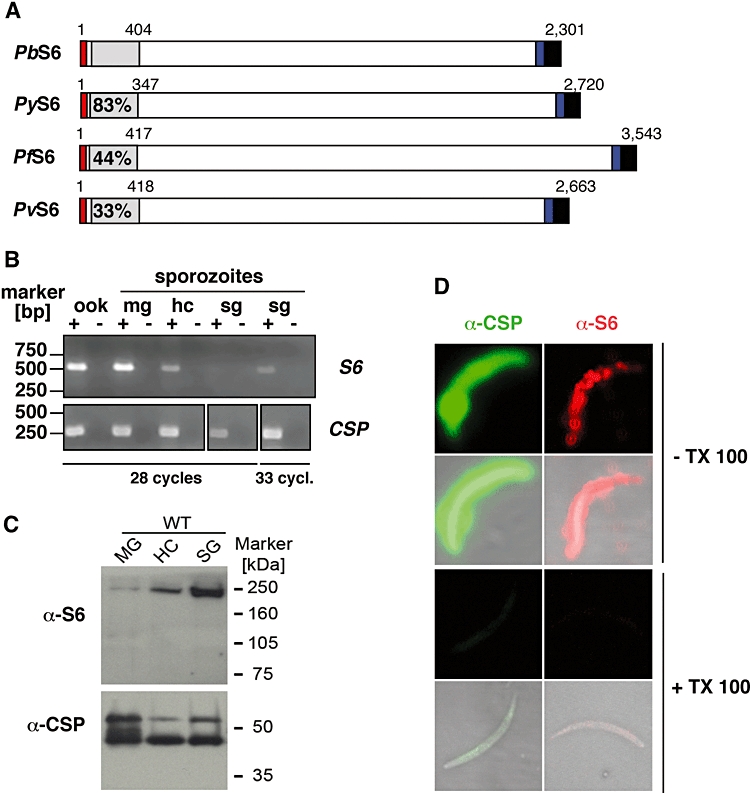
Malaria transmission occurs by intradermal deposition of Plasmodium sporozoites during the infectious bite of a female Anopheles mosquito. After formation in midgut-associated oocysts sporozoites actively enter mosquito salivary glands and subsequently invade host hepatocytes where they transform into clinically silent liver stages. To date, two sporozoite-specific transmembrane proteins have been identified that perform vital functions in natural malaria transmission. The sporozoite invasin TRAP drives sporozoite motility and target cell entry whereas the adhesin MAEBL mediates sporozoite recognition of and attachment to salivary glands. Here, we demonstrate that the sporozoite-specific transmembrane protein S6 is required for efficient malaria transmission to the vertebrate host. Targeted deletion of S6 results in severe impairment of sporozoite gliding motility and invasion of mosquito salivary glands. During sporozoite maturation S6 expression is tightly regulated by transcriptional and translational control. We propose that S6 functions together with TRAP/MIC2 family invasins to direct fast, efficient and specific cell entry and, ultimately, life cycle progression of the malaria sporozoite.
疟疾传播是通过雌性按蚊在具有传染性的叮咬过程中将疟原虫子孢子皮内沉积而发生的。在与中肠相关的卵囊中形成后,子孢子会主动进入蚊子的唾液腺,随后侵入宿主肝细胞,在那里它们会转变为临床上无症状的肝脏阶段。迄今为止,已经鉴定出两种子孢子特异性跨膜蛋白,它们在自然疟疾传播中发挥着至关重要的作用。子孢子入侵蛋白TRAP驱动子孢子的运动性和靶细胞进入,而粘附素MAEBL介导子孢子对唾液腺的识别和附着。在这里,我们证明子孢子特异性跨膜蛋白S6是疟疾向脊椎动物宿主有效传播所必需的。靶向缺失S6会导致子孢子滑行运动性和侵入蚊子唾液腺的严重受损。在子孢子成熟过程中,S6的表达受到转录和翻译控制的严格调节。我们提出,S6与TRAP/MIC2家族入侵蛋白共同发挥作用,指导快速、高效和特异性的细胞进入,并最终推动疟原虫子孢子的生命周期进程。