Sy Thau Nguyen, Nguyen Tuyet-Kha, Truong Nguyen Van, Chu Thi-Thanh Hang, Na Sung-Hun, Moon Robert W, Lau Yee Ling, Nyunt Myat Htut, Park Won-Sun, Chun Wan-Joo, Lu Feng, Lee Seong-Kyun, Han Jin-Hee, Han Eun-Taek
Department of Medical Environmental Biology and Tropical Medicine, Kangwon National University School of Medicine, Chuncheon, Gangwon-do, Republic of Korea.
Department of Obstetrics and Gynecology, Kangwon National University School of Medicine, Chuncheon, Gangwon-d, Republic of Korea.
Front Cell Infect Microbiol. 2024 Feb 23;14:1354880. doi: 10.3389/fcimb.2024.1354880. eCollection 2024.
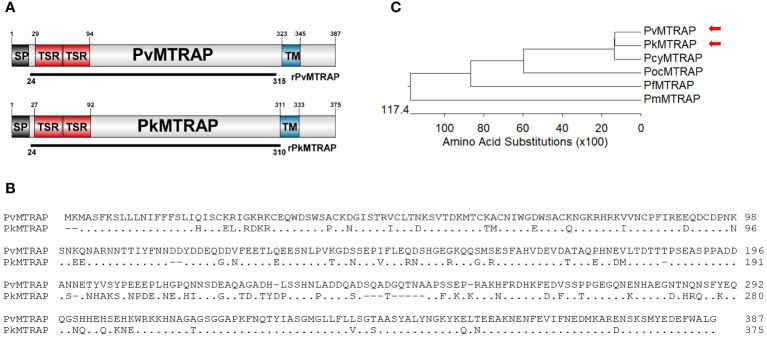
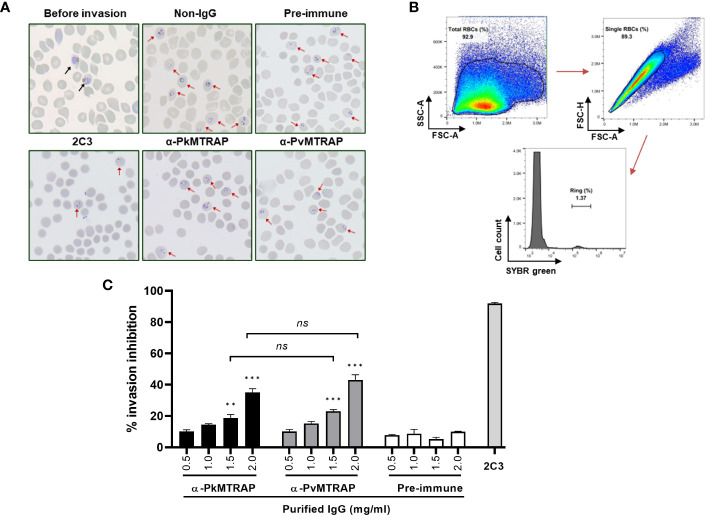
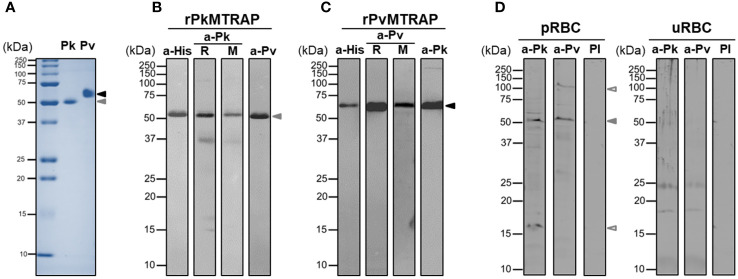
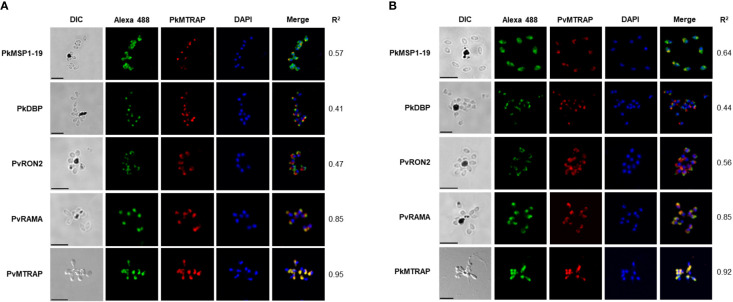
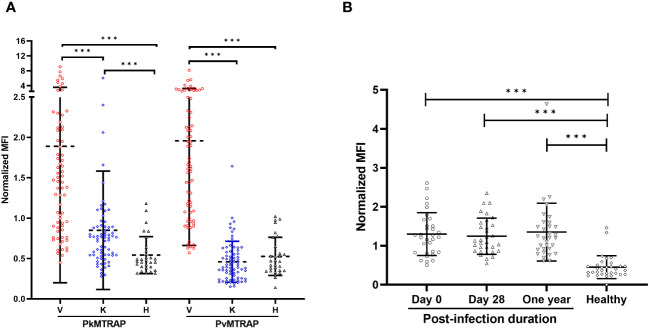
, the most widespread human malaria parasite, and , an emerging that infects humans, are the phylogenetically closest malarial species that infect humans, which may induce cross-species reactivity across most co-endemic areas in Southeast Asia. The thrombospondin-related anonymous protein (TRAP) family is indispensable for motility and host cell invasion in the growth and development of parasites. The merozoite-specific TRAP (MTRAP), expressed in blood-stage merozoites, is supposed to be essential for human erythrocyte invasion. We aimed to characterize MTRAPs in blood-stage and parasites and ascertain their cross-species immunoreactivity. Recombinant and MTRAPs of full-length ectodomains were expressed in a mammalian expression system. The MTRAP-specific immunoglobulin G, obtained from immune animals, was used in an immunofluorescence assay for subcellular localization and invasion inhibitory activity in blood-stage parasites was determined. The cross-species humoral immune responses were analyzed in the sera of patients with or infections. The MTRAPs of (PvMTRAP) and (PkMTRAP) were localized on the rhoptry body of merozoites in blood-stage parasites. Both anti-PvMTRAP and anti-PkMTRAP antibodies inhibited erythrocyte invasion of blood-stage parasites. The humoral immune response to PvMTRAP showed high immunogenicity, longevity, and cross-species immunoreactivity with . MTRAPs are promising candidates for development of vaccines and therapeutics against vivax and knowlesi malaria.
间日疟原虫是最广泛传播的人类疟原虫,而诺氏疟原虫是一种新兴的感染人类的疟原虫,它们是在系统发育上最接近的感染人类的疟原虫物种,这可能会在东南亚大多数共流行地区引发跨物种反应。血小板反应蛋白相关匿名蛋白(TRAP)家族在间日疟原虫和诺氏疟原虫的生长发育过程中,对于其运动性和宿主细胞入侵是不可或缺的。在血液阶段裂殖子中表达的裂殖子特异性TRAP(MTRAP),被认为对人类红细胞入侵至关重要。我们旨在表征血液阶段间日疟原虫和诺氏疟原虫中的MTRAP,并确定它们的跨物种免疫反应性。全长胞外域的重组间日疟原虫和诺氏疟原虫MTRAP在哺乳动物表达系统中表达。从免疫动物获得的MTRAP特异性免疫球蛋白G用于免疫荧光测定以进行亚细胞定位,并测定血液阶段寄生虫的入侵抑制活性。对间日疟原虫或诺氏疟原虫感染患者的血清进行跨物种体液免疫反应分析。间日疟原虫(PvMTRAP)和诺氏疟原虫(PkMTRAP)的MTRAP定位于血液阶段寄生虫裂殖子的棒状体上。抗PvMTRAP和抗PkMTRAP抗体均抑制血液阶段间日疟原虫的红细胞入侵。对PvMTRAP的体液免疫反应显示出高免疫原性、持久性以及与诺氏疟原虫的跨物种免疫反应性。MTRAP是开发针对间日疟和诺氏疟疟疾的疫苗和治疗方法的有前景的候选物。