Mondego Jorge M C, Carazzolle Marcelo F, Costa Gustavo G L, Formighieri Eduardo F, Parizzi Lucas P, Rincones Johana, Cotomacci Carolina, Carraro Dirce M, Cunha Anderson F, Carrer Helaine, Vidal Ramon O, Estrela Raíssa C, García Odalys, Thomazella Daniela P T, de Oliveira Bruno V, Pires Acássia Bl, Rio Maria Carolina S, Araújo Marcos Renato R, de Moraes Marcos H, Castro Luis A B, Gramacho Karina P, Gonçalves Marilda S, Neto José P Moura, Neto Aristóteles Góes, Barbosa Luciana V, Guiltinan Mark J, Bailey Bryan A, Meinhardt Lyndel W, Cascardo Julio Cm, Pereira Gonçalo A G
Laboratório de Genômica e Expressão, Departamento de Genética e Evolução, Instituto de Biologia, Universidade Estadual de Campinas, CP 6109, 13083-970, Campinas, SP, Brazil.
BMC Genomics. 2008 Nov 18;9:548. doi: 10.1186/1471-2164-9-548.
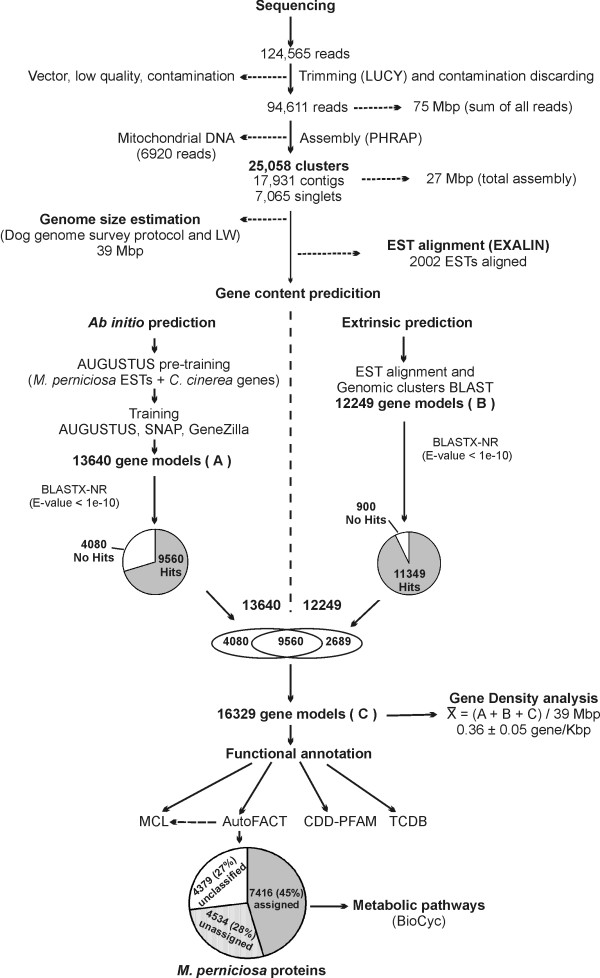
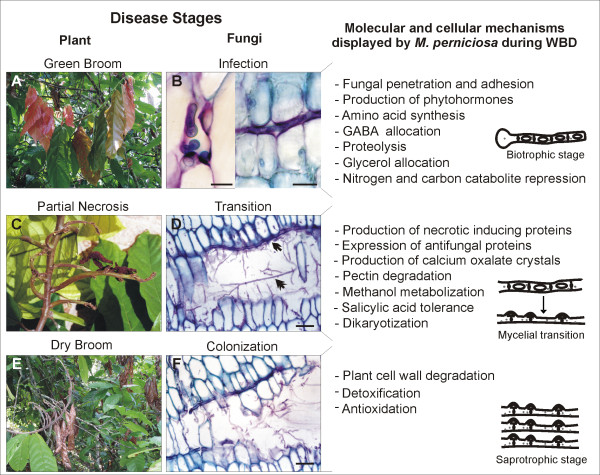
The basidiomycete fungus Moniliophthora perniciosa is the causal agent of Witches' Broom Disease (WBD) in cacao (Theobroma cacao). It is a hemibiotrophic pathogen that colonizes the apoplast of cacao's meristematic tissues as a biotrophic pathogen, switching to a saprotrophic lifestyle during later stages of infection. M. perniciosa, together with the related species M. roreri, are pathogens of aerial parts of the plant, an uncommon characteristic in the order Agaricales. A genome survey (1.9x coverage) of M. perniciosa was analyzed to evaluate the overall gene content of this phytopathogen.
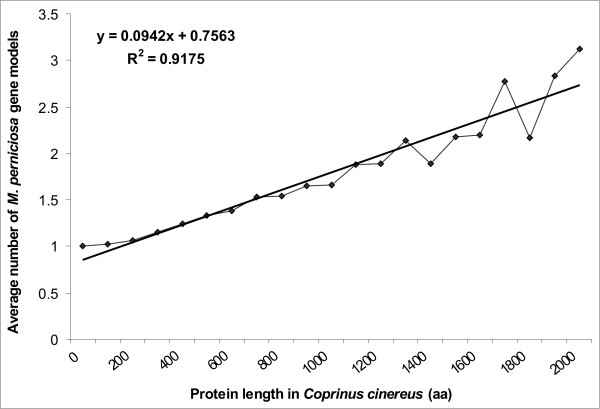
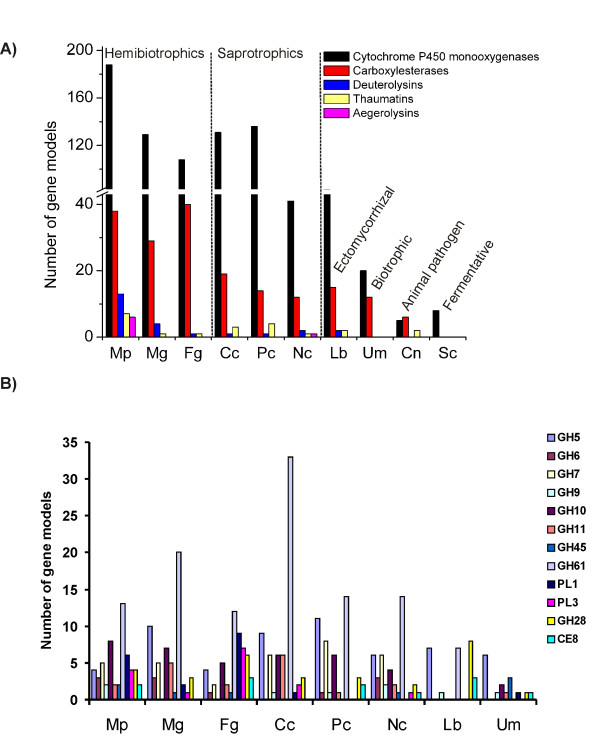
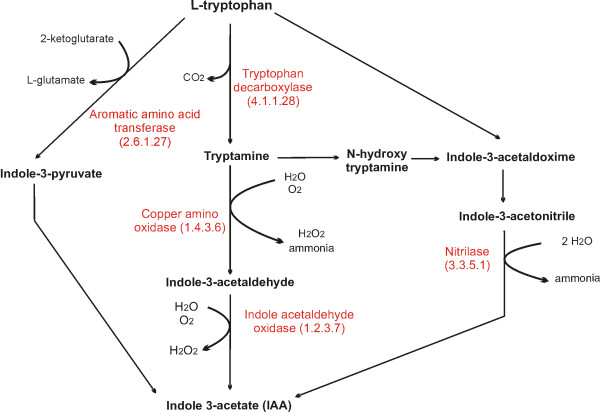
Genes encoding proteins involved in retrotransposition, reactive oxygen species (ROS) resistance, drug efflux transport and cell wall degradation were identified. The great number of genes encoding cytochrome P450 monooxygenases (1.15% of gene models) indicates that M. perniciosa has a great potential for detoxification, production of toxins and hormones; which may confer a high adaptive ability to the fungus. We have also discovered new genes encoding putative secreted polypeptides rich in cysteine, as well as genes related to methylotrophy and plant hormone biosynthesis (gibberellin and auxin). Analysis of gene families indicated that M. perniciosa have similar amounts of carboxylesterases and repertoires of plant cell wall degrading enzymes as other hemibiotrophic fungi. In addition, an approach for normalization of gene family data using incomplete genome data was developed and applied in M. perniciosa genome survey.
This genome survey gives an overview of the M. perniciosa genome, and reveals that a significant portion is involved in stress adaptation and plant necrosis, two necessary characteristics for a hemibiotrophic fungus to fulfill its infection cycle. Our analysis provides new evidence revealing potential adaptive traits that may play major roles in the mechanisms of pathogenicity in the M. perniciosa/cacao pathosystem.
担子菌纲真菌可可球二孢是可可树女巫扫帚病(WBD)的病原体。它是一种半活体营养型病原体,作为活体营养型病原体定殖于可可分生组织的质外体,在感染后期转变为腐生生活方式。可可球二孢与相关物种罗雷球二孢一起,是植物地上部分的病原体,这在伞菌目中是不常见的特征。对可可球二孢进行了基因组调查(1.9倍覆盖度),以评估这种植物病原体的整体基因含量。
鉴定出了编码参与逆转座、活性氧(ROS)抗性、药物外排转运和细胞壁降解的蛋白质的基因。大量编码细胞色素P450单加氧酶的基因(占基因模型的1.15%)表明,可可球二孢具有很强的解毒、毒素和激素产生潜力;这可能赋予该真菌较高的适应能力。我们还发现了编码富含半胱氨酸的假定分泌多肽的新基因,以及与甲基营养和植物激素生物合成(赤霉素和生长素)相关的基因。基因家族分析表明,可可球二孢的羧酸酯酶数量和植物细胞壁降解酶种类与其他半活体营养型真菌相似。此外,还开发了一种使用不完整基因组数据对基因家族数据进行标准化的方法,并应用于可可球二孢基因组调查。
这项基因组调查概述了可可球二孢的基因组,并揭示其中很大一部分与胁迫适应和植物坏死有关,这是半活体营养型真菌完成其感染周期的两个必要特征。我们的分析提供了新的证据,揭示了可能在可可球二孢/可可病理系统致病机制中起主要作用的潜在适应性状。