Departamento de Ciências Biológicas (DCB), Centro de Biotecnologia e Genética (CBG), Universidade Estadual de Santa Cruz (UESC), Rodovia Ilhéus-Itabuna, km 16, Ilhéus, 45662-900, Bahia, Brazil.
Comissão Executiva do Plano da Lavoura Cacaueira (CEPLAC), Centro de Pesquisas do Cacau (CEPEC), Seção de Fitossanidade (SEFIT), Laboratório de Fitopatologia Molecular (FITOMOL), km 22 Rod. Ilhéus Itabuna, Ilhéus, 45600-970, Bahia, Brazil.
BMC Genomics. 2018 Jul 3;19(1):509. doi: 10.1186/s12864-018-4875-7.
The hemibiotrophic pathogens Moniliophthora perniciosa (witches' broom disease) and Moniliophthora roreri (frosty pod rot disease) are among the most important pathogens of cacao. Moniliophthora perniciosa has a broad host range and infects a variety of meristematic tissues in cacao plants, whereas M. roreri infects only pods of Theobroma and Herrania genera. Comparative pathogenomics of these fungi is essential to understand Moniliophthora infection strategies, therefore the detection and in silico functional characterization of effector candidates are important steps to gain insight on their pathogenicity.
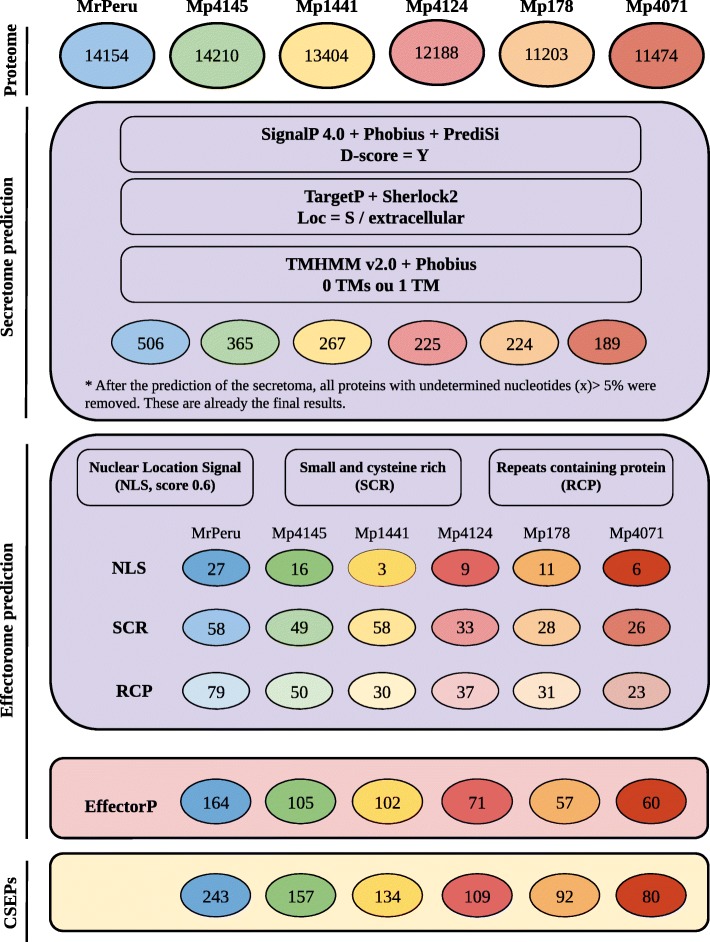
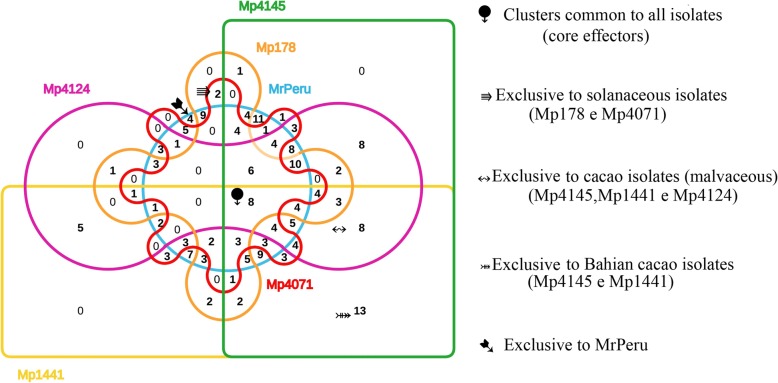
Candidate secreted effector proteins repertoire were predicted using the genomes of five representative isolates of M. perniciosa subpopulations (three from cacao and two from solanaceous hosts), and one representative isolate of M. roreri from Peru. Many putative effectors candidates were identified in M. perniciosa: 157 and 134 in cacao isolates from Bahia, Brazil; 109 in cacao isolate from Ecuador, 92 and 80 in wild solanaceous isolates from Minas Gerais (Lobeira) and Bahia (Caiçara), Brazil; respectively. Moniliophthora roreri showed the highest number of effector candidates, a total of 243. A set of eight core effectors were shared among all Moniliophthora isolates, while others were shared either between the wild solanaceous isolates or among cacao isolates. Mostly, candidate effectors of M. perniciosa were shared among the isolates, whereas in M. roreri nearly 50% were exclusive to the specie. In addition, a large number of cell wall-degrading enzymes characteristic of hemibiotrophic fungi were found. From these, we highlighted the proteins involved in cell wall modification, an enzymatic arsenal that allows the plant pathogens to inhabit environments with oxidative stress, which promotes degradation of plant compounds and facilitates infection.
The present work reports six genomes and provides a database of the putative effectorome of Moniliophthora, a first step towards the understanding of the functional basis of fungal pathogenicity.
半活体病原菌蜜环菌(疯扫帚病)和蜜环菌(霜霉病)是可可最重要的病原菌之一。蜜环菌具有广泛的宿主范围,感染可可植物的各种分生组织,而蜜环菌仅感染可可属和赫雷尼亚属的豆荚。对这些真菌进行比较病原体组学研究对于了解蜜环菌的感染策略至关重要,因此,检测和计算机功能分析效应子候选物是深入了解其致病性的重要步骤。
使用来自巴西巴伊亚州的三个可可分离株、厄瓜多尔的一个可可分离株、米纳斯吉拉斯州(Lobeira)和巴伊亚州(Caiçara)的两个野生茄科分离株的五个代表性蜜环菌亚群代表分离株以及一个来自秘鲁的蜜环菌 roreri 代表分离株的基因组,预测了候选分泌效应蛋白库。在可可分离株中鉴定出 157 和 134 个效应子候选物,来自巴西巴伊亚州的 109 个效应子候选物,来自厄瓜多尔的 92 和 80 个效应子候选物,来自巴西米纳斯吉拉斯州(Lobeira)和巴伊亚州(Caiçara)的野生茄科分离株。蜜环菌 roreri 显示出最多数量的效应子候选物,总共有 243 个。一组 8 个核心效应子在所有蜜环菌分离株中共享,而其他效应子则在野生茄科分离株之间或可可分离株之间共享。大多数情况下,蜜环菌分离株中的候选效应子是共享的,而在蜜环菌 roreri 中,近 50%的效应子是该种所特有的。此外,还发现了大量特征为半活体真菌的细胞壁降解酶。在这些酶中,我们重点介绍了参与细胞壁修饰的蛋白质,这是一种酶的武库,使植物病原体能够栖息在氧化应激的环境中,促进植物化合物的降解,并促进感染。
本研究报告了六个基因组,并提供了蜜环菌效应子组的数据库,这是了解真菌致病性功能基础的第一步。