Blanié Sophie, Mortier Jérémy, Delverdier Maxence, Bertagnoli Stéphane, Camus-Bouclainville Christelle
INRA, UMR 1225, F-31076 Toulouse, France.
Vet Res. 2009 Jan-Feb;40(1):11. doi: 10.1051/vetres:2008049. Epub 2008 Nov 19.
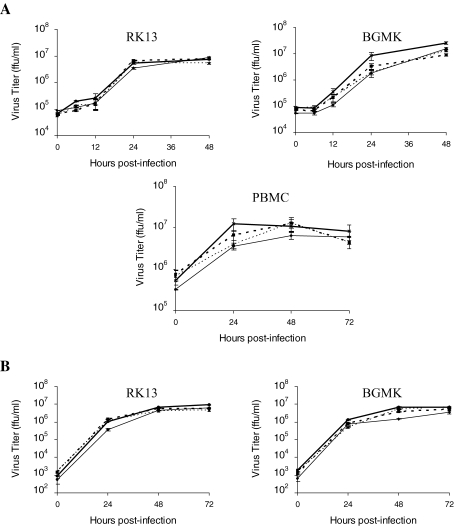
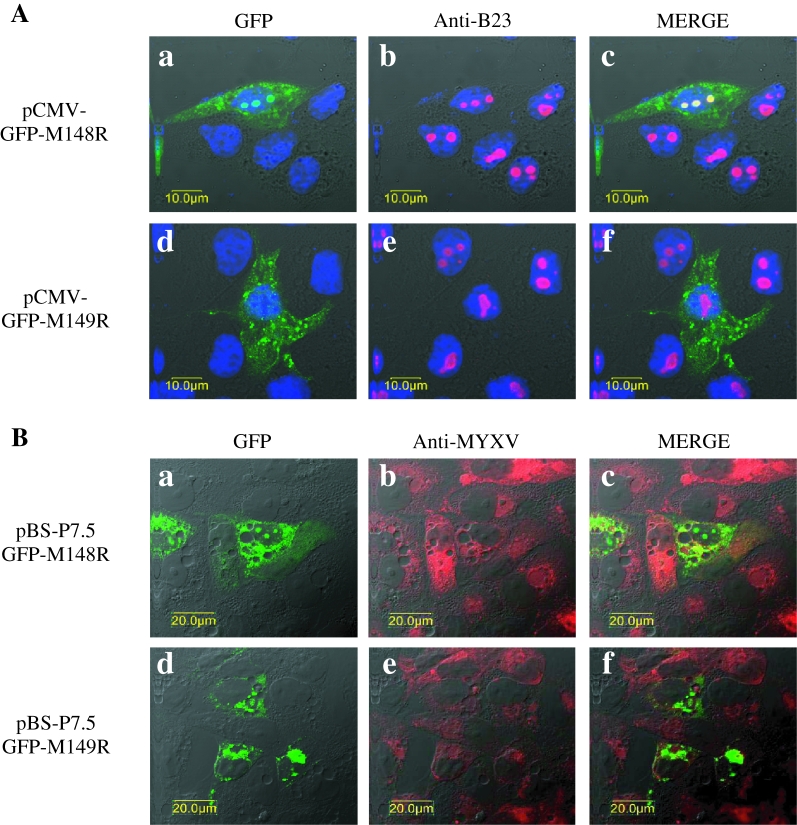
Myxoma virus (MYXV), a member of the Poxviridae family, is the agent responsible for myxomatosis, a fatal disease in the European rabbit (Oryctolagus cuniculus). MYXV has a linear double-stranded DNA genome that encodes several factors important for evasion from the host immune system. Among them, four ankyrin (ANK) repeat proteins were identified: M148R, M149R, M150R and M-T5. To date, only M150R and M-T5 were studied and characterized as critical virulence factors. This article presents the first characterization of M148R and M149R. Green Fluorescent Protein (GFP) fusions allowed us to localize them in a viral context. Whereas M149R is only cytoplasmic, interestingly, M148R is in part located in the nucleolus, a unique feature for an ANK repeat poxviral protein. In order to evaluate their implication in viral pathogenicity, targeted M148R, M149R, or both deletions were constructed in the wild type T1 strain of myxoma virus. In vitro infection of rabbit and primate cultured cells as well as primary rabbit cells allowed us to conclude that M148R and M149R are not likely to be implicated in cell tropism or host range functions. However, in vivo experiments revealed that they are virulence factors since after infection of European rabbits with mutant viruses, a delay in the onset of clinical signs, an increase of survival time and a dramatic decrease in mortality rate were observed. Moreover, histological analysis suggests that M148R plays a role in the subversion of host inflammatory response by MYXV.
黏液瘤病毒(MYXV)是痘病毒科的成员,是导致黏液瘤病的病原体,黏液瘤病是欧洲兔(穴兔)的一种致命疾病。MYXV具有线性双链DNA基因组,该基因组编码几种对逃避宿主免疫系统很重要的因子。其中,鉴定出了四种锚蛋白(ANK)重复蛋白:M148R、M149R、M150R和M-T5。迄今为止,仅对M150R和M-T5进行了研究,并将其表征为关键毒力因子。本文首次对M148R和M149R进行了表征。绿色荧光蛋白(GFP)融合使我们能够在病毒环境中定位它们。M149R仅存在于细胞质中,而有趣的是,M148R部分位于核仁中,这是ANK重复痘病毒蛋白的独特特征。为了评估它们在病毒致病性中的作用,在黏液瘤病毒的野生型T1株中构建了靶向M148R、M149R或两者的缺失突变体。对兔和灵长类动物培养细胞以及原代兔细胞进行的体外感染使我们得出结论,M148R和M149R不太可能参与细胞嗜性或宿主范围功能。然而,体内实验表明它们是毒力因子,因为用突变病毒感染欧洲兔后,观察到临床症状出现延迟、存活时间延长和死亡率显著降低。此外,组织学分析表明,M148R在MYXV颠覆宿主炎症反应中发挥作用。