Blount Jonathan D, Speed Michael P, Ruxton Graeme D, Stephens Philip A
School of Biosciences, University of Exeter, Cornwall Campus, Penryn TR10 9EZ, UK.
Proc Biol Sci. 2009 Mar 7;276(1658):871-7. doi: 10.1098/rspb.2008.1407.
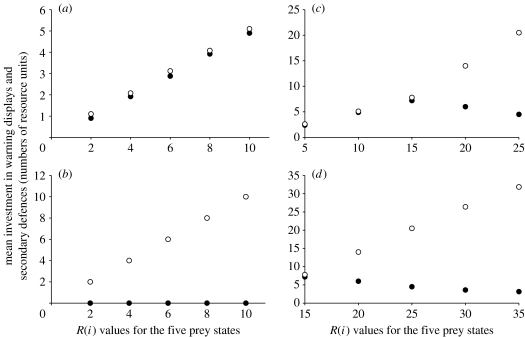
Many prey species use colourful 'aposematic' signalling to advertise the fact that they are toxic. Some recent studies have shown that the brightness of aposematic displays correlates positively with the strength of toxicity, suggesting that aposematic displays are a form of handicap signal, the conspicuousness of which reliably indicates the level of toxicity. The theoretical consensus in the literature is, however, at odds with this finding. It is commonly assumed that the most toxic prey should have less bright advertisements because they have better chances of surviving attacks and can therefore reduce the costs incurred by signalling. Using a novel theoretical model, we show that aposematic signals can indeed function as handicaps. To generate this prediction, we make a key assumption that the expression of bright displays and the storage of anti-predator toxins compete for resources within prey individuals. One shared currency is energy. However, competition for antioxidant molecules, which serve dual roles as pigments and in protecting prey against oxidative stress when they accumulate toxins, provides a specific candidate resource that could explain signal honesty. Thus, contrary to the prevailing theoretical orthodoxy, warning displays may in fact be honest signals of the level of (rather than simply the existence of) toxicity.
许多猎物物种利用色彩鲜艳的“警戒色”信号来表明它们有毒这一事实。最近的一些研究表明,警戒色展示的亮度与毒性强度呈正相关,这表明警戒色展示是一种不利条件信号,其醒目程度可靠地表明了毒性水平。然而,文献中的理论共识与这一发现不一致。人们通常认为,毒性最强的猎物应该有不太鲜艳的警示信号,因为它们在攻击中存活的机会更大,因此可以降低发出信号所带来的成本。通过一个新的理论模型,我们表明警戒信号确实可以起到不利条件信号的作用。为了得出这一预测,我们做出了一个关键假设,即鲜艳展示的表达和抗捕食者毒素的储存会在猎物个体内部争夺资源。一种共享货币是能量。然而,对抗氧化分子的竞争提供了一种特定的候选资源,这种分子既作为色素,又在猎物积累毒素时保护它们免受氧化应激,这可以解释信号的真实性。因此,与普遍的理论正统观点相反,警示展示实际上可能是毒性水平(而不仅仅是毒性的存在)的诚实信号。