Thurlow D L, Shilowski D, Marsh T L
Department of Chemistry, Clark University, Worcester, MA 01610.
Nucleic Acids Res. 1991 Feb 25;19(4):885-91. doi: 10.1093/nar/19.4.885.
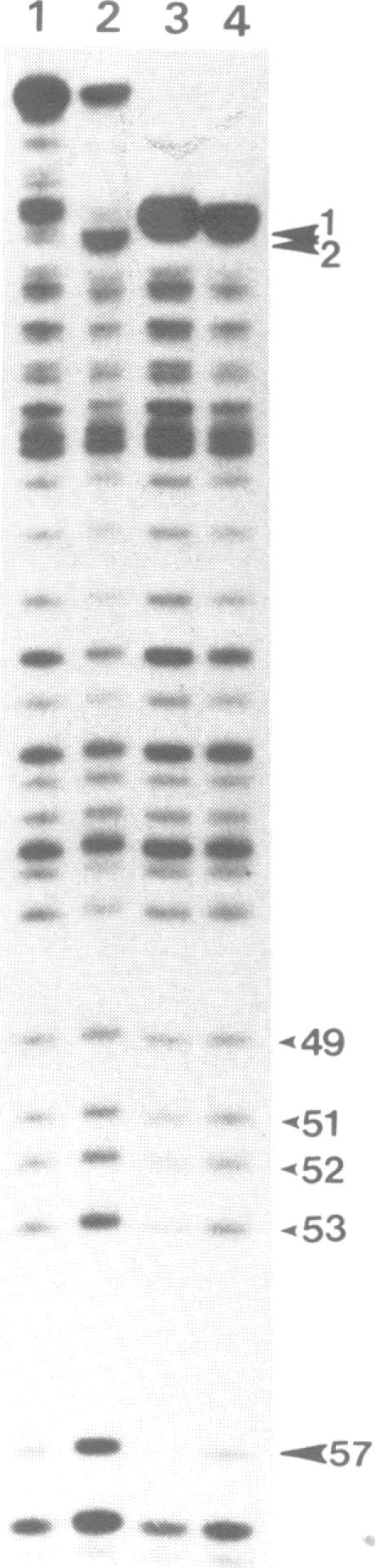
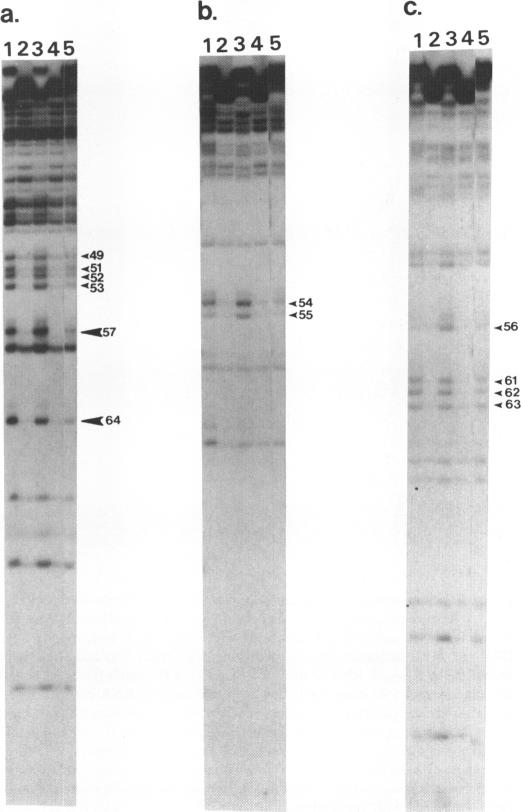
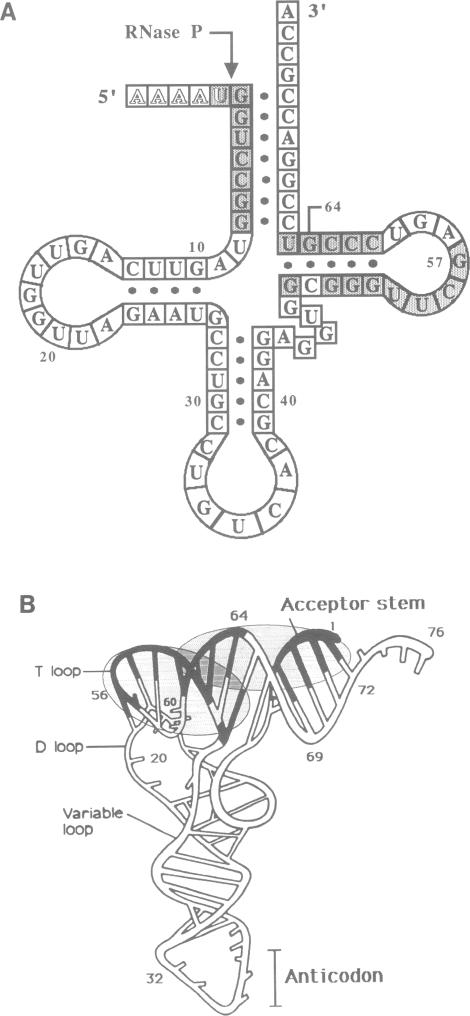
Precursor tRNAAsp molecules, containing a 26-base 5' leader, were treated with diethylpyrocarbonate, 50% hydrazine or anhydrous hydrazine/3M NaCl and then subjected to processing by RNase P RNAs from Escherichia coli or Bacillus subtilis. Fully processed tRNAs and material not successfully cleaved by the catalytic RNAs were analyzed for their content of chemically altered nucleotides. Several bases were identified as being required intact for optimal activity as substrate as judged by exclusion of chemically modified residues from processed molecules, and simultaneous enhancement in material that was not recognized as substrate. Such nucleotides cluster near the site of cleavage at the mature 5' end and in the T stem and loop. Purines at residues 1 and 2 adjacent to the site of cleavage, position 57 in the T loop, and site 64 in the T stem exhibited the most pronounced effects. These results suggest a model of recognition of substrate by RNase P RNAs in which the ribozyme interacts with the corner of the precursor tRNA's three dimensional structure, where the T- and D-loops are juxtaposed, and extends along the top of the molecule back towards the site of catalysis.
含有26个碱基5'前导序列的前体天冬氨酸tRNA分子,用焦碳酸二乙酯、50%肼或无水肼/3M氯化钠处理,然后用来自大肠杆菌或枯草芽孢杆菌的RNase P RNA进行加工。对完全加工的tRNA和未被催化RNA成功切割的物质进行化学改变核苷酸含量分析。通过从加工后的分子中排除化学修饰的残基,并同时增加未被识别为底物的物质,确定了几个碱基对于作为底物的最佳活性是完整所需的。这些核苷酸聚集在成熟5'端的切割位点附近以及T茎环中。切割位点相邻的第1和第2位残基、T环中的第57位以及T茎中的第64位的嘌呤表现出最明显的影响。这些结果提示了一种RNase P RNA识别底物的模型,其中核酶与前体tRNA三维结构的角相互作用,T环和D环并列于此,并沿着分子顶部向后延伸至催化位点。