Fischer Marek, Joos Beda, Niederöst Barbara, Kaiser Philipp, Hafner Roland, von Wyl Viktor, Ackermann Martina, Weber Rainer, Günthard Huldrych F
University Hospital Zürich, Division of Infectious Diseases, Rämistrasse 100, 8092 Zürich, Switzerland.
Retrovirology. 2008 Nov 26;5:107. doi: 10.1186/1742-4690-5-107.
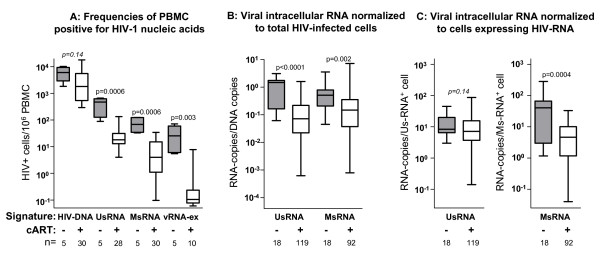
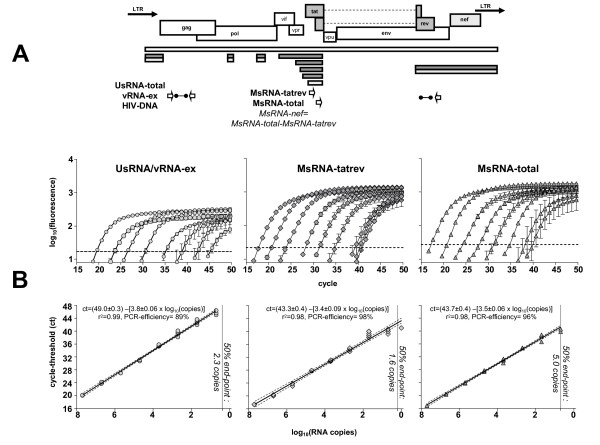
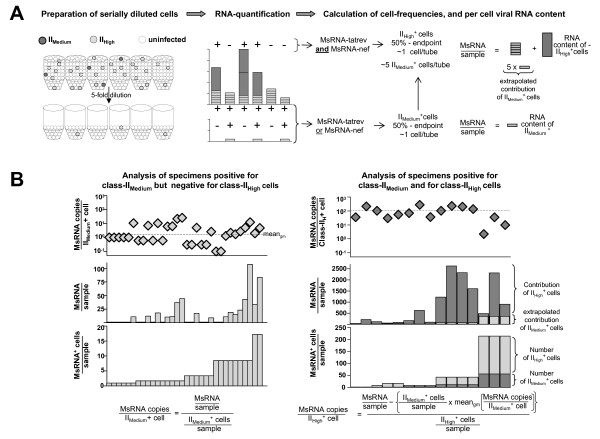
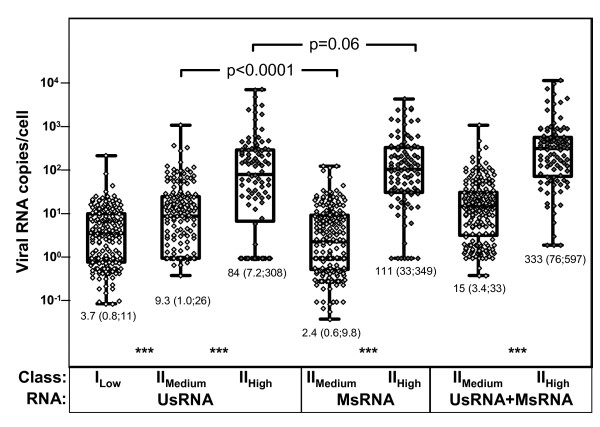
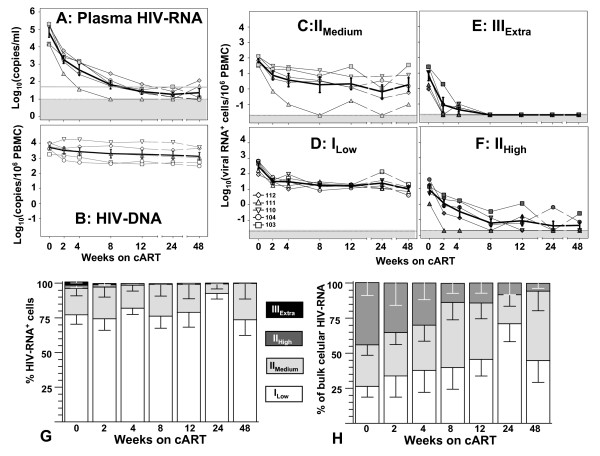
Mathematical models based on kinetics of HIV-1 plasma viremia after initiation of combination antiretroviral therapy (cART) inferred HIV-infected cells to decay exponentially with constant rates correlated to their strength of virus production. To further define in vivo decay kinetics of HIV-1 infected cells experimentally, we assessed infected cell-classes of distinct viral transcriptional activity in peripheral blood mononuclear cells (PBMC) of five patients during 1 year after initiation of cART RESULTS: In a novel analytical approach patient-matched PCR for unspliced and multiply spliced viral RNAs was combined with limiting dilution analysis at the single cell level. This revealed that HIV-RNA+ PBMC can be stratified into four distinct viral transcriptional classes. Two overlapping cell-classes of high viral transcriptional activity, suggestive of a virion producing phenotype, rapidly declined to undetectable levels. Two cell classes expressing HIV-RNA at low and intermediate levels, presumably insufficient for virus production and occurring at frequencies exceeding those of productively infected cells matched definitions of HIV-latency. These cells persisted during cART. Nevertheless, during the first four weeks of therapy their kinetics resembled that of productively infected cells.
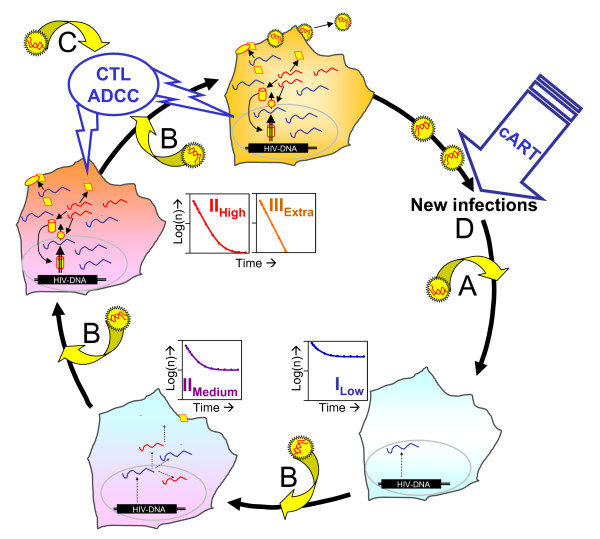
We have observed biphasic decays of latently HIV-infected cells of low and intermediate viral transcriptional activity with marked decreases in cell numbers shortly after initiation of therapy and complete persistence in later phases. A similar decay pattern was shared by cells with greatly enhanced viral transcriptional activity which showed a certain grade of levelling off before their disappearance. Thus it is conceivable that turnover/decay rates of HIV-infected PBMC may be intrinsically variable. In particular they might be accelerated by HIV-induced activation and reactivation of the viral life cycle and slowed down by the disappearance of such feedback-loops after initiation of cART.
基于联合抗逆转录病毒疗法(cART)启动后HIV-1血浆病毒血症动力学的数学模型推断,HIV感染细胞以与病毒产生强度相关的恒定速率呈指数衰减。为了通过实验进一步确定HIV-1感染细胞的体内衰减动力学,我们评估了5名患者在启动cART后1年内外周血单核细胞(PBMC)中具有不同病毒转录活性的感染细胞类别。结果:在一种新的分析方法中,将针对未剪接和多次剪接病毒RNA的患者匹配PCR与单细胞水平的极限稀释分析相结合。这表明HIV-RNA+ PBMC可分为四个不同的病毒转录类别。两个具有高病毒转录活性的重叠细胞类别,提示有病毒体产生表型,迅速下降到检测不到的水平。两个以低水平和中等水平表达HIV-RNA的细胞类别,可能不足以产生病毒,其出现频率超过有 productive感染细胞,符合HIV潜伏的定义。这些细胞在cART期间持续存在。然而,在治疗的前四周,它们的动力学类似于有 productive感染细胞。
我们观察到低水平和中等病毒转录活性的潜伏HIV感染细胞呈双相衰减,治疗开始后细胞数量迅速减少,后期完全持续存在。具有大大增强的病毒转录活性的细胞也有类似的衰减模式,在消失前有一定程度的趋于平稳。因此,可以想象HIV感染的PBMC的更新/衰减率可能本质上是可变的。特别是,它们可能会因HIV诱导的病毒生命周期激活和重新激活而加速,并因cART启动后此类反馈回路的消失而减慢。