Touboul Cyril, Badiou Wassim, Saada Julien, Pelage Jean-Pierre, Payen Didier, Vicaut Eric, Jacob Denis, Rafii Arash
Department of Obstetrics and Gynaecology, Hôpital Lariboisière, AP-HP, Paris, France.
PLoS One. 2008;3(11):e3819. doi: 10.1371/journal.pone.0003819. Epub 2008 Nov 26.
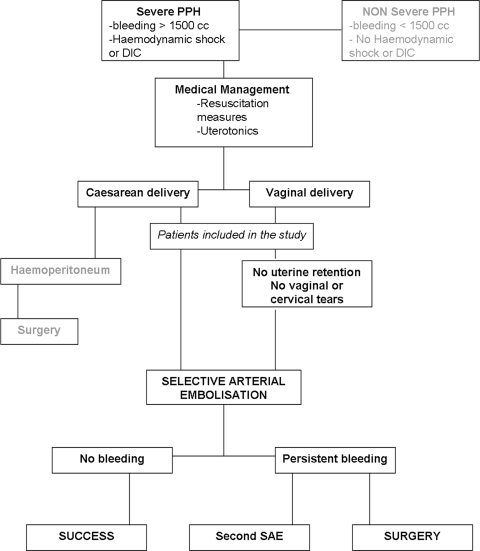
The objective of this study was to assess efficacy and determine the optimal indication of selective arterial embolisation (SAE) in patients with life-threatening post-partum haemorrhage (PPH).
METHODOLOGY/PRINCIPAL FINDINGS: One hundred and two patients with PPH underwent SAE and were included from January 1998 to January 2002 in our university care center. Embolisation was considered effective when no other surgical procedure was required. Univariate and multivariate statistical analysis were performed. SAE was effective for 73 patients (71.5%), while 29 required surgical procedures. SAE was effective in 88.6% of women with uterine atony that was associated with positive outcome (OR 4.13, 1.35-12.60), whereas caesarean deliveries (OR 0.16, 0.04-0.5) and haemodynamic shock (OR 0.21, 0.07-0.60) were associated with high failure rates, 47.6% and 39.1%, respectively.
CONCLUSIONS/SIGNIFICANCE: Success rate for SAE observed in a large population is lower than previously reported. It is most likely to succeed for uterine atony but not recommended in case of haemodynamic shock or after caesarean section.
本研究的目的是评估选择性动脉栓塞术(SAE)在危及生命的产后出血(PPH)患者中的疗效,并确定其最佳适应证。
方法/主要发现:1998年1月至2002年1月期间,在我校医疗中心,102例PPH患者接受了SAE治疗并被纳入研究。当不需要其他外科手术时,栓塞被认为是有效的。进行了单因素和多因素统计分析。SAE对73例患者(71.5%)有效,而29例需要进行外科手术。SAE在88.6%与阳性结局相关的宫缩乏力女性中有效(比值比4.13,1.35 - 12.60),而剖宫产(比值比0.16,0.04 - 0.5)和血流动力学休克(比值比0.21,0.07 - 0.60)与高失败率相关,分别为47.6%和39.1%。
结论/意义:在大量人群中观察到的SAE成功率低于先前报道。SAE在宫缩乏力的情况下最有可能成功,但在血流动力学休克或剖宫产术后不推荐使用。