Huff James, Jacobson Michael F, Davis Devra Lee
National Institute of Environmental Health Sciences, National Institutes of Health, Department of Health and Human Services, Research Triangle Park, North Carolina, USA.
Environ Health Perspect. 2008 Nov;116(11):1439-42. doi: 10.1289/ehp.10716. Epub 2008 Jun 30.
Chemical carcinogenesis bioassays in animals have long been recognized and accepted as valid predictors of potential cancer hazards to humans. Most rodent bioassays begin several weeks after birth and expose animals to chemicals or other substances, including workplace and environmental pollutants, for 2 years. New findings indicate the need to extend the timing and duration of exposures used in the rodent bioassay.
In this Commentary, we propose that the sensitivity of chemical carcinogenesis bio-assays would be enhanced by exposing rodents beginning in utero and continuing for 30 months (130 weeks) or until their natural deaths at up to about 3 years.
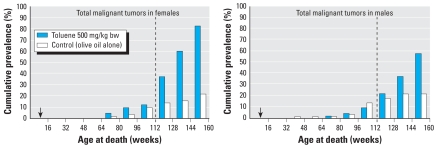
Studies of three chemicals of different structures and uses-aspartame, cadmium, and toluene-suggest that exposing experimental animals in utero and continuing exposure for 30 months or until their natural deaths increase the sensitivity of bioassays, avoid false-negative results, and strengthen the value and validity of results for regulatory agencies.
Government agencies, drug companies, and the chemical industry should conduct and compare the results of 2-year bioassays of known carcinogens or chemicals for which there is equivocal evidence of carcinogenicity with longer-term studies, with and without in utero exposure. If studies longer than 2 years and/or with in utero exposure are found to better identify potential human carcinogens, then regulatory agencies should promptly revise their testing guidelines, which were established in the 1960s and early 1970s. Changing the timing and dosing of the animal bioassay would enhance protection of workers and consumers who are exposed to potentially dangerous workplace or home contaminants, pollutants, drugs, food additives, and other chemicals throughout their lives.
长期以来,动物化学致癌生物测定一直被认为并被接受为对人类潜在癌症危害的有效预测指标。大多数啮齿动物生物测定在出生后几周开始,让动物接触化学物质或其他物质,包括工作场所和环境污染物,持续2年。新的研究结果表明,需要延长啮齿动物生物测定中暴露的时间和持续时间。
在本评论中,我们建议通过从子宫内开始对啮齿动物进行暴露,并持续30个月(130周)或直至其在约3岁时自然死亡,来提高化学致癌生物测定的敏感性。
对三种结构和用途不同的化学物质——阿斯巴甜、镉和甲苯——的研究表明,在子宫内对实验动物进行暴露并持续暴露30个月或直至其自然死亡,可提高生物测定的敏感性,避免假阴性结果,并增强结果对监管机构的价值和有效性。
政府机构、制药公司和化学工业应进行已知致癌物或致癌性证据不明确的化学物质的2年生物测定,并将结果与长期研究(包括有或没有子宫内暴露的研究)进行比较。如果发现超过2年和/或有子宫内暴露的研究能更好地识别潜在的人类致癌物,那么监管机构应立即修订其测试指南,这些指南是在20世纪60年代和70年代初制定的。改变动物生物测定的时间和剂量将加强对一生都接触潜在危险的工作场所或家庭污染物、污染物、药物、食品添加剂和其他化学物质的工人和消费者的保护。