van Leeuwen Danitsja M, Gottschalk Ralph W H, Schoeters Greet, van Larebeke Nicolas A, Nelen Vera, Baeyens Willy F, Kleinjans Jos C S, van Delft Joost H M
Department of Health Risk Analysis and Toxicology, Maastricht University, Maastricht, the Netherlands.
Environ Health Perspect. 2008 Nov;116(11):1519-25. doi: 10.1289/ehp.11401. Epub 2008 Jun 23.
Human carcinogenesis is known to be initiated and/or promoted by exposure to chemicals that occur in the environment. Molecular cancer epidemiology is used to identify human environmental cancer risks by applying a range of effect biomarkers, which tend to be nonspecific and do not generate insights into underlying modes of action. Toxicogenomic technologies may improve on this by providing the opportunity to identify molecular biomarkers consisting of altered gene expression profiles.
The aim of the present study was to monitor the expression of selected genes in a random sample of adults in Flanders selected from specific regions with (presumably) different environmental burdens. Furthermore, associations of gene expression with blood and urinary measures of biomarkers of exposure, early phenotypic effects, and tumor markers were investigated.
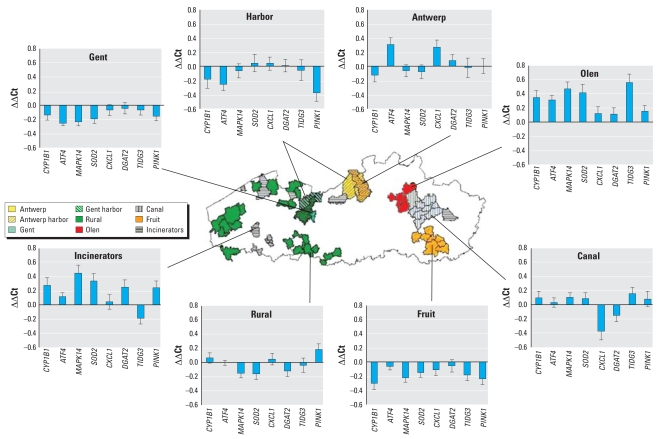
Individual gene expression of cytochrome p450 1B1, activating transcription factor 4, mitogen-activated protein kinase 14, superoxide dismutase 2 (Mn), chemokine (C-X-C motif) lig-and 1 (melanoma growth stimulating activity, alpha), diacylglycerol O-acyltransferase homolog 2 (mouse), tigger transposable element derived 3, and PTEN-induced putative kinase1 were measured by means of quantitative polymerase chain reaction in peripheral blood cells of 398 individuals. After correction for the confounding effect of tobacco smoking, inhabitants of the Olen region showed the highest differences in gene expression levels compared with inhabitants from the Gent and fruit cultivation regions. Importantly, we observed multiple significant correlations of particular gene expressions with blood and urinary measures of various environmental carcinogens.
Considering the observed significant differences between gene expression levels in inhabitants of various regions in Flanders and the associations of gene expression with blood or urinary measures of environmental carcinogens, we conclude that gene expression profiling appears promising as a tool for biological monitoring in relation to environmental exposures in humans.
已知人类致癌作用是由接触环境中存在的化学物质引发和/或促进的。分子癌症流行病学通过应用一系列效应生物标志物来识别人类环境癌症风险,这些生物标志物往往是非特异性的,无法深入了解潜在的作用模式。毒理基因组学技术可能通过提供识别由改变的基因表达谱组成的分子生物标志物的机会来改善这一状况。
本研究的目的是监测从(可能)具有不同环境负荷的特定区域选取的佛兰德成年随机样本中选定基因的表达。此外,还研究了基因表达与接触生物标志物、早期表型效应和肿瘤标志物的血液及尿液测量值之间的关联。
通过定量聚合酶链反应在398名个体的外周血细胞中测量了细胞色素P450 1B1、激活转录因子4、丝裂原活化蛋白激酶14、超氧化物歧化酶2(锰)、趋化因子(C-X-C基序)配体1(黑色素瘤生长刺激活性,α)、二酰甘油O-酰基转移酶同源物2(小鼠)、触发转座元件衍生3和PTEN诱导的推定激酶-1的个体基因表达。在校正吸烟的混杂效应后,与根特和水果种植区的居民相比,奥伦地区的居民在基因表达水平上表现出最大差异。重要的是,我们观察到特定基因表达与各种环境致癌物的血液和尿液测量值之间存在多重显著相关性。
考虑到在佛兰德不同地区居民的基因表达水平之间观察到的显著差异以及基因表达与环境致癌物的血液或尿液测量值之间的关联,我们得出结论,基因表达谱分析作为一种与人类环境暴露相关的生物监测工具似乎很有前景。